Schools
Institute Helps Girls Overcome Pressures, Have Healthy Relationships
Girls Leadership Institute aims to have life-long impact.
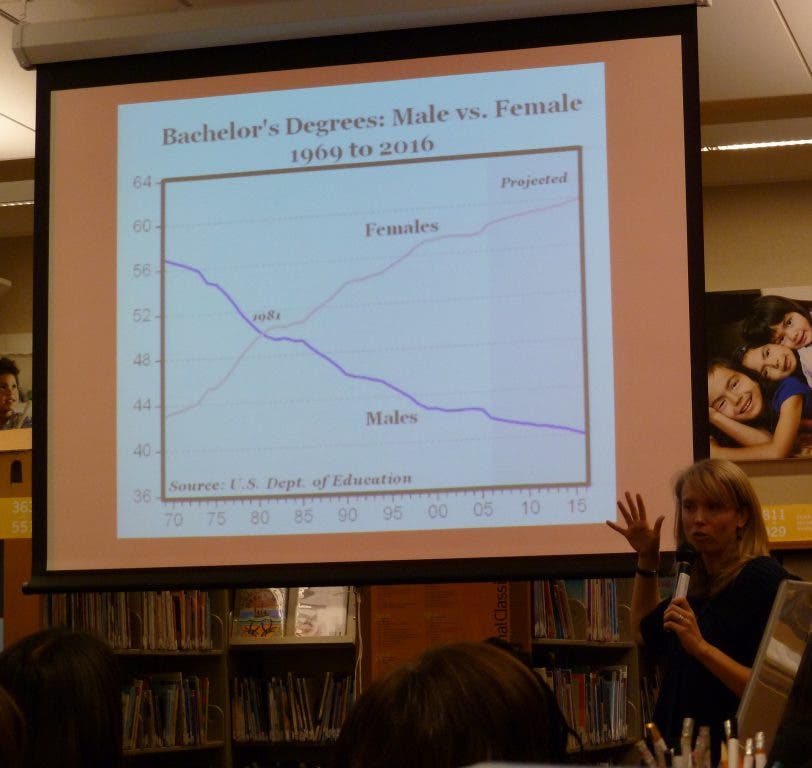


Hearing Girls Leadership Institute Executive Director Simone Marean talk about “Raising Resilient Girls” seemed like a good way to better understand the complex undercurrents of the interactions of girls on the school yard. But what stood out during Marean’s talk at is that the issues she raises have a profound impact on girls throughout their lives. Fortunately, the solutions she offers are also far reaching, and anyone can benefit from the skills she works to instill in girls.
Addressing more than 100 people Feb. 2, Marean said while some data, such as the number of women vs. men attaining bachelor’s degrees, may suggest girls are doing fine, other statistics tell a different story. She cited studies indicating teen-age girls suffer from depression at twice the rate of boys and even a majority of girls as young as 10 responded no to “Are you happy the way you are?”
The pressures that cause girls to experience a “loss of self,” she said, can lead to problems like cyber-bullying and use of friendship as a weapon.
Find out what's happening in El Cerritofor free with the latest updates from Patch.
One pressure she cited is that at the same time girls are entering puberty and gaining “normal, healthy weight,” they are bombarded with images that equate thinness with happiness.
Another pressure, she said, comes from “aspirational marketing,” which with young girls means taking advantage of their desire to be “older and cooler.” Modern marketers have stopped worrying about what is and isn’t appropriate for young girls and are sexualizing them with things like low-cut clothing and sexy Halloween costumes.
Find out what's happening in El Cerritofor free with the latest updates from Patch.
Girls’ sense of self, Marean said, becomes based on how other people see them. If how they are perceived is based on something like how smart, funny, or kind they are, that can’t be taken away. But, she said, if it’s based on hair or looks, someone can always come along with something better. This leaves them susceptible to problems such as anorexia, depression, and low self-esteem.
Another negative influence, she said, is media images that suggest that mean-girl aggression is OK.
When girls get upset, she said, they tend to act in different ways than boys do, such as getting other girls involved, avoiding the issue, holding grudges, giving other girls the silent treatment, spreading rumors, and excluding other girls.
Marean said girls resort to these sorts of behaviors because the expectations placed on them make it difficult to find a healthy way to respond to challenges and meet their own emotional needs. In describing these expectations, she cited “The Good Girl Rules,” as outlined by author and institute co-founder Rachel Simmons , which include being a “pleaser,” having to do everything right, and being nice to everyone.
Girls need to learn things like it is OK not to have a best friend, and that even friends have conflicts and make mistakes, and this is normal, and that it is OK to experience a range of emotions.
The Berkeley-based institute, she said, teaches the girls: “There’s no such thing as a bad feeling. It’s what we do with it that can be a good or a bad choice.” When girls become more aware of and able to manage their own feelings, she said, then they can become more empathetic of others.
One method the institute uses is drawn from Harvard Business School’s strategies for negotiating difficult conversations. It recognizes that a problem is rarely one person’s fault and calls on each party to acknowledge his or her contribution to the problem by saying something like “I’m sorry I...” or “I realize I did...” The strategy can be applied to other situations such as the workplace or within a family.
Marean said girls often fear conflict because their relationships are so valuable to them, but they can be taught that conflict is an opportunity to change a relationship in a way that makes it stronger.
When a child comes home upset, she said, parents may immediately be concerned with taking away the pain. While parents should show empathy, Marean suggests they avoid giving advice and instead have the girl talk about what she wants to do. The parent can help role-play possible outcomes so the child can see the effect her actions might have.
“She will learn that she can handle it. That is where resilience comes from.” She will also learn she has a right to be heard and a right to be herself, Marean said. The resilience will carry through high school and beyond, she said, and teach her how to have healthier relationships.
See the institute's website for information on programs offered by the institute, including upcoming sessions at Windrush (which are open to girls who don't attend the school).