http://no710.com/index.html
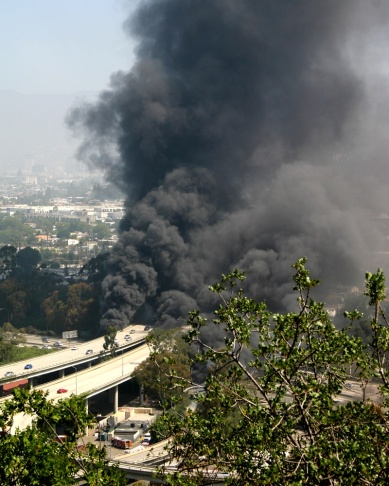
^ Above - Tanker Truck Fire at I-5 & SR-2 Tunnel Connector,
July 2013
Gasoline poured into the street and ignited. Repairs cost $16 million. Tunnel reopened January 2014
Photo Source: scpr.org
Roadway tunnels are inherently dangerous. Check out these images from tunnel disasters around the world.
http://no710.com/_critical-issues-links/2-concerns/2-tunnel_info/what-could-happen-sm.pdf
Tunnel Dangers
Concerns from the Beginning
From 1947 through the 1990s, communities opposing the extension of the 710 freeway were focused on preserving the character of their neighborhoods and solving their transportation issues through other projects. Carving up the beautiful historic homes and small town businesses to send more vehicles through the area just doesn’t make sense. These communities already have more than one freeway. Why add more?
Find out what's happening in Montrose-La Crescentafor free with the latest updates from Patch.
Feasibility of Using a Bored Tunnel
In 2002, after years of litigation with the City of South Pasadena and others, Caltrans and Metro shifted their plans and began to explore the feasibility of using a bored tunnel to extend the freeway. This concept raised new concerns for the communities: huge costs, concentrated pollution emissions, but more importantly, safety. Los Angeles is well known for its high incidence of earthquakes and other natural disasters. The public now had to consider the danger of being inside a 5-mile long tunnel during a substantial earthquake, rising flood waters, or a natural or man-made fire.
Find out what's happening in Montrose-La Crescentafor free with the latest updates from Patch.
Dangers Come from within a Tunnel
Modern roadway tunnels are built with safety features incorporated into their design. Some earth movement is expected and planned for so that the passageway is able to “flex” with a shifting environment. The amount of “flexing” that a tunnel is able to do without damage, depends on many factors. An earthquake will not collapse a well-built tunnel. The greatest risk comes from cars, trucks, and busses filled with passengers and gasoline, shaking inside the tunnel, deep underground.
Tunnel Safety Measures
Every large tunnel built for vehicles has 24 hour monitoring of events inside, typically two, stationed control rooms, one at either end of the tunnel that are responsible for systems maintenance, observation of problems, and collection of tolls. Emergency escape exits and phones are located at intervals along the route. Most of these require a person to be “able-bodied” to use. Emergency response time can vary greatly depending on the severity of the problem, level of communication between jurisdictions, and specific training of first responders.
The Longest Roadway Tunnel in the United States
Los Angeles does not currently have any long, road tunnels. There are some short tunnels intermittently on area freeways where the freeway meets a rise in elevation, such as the SR-110 freeway near Dodgers Stadium or like the long underpasses at the connection of the I-5 and SR-2. The closest modern, roadway tunnel, the Caldecott Tunnel near Oakland California, consists of three tunnels, just about 4,000 feet long. If the 710 Extension iss built underground, it would have two 57-foot diameter tunnels, each 4.9 miles long, the longest road tunnels in the United States. Even the Central Artery Tunnel in Boston, also known as the Big Dig, is only 3.5 miles long. Ours will be an even Bigger Dig.
Accidents
Big Rig Accident on I-5 Freeway
Locally, in 2007, an accident involving five big rigs in a small 550-foot long underpass tunnel on the I-5 freeway, just north of the SR-14 connector, resulted in a fireball so hot that the vehicles burned down to their cores and concrete exploded off the walls. The Los Angeles Times reported, that “fire, police and Caltrans officials spent the day trying to assess damage to the concrete but were hampered by a continuing blaze in the tunnel's center, and heavy smoke and high concentrations of carbon dioxide [monoxide], particularly on the tunnel's north, or uphill, end. They could not get very far past the mouths of the tunnel.” Sadly, 3 people lost their lives and 10 others were treated at area hospitals. It was estimated that 10 to 20 people were able to flee the short tunnel on foot. This accident is a very small example of the type of emergency that can happen in a roadway tunnel. A longer tunnel with a higher number of trucks carrying cargo, would increase the potential for fire and death exponentially.
Mont Blanc Tunnel, Margarine and Flour Fire
The Mont Blanc Tunnel between France and Italy became the focus of an investigation in 1999, when a truck carrying margarine and flour caught fire midway through the 7-mile tunnel. Apparently the driver did not notice the smoke coming from his vehicle for about a mile as opposing cars waved at him. When he finally stopped to inspect, the truck ignited, sending smoke and dangerous levels of carbon monoxide throughout the area. The drivers in the vehicles behind the truck became trapped, unable to turn around, as the smoke was drawn uphill from the grade and overcame them. The truck’s cargo of margarine volatized and fed the fire that burned at about 1800OF for 53 hours. A total of 38 people died within 15 minutes of the incident; one first responder died later. Prior to that day, it was believed that food cargo posed no transport risk; it was considered combustible but not flammable under normal conditions. However, investigators who examined this accident began to consider that even innocuous food goods and road pavement materials could become flammable when heated by fuels and other flammables, causing them to emit dangerous chemicals when burned in a contained space.
St. Gotthard Tunnel Fire, Smoke Caused Fatalities
Roadway tunnels all around the world have a disturbing history of fatalities. A tunnel full of vehicles contains 15 gallons of gas on average per vehicle. Add to that, some trucks and busses have larger 150-gallon tanks with potentially flammable cargo and plastic that becomes flammable when heated. One accident can cause a chain reaction of explosions to all of those tanks. In 2001, the 10-mile St. Gotthard Tunnel in Göschenen Switzerland had a blazing inferno that killed 11 people. The accident was a collision between a truck and an empty minibus that caused gasoline to pour onto the floor of the tunnel. The result was a blaze so hot that it melted the vehicles causing them to be fused together. It was determined that the fatalities were caused by smoke and gas inhalation and that the ventilation system had not been working properly or was not adequate for such conditions. This tunnel suffered three major accidents in three years.
Caldecott Tunnel, Gasoline Fire
The Caldecott Tunnel as previously mentioned, had a fire in 1982 that caused 7 deaths. A gasoline tanker crashed into a stopped car and gas spilled into the gutter and ignited. Smoke travelled uphill, choking the victims who didn’t have a chance to get out the emergency exits. The ventilation system was not even on at the time although it would have been totally inadequate under these circumstances. The same tunnel in 2010, had to close during an intense rainstorm due to flooding. A drainage pipe had filled with debris from runoff and storm water backed up in the tunnel.
Big Dig Tunnel, Shoddy Construction
Sometimes the danger in a tunnel comes from an unexpected cause. The Central Artery Tunnel in Boston, the Big Dig, was damaged when ceiling tiles cascaded to the ground below because an inadequate glue was used to secure the 4,600-pound panels. One woman lost her life when a tile fell directly on her while riding as a passenger in a vehicle, also injuring the driver, her husband. The project manager, Bechtel/Parsons Brinckerhoff as well as others, were accused of cutting corners and doing shoddy work. There was also a great deal of investigation on whether the glue manufacturer or the installer were to blame for the tiles falling. The tunnel fully reopened 11 months later.
Flood Water Hazards, Diversion of Traffic
Flooding is a concern for Los Angeles area residents as it is common throughout the rainy season. At a public outreach meeting conducted by Caltrans during the 2010 Geotechnical Study, a question was asked about how flood waters would be managed in heavy downpours in and around the tunnel. Earlier in the week, television news coverage showed that the southern end of the 710 was evacuated due to rising waters. The response by Doug Failing, Executive Director of Highway Programs at Metro, was that the 710 freeway is supposed to flood to keep water out of the area neighborhoods. He stated that it was designed that way. However, one might argue that building a tunnel at the end of a freeway that is designed to flood, could create an inescapable hazard. There are no exit ramps in a tunnel. In addition, unlike the average freeway, when an entire tunnel section does close down for weather, maintenance, or accidents, the resulting overspill of cars and heavy cargo trucks into the local communities is devastating.
Soft Target for Terrorists
As we look to Los Angeles in the future, we must consider that a large tunnel could become the ultimate target for terrorists, as was the case in London in 2005. In a roadway tunnel, since tolls are collected electronically and there are no stops for inspection, it would be easy to trigger an explosion with just a flare and a can of gasoline. An act such as this would yield catastrophic loss of life and property.
Let’s be sure that the supposed benefits of this project far surpass the tremendous risks.
Compiled by Susan Bolan, La Crescenta Resident
Updated 1-14-14