Community Corner
Camp Pendleton Explores 3-D Printing Technology for Battlefield Use
The Marines are exploring the possibilities of replacing broken equipment onsite when replacements parts are needed immediately.

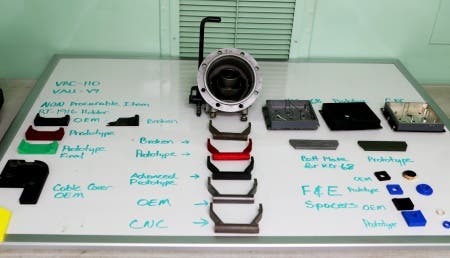
From the US Marine Corps:
CAMP PENDLETON, CA - Technology has proven to be a driving force in economic and social growth, filling the gaps of possibility. The development of 3-D printing technology has already made an impact in a relatively short period of time, and the Marine Corps knows that the ability to quickly fabricate a replacement part and fix a broken piece of gear in a matter of hours can be a game changer on the battlefield.
The Marines of 1st Maintenance Battalion, Combat Logistics Regiment 15, 1st Marine Logistics Group, demonstrated the potential of 3-D printing capabilities to the commanding generals and staff of I Marine Expeditionary Force and 1st MLG aboard Camp Pendleton, Calif., April 6, 2016. Still in the testing phase with the printers, the battalion has already discovered endless possibilities as to how they can integrate the technology into their mission.
Find out what's happening in Oceanside-Camp Pendletonfor free with the latest updates from Patch.
“The expeditionary manufacturing facility is capable of taking a broken item, generating a 3-D scan into a computer animated design, and sending that to a 3-D printer to print out a replica part,” said Lt. Col. Gregory Pace, the commanding officer of 1st Maintenance Battalion. “The program is designed to be able to take a manufacturing capability and place it as far forward on the battlefield as possible.”
All the tools, computers, software, and printers necessary to examine a part, create a computer animated design, and construct a plastic replica are contained in a small shipping container-like space called the expeditionary manufacturing facility.
Find out what's happening in Oceanside-Camp Pendletonfor free with the latest updates from Patch.
“In some cases the components we are trying to replace are plastic, so we can go right from the 3-D printer to a test for fit, form and function, then right into application,” said Pace.
These plastic parts don’t have the strength to replace certain metal parts, but will be able to serve as an example for the Marines in the metal shop to fabricate the part, explained Pace.
“There are a lot of different ways the Marine Corps could use a 3-D printer and the software to save money and time,” said Cpl. Samuel Stonestreet, a ground radio repairman. “Once you input the measurements, it only takes a few hours for the machine to fabricate the part.”
Stonestreet is one of several Marines that the battalion has tasked with learning and exploring the possibilities of 3-D printing in military applications.
Replacement parts sometimes take several weeks or months to be received by conventional methods, and 3-D printing just might hold the key to keeping fragile gear up and running.
“It’s the instantaneous nature of being able to print things on your premises,” said Pace. “If we can reduce a 100-day lead time down to one day because we have the capacity to print the replacement part, I think we are doing a significant increase to MEF readiness.”
Although this technology may still be in the testing stages, these tests have proven that 3-D printing could be a useful asset for the Marine Corps both in garrison and deployed environments.
“I think it’s very important for the Marine Corps and the Department of Defense as a whole to look into this and see how we can implement it into missions and the big picture of things,” said Stonestreet.
Pace explained that if 3-D printing is determined to be effective and cost efficient, units throughout the Marine Corps could expect to see more of this technology in their daily operations.
See a video demonstration here.
Get more local news delivered straight to your inbox. Sign up for free Patch newsletters and alerts.