Community Corner
Nuclear Waste: Here or Elsewhere?
Nuclear Experts Meet to Discuss Problems with Safe Storage of Radioactive Waste

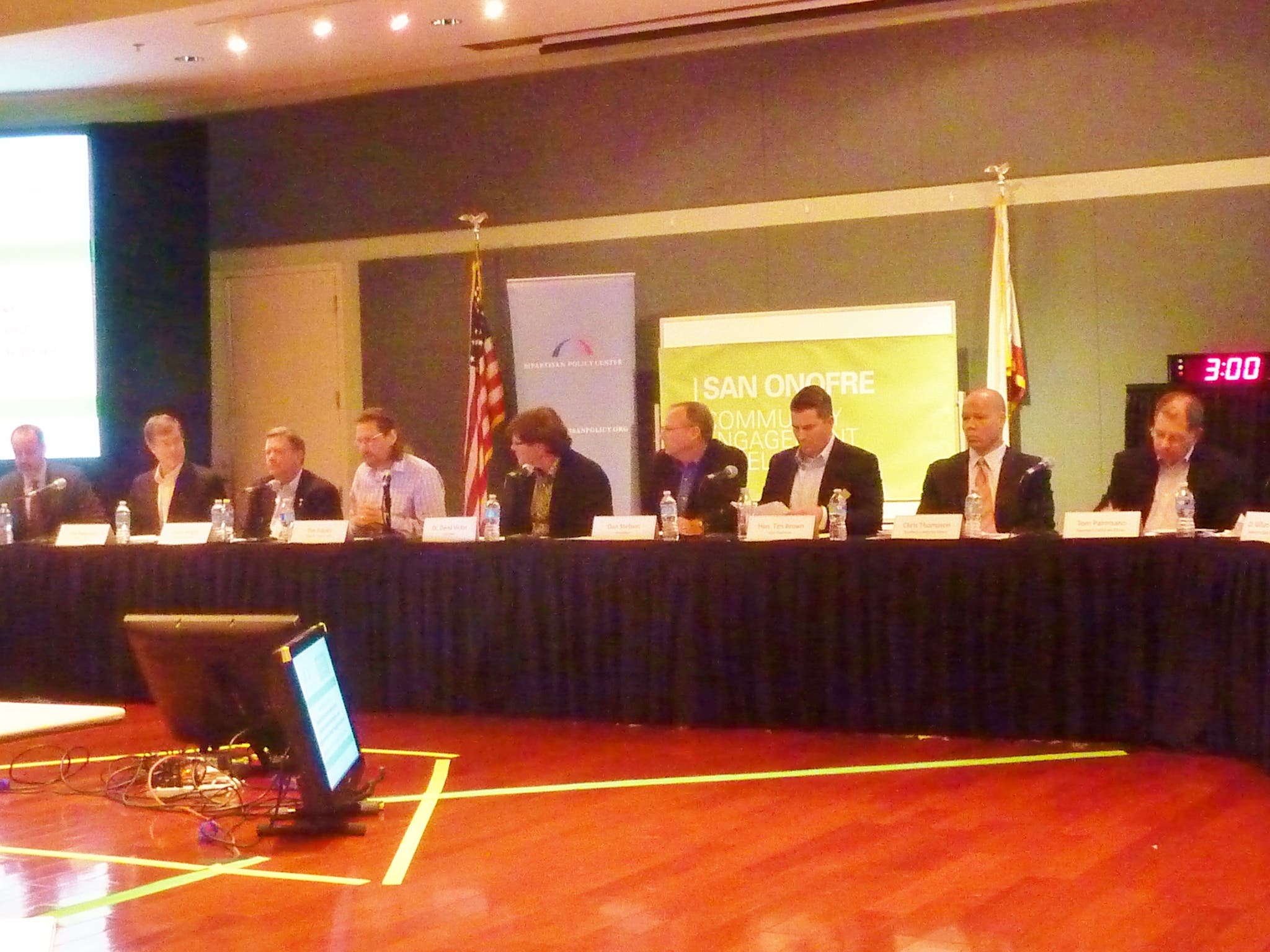


A large crowd filled the San Juan Capistrano Community Center on Jan. 27 to hear a 3 hour panel discussion called “America’s Nuclear Future: Taking Action to Address Nuclear Waste.” This was a joint meeting of Edison’s Community Engagement Panel and the Bipartisan Policy Center, a Washington D.C. think tank. The panel focused on what local, state, and regional stakeholders can do stimulate progress on this issue which has plagued the nation for half a century. Addressing the audience were 21 panelists ranging from nuclear experts to concerned citizens.
One goal of the meeting was to highlight the many barriers which now block the safe storage the vast quantities of radioactive waste generated by nuclear power plants. In a bleak assessment, the audience was told that there is currently no activity, no research, and no Congressional direction. The NRC ruled last August that since there is no way to get rid of this waste, every nuclear power plant in the U.S. will now become (by default) a nuclear waste dump for the indefinite future. That is bad news indeed for everyone in Southern California and especially those who are unfortunate to live within 50 miles of San Onofre or Diablo Canyon.
Vast Amounts of Nuclear Waste with Nowhere to Go
Find out what's happening in San Clementefor free with the latest updates from Patch.
Across the country there are 99 operating reactors in 33 states which continue to churn out about 7 tons of high-level nuclear waste every day with no place to go. California has only one active nuclear power plant (Diablo Canyon) but 3 inactive ones (San Onofre, Rancho Seco, and Humbolt Bay). Although San Onofre is closed, it continues to store most of its waste in deep pools of water which are vulnerable to earthquakes, terrorist attacks, natural disasters, and human error.
The problem addressed at this meeting is what the nuclear industry calls the back end of the fuel cycle. When radioactive fuel rods are no longer profitable they are removed and called “spent” even though they continue to be highly radioactive. Some radionuclides like Plutonium 239 will take 2.4 million years to decay to safe levels. The nuclear industry has known about this since the 1950s but they launched ahead with nuclear power anyway lured by the profits and by the promise of the U.S. government to start removing nuclear waste by 1998. Another big incentive was when the nuclear industry persuaded Congress to pass the Price Anderson Act of 1957. This Congressional action indemnified power plant operators from liability in case of an accident and effectively made American tax payers an insurance company. The accident at Chernobyl resulted in the contamination, condemnation, and permanent evacuation of 1,000 square miles. Some estimate that a similar accident here would cost taxpayers over $1 trillion.
Find out what's happening in San Clementefor free with the latest updates from Patch.
California Takes the Lead
California was the first state to recognize that nuclear waste was a very serious issue which might never be solved. In 1976 it wisely considered a bill to close all existing nuclear power plants and forbid any new ones from being constructed. Courageous citizens and environmentalists lobbied for the bill. Curiously, they were joined by the utilities who calculated that the U.S. Supreme Court would overturn the law and pave the way for the construction of over 100 nuclear power plants in California. A compromise was passed which permitted the two existing plants (San Onofre and Diablo Canyon) but forbid any new ones. The utilities (Edison, PSE&G, and PG&E) were shocked and disappointed when the Supreme Court failed to overturn the law. As a result, California ended up with only 2 nuclear power plants rather than hundreds.
It is telling that California recognized the immensity of the problem way back in 1976. Now it is 2015 and still there is no solution nor any prospects for a solution. At great expense, the nation built two deep geological repositories but both have failed. Yucca Mountain failed because scientists concluded that there is no known technology to seal waste from water penetration. The Waste Isolation Pilot Plant (WIPP) in Carlsbad NM was closed a year ago after fires and explosions. It was guaranteed to last 10,000 years but it failed after 15. Panelists at the meeting stated that Yucca Mountain will never work until lots of major technical and political problems are solved. There are over 300 lawsuits blocking any reopening. Nevada has no nuclear power plants generating waste, but many Republicans despise Democratic Senator Harry Reid of Nevada and want to “stick it to Nevada” as political payback. Panelists seemed agreed that the politicizing of nuclear waste issues is one of the major barriers to a national solution.
Who Pays for Nuclear Waste Inaction?
For decades, everyone has been paying a surcharge on their electric bills. The utilities collect this money and send it to the Dept. of Energy for the purpose of financing a permanent national solution. DOE accumulated $30 billion from all of us but has come up with no solution. Even worse, the DOE already spend the money on other priorities. If they ever come up with a new solution, taxpayers will again have to cough up and pay for it again. Even if Yucca Mountain reopened (which is unlikely), it could not hold the nearly 80,000 tons of high level nuclear waste now being stored around the nation. According to the NEI (Nuclear Energy Institute, the Washington nuclear industry powerhouse that lobbies Congress and the NRC), radioactive fuel rods stacked side by side would fill a football field 21 feet high.
One of the speakers at the meeting was Prof. Per Peterson, Chair of the Dept. of Nuclear Engineering at UCBerkeley and member of the President’s Blue Ribbon Commission on America’s Nuclear Future. Prof. Peterson stated that there is now pressure to take the entire issue out of the hands of the Dept. of Energy. Utilities regularly sue the Dept. of Energy for every year that it reneges on its promise to remove the waste. The DOE has already paid out $2 billion in damage settlements and it is projected that by 2020 the damages could be as high as $20 billion, all financed by tax payers. (The nuclear industry does not count taxpayer costs when it claims that nuclear energy is cheap. It is actually very expensive when all costs are counted.)
One optimistic note that surfaced at the meeting was posing the question as to why more attention is not given to a “California solution” for its own nuclear waste problems. Several panelists criticized the Federal Government for monopolizing all decision making and blocking alternative solutions. Geoff Fetus of the Natural Resources Defense Council argued that states need to have a meaningful regulatory framework over nuclear waste storage in their jurisdiction, something they now lack. City councilmen Tim Brown (San Clemente) and Jerry Kern (Oceanside) echoed this concern and asked why states and localities have no power over waste storage in their own communities. By NRC fiat last August, Zip Code 92672 (San Clemente) is now a nuclear waste dump as is Camp Pendleton and Oceanside and realistically speaking all cities and towns within 50 miles of any open or closed nuclear facility. The refusal of the federal government to share jurisdiction with states may partly explain why Gov. Jerry Brown has completely ignored this issue even though he was governor back in 1976 when the nuclear moratorium was passed.
Politics and Nuclear Waste
This does not explain why Congressman Darrell Issa has quietly gone along with the plan to turn his own District 49 into a nuclear waste dump. His office appears to be uninformed, unengaged, unwilling to lift a finger to protect his constituents. His only public statements have been to support Edison and to stick it to Nevada and Harry Reid. This kind of playing politics with nuclear waste probably does more harm than good. The possibility of moving nuclear waste out of District 49 would be greatly improved if Congressman Issa ever exercised any leadership or concern on this issue.
Forcing the waste down the throat of an unwilling community did not work in Nevada, a state which has no nuclear power plants and never generated any waste. Prof. Peterson told the audience that there is finally a recognition that we need a process of consent-based authority so no community is forced to store nuclear waste against its will. Of course this ignores the current reality which is now happening in southern California: no one wants nuclear waste dumps here but we are going to get it anyhow because the NRC is forcing it down our throats, like it or not.
Other tidbits from the meeting include the admission that the nation needs to stop thinking that one permanent site will solve all problems. There will have to be more than one repository and perhaps a number of regional sites. Panelists also emphasized that transportation of nuclear waste is not the problem. Nuclear waste is routinely transported in Europe, and it has also been moved throughout the US. In 1998, highly enriched uranium from South Korea was moved around California without public notice.
Keeping nuclear waste for long periods in casks designed for temporary storage is a recipe for disaster according to Donna Gilmore, resident of San Clemente and webmaster of SanOnofreSafety.org. Her website is an information packed treasure which acts as a truth squad to counteract the many distortions found on Edison’s self-promoting website. She complained to the panel that the nuclear waste at San Onofre will be placed in unsafe storage canisters which cannot be monitored until after they leak (and some already show signs of cracking). CEP chair Dr. David Victor listened but ruled further discussion out of order for this meeting.
Another problem is the mindset that we should focus only on permanent repositories and ignore consideration of interim (also called consolidated) sites. It is important to plan for safer temporary sites because a half a century of searching for permanent solutions has failed. The recent idea of keeping waste indefinitely on site at nuclear power plants was never seriously considered by anyone because it was assumed that all nuclear waste would be removed starting in 1998. Nuclear power plants were never designed with any intention of keeping the waste on-site indefinitely. Storage canisters were designed to be only temporary, not long term. The inability of the nuclear industry to deal with its waste was emphasized by former NRC chairwoman Dr. Allison Macfarlane when she recently resigned. She observed that the NRC was set up to license nuclear plants, not to shut them down. The NRC has little experience with safely storing nuclear waste for long periods. Even the scientists cannot agree on how to proceed.
Chasing Dreams of Permanent Storage Monopolizes all Thinking
What everyone can agree with is that the plan to store waste on site indefinitely is no solution. Over 116 million Americans (one-third of the population) now live within 50 miles of a nuclear waste dump. (http://www.nbcnews.com/id/42555888/ns/us_news-life/t/nuclear-neighbors-population-rises-near-us-reactors/#.VNKcydIVh7E). This is a disaster waiting to happen. Since no permanent solution is on the horizon it is imperative to start searching for safer interim sites. Several panelists as well as members of the audience spoke in favor getting busy and identifying potential temporary sites. This would involve making changes to a long list of federal and state laws which prohibit progress on anything other than a permanent repository.
Another point of agreement among panel members was that the way of thinking in Washington has to change. Progress continues to be blocked by a lack of political will and no sense of urgency. David Wright of the South Carolina Public Service Commission stated flatly that he has little hope that Congress will provide any leadership or direction. He argued that only a bottom-up approach of citizen activists could carry the day. Perhaps the strategy of the nuclear industry is to rely on advertising and public relations campaigns to trivialize the danger of nuclear waste. And perhaps the strategy of bureaucrats is to hope that residents in places like Orange and San Diego counties don’t know and don’t care about the dangers of living near a nuclear waste dump. These strategies seem to be working because most residents are not even aware of what is probably the biggest issue for their future. Local and regional media seem uninterested.
When Will Constructive Proposals See the Light of Day?
One step in the right direction might be an admission by the nuclear industry, the federal government, and regulatory agencies is that they have created a huge mess with no apparent solution. They irresponsibly charged ahead creating nuclear waste for over a half a century in what Forbes magazine calls “Nuclear Power’s Long and Toxic Tail.” Some cynics say that only a major nuclear accident will wake up the public.
The irony is that solutions are coming from concerned members of the public, not from endless rounds of reports, conferences, and commissions by bureaucrats and industry spokespersons. Whether it is the President’s Blue Ribbon Commission or Edison’s hand-picked Community Engagement Panel, many perceive these groups as safety valve committees to make blowing off steam appear like progress. Instead, they seem to focus on preserving the status quo and talking about problems rather than taking any action.
There was only one member of the public on the panel, Marni Magda of Laguna Beach, and she presented a position paper and proposal which met with considerable audience approval. She stated that we live in a “Ring of Fire” and we must move the waste out of populated areas before the waste leaks and before it becomes too fragile to move. She proposed a California Interim Storage Facility to be built on a remote military base in California purposed to safely store nuclear waste on a temporary basis. Such a site would receive only waste generated in California. This is certainly a reasonable idea worth exploring. Why is everyone in government and industry afraid to consider it?
Camp Pendleton and other Military Bases
California has 32 military bases. Why do we want to keep the waste stored at perhaps the most valuable, vulnerable, and risky of all military bases in the state? Camp Pendleton is totally unsuitable because it is located on earthquake faults in a tsunami zone in the middle of two major metropolitan areas. It is a choice and vulnerable target for terrorists coming from land or sea. It is surrounded by public beaches and the ocean on one side and local roads and an interstate highway on the other. Why does the military itself not want to transfer the waste to another safer and more remote military base?
Panelist Tom Caughlan, Director of Safety for Camp Pendleton and MCI West stated that the marine corps has no competence in nuclear waste storage and relies on the NRC to make decisions. It would seem that storing 2,000 tons of uranium and plutonium on base would be of some concern to the marines. A radiation accident could do what no foreign enemy could ever do: force the permanent evacuation of the entire base and the abandonment of all structures and equipment as contaminated. Camp Pendleton should be a major stakeholder in the debate, but to date it has chosen not to be involved.
Why not move the waste only 100 miles to Chocolate Mountain Aerial Gunnery Range, an uninhabited desert and mountain wasteland of 456,000 acres, 4 times the size of Camp Pendleton? This would certainly please panelist Jim Williams of the Western Interstate Energy Board. He objected strongly to moving nuclear waste out of California into populated corridors in other states. He was in favor of moving nuclear waste the shortest possible distance. Chocolate Mountain makes a lot of sense because it has no cities or towns, no roads, no public access and it is out of earthquake and tsunami zones. It is a no-fly zone and is of no interest to terrorists. According to the New York Times, and interim storage site would require at least 4 acres of land and a lot of concrete. Surely Chocolate Mountain could spare 4 acres (or 40, or 400, or 4,000). There are probably lots of other possible sites as well. Why is there no commission appointed to study alternatives to Camp Pendleton? Why is doing nothing for public safety a favorite pastime of politicians, bureaucrats, and nuclear industry proponents?
How Safe is San Onofre from Terrorist Attacks?
Just how safe is San Onofre and Camp Pendleton from terrorist attacks? The audience wanted to know, so the microphone was turned over to Tom Palmisano, chief nuclear officer for the Edison plant. Mr. Palmisano assured the audience that San Onofre was well protected and was in complete compliance with NRC regulations. Many in the audience did not notice that he never said it was safe from terrorist attacks. He said only that it was in compliance with NRC regulations. These regulations are notoriously weak and require only that the plant defend itself against 3-5 armed bad guys. After 911, the NRC was pressured to require plants to sharply upgrade their defenses against terrorists but the NRC refused. It was under heavy pressure from the nuclear industry which did not want to spend money defending its plants. It is no surprise that the NRC caved into industry pressure and only did minor tinkering with plant security. After all, the nuclear industry funds the NRC and pretty much controls what the NRC does. That is why the NRC is widely regarded as a captured regulatory agency: a government bureaucracy under the control of the industry it is supposed to regulate.
Has anyone seriously studied terrorist attacks on nuclear power plants? A resounding yes comes from a major 2006 report by The National Academy of Sciences about the safety of fuel pools and dry cask storage from terrorists attacks: http://www.nap.edu/openbook.php?record_id=11263&page=R9 The report is partly classified, but the public document concludes that indeed there are many scenarios in which a plant like San Onofre could be attacked ending up with the discharge of enormous plumes of radioactive fallout over a widespread area. This would cause massive and chaotic evacuations, contamination of possibly thousands of square miles, and untold number of cancer cases in years to come (especially in children). San Onofre has no defenses against attacks by ships, missiles, drones, high explosives, truck bombs, or high jacked airplanes.
Plutonium is Now Your Neighbor
There are risks involved no matter where nuclear waste is stored, but Camp Pendleton is probably the rock bottom worst and most dangerous site in the state. Unless there are massive protests among residents or a sudden awakening by politicians, this is where the waste will stay for the indefinite future. Although the evening was informative, its self-proclaimed titled “Taking Action” seemed presumptuous given that the Edison committee is designed to be a talking committee, not an action committee. Those in leadership roles are stuck in stalemate mode. There appears to be a huge void in leadership and political will at every level of government, fueled perhaps by public apathy. Continuing to do nothing seems to be the order of the day. Meantime, we wait for the first radiation leak or nuclear accident.