Community Corner
A Post-Mother's Day Tribute
Columnist Carla Sameth reflects on love for a mother-in-law now gone.
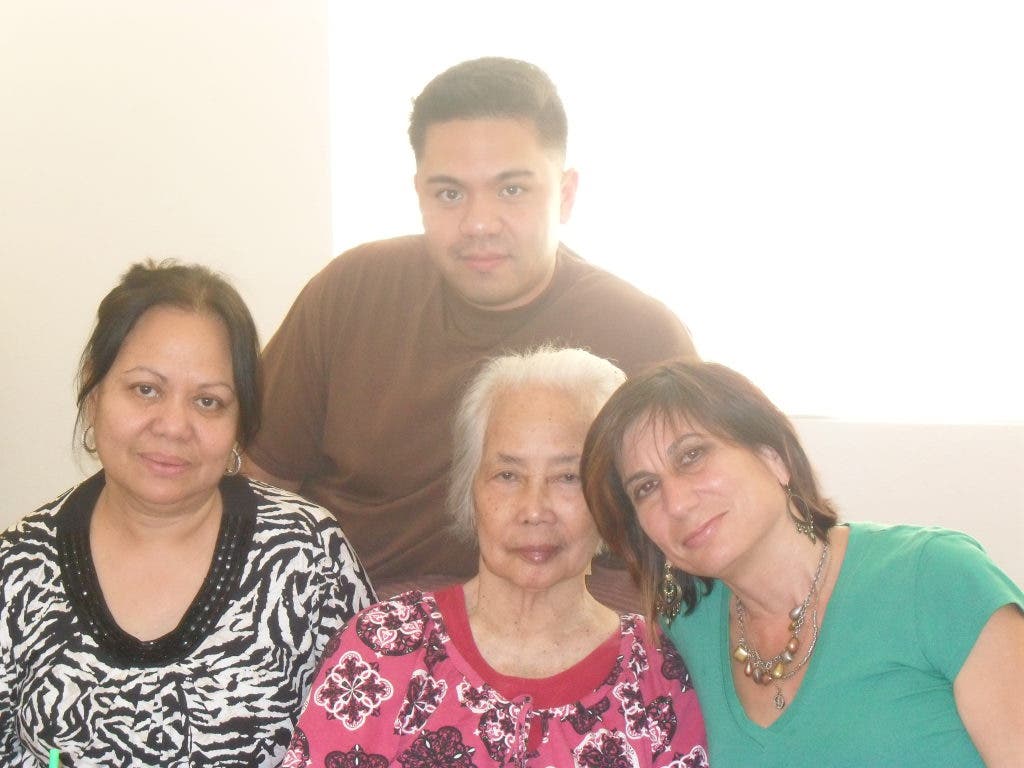

My only real mother-in-law, the one who trusted me as a daughter and felt so betrayed when I left her son, died last night. Tomasa (Masing) Pudiquet Ogilvie was almost 89.
When I first left Seattle, and Henry, Masing asked me sadly and accusingly, “Why do you leave me? You are my daughter.”
Henry let go of his love for me and learned to love Manuelita. When I returned to visit Masing, she pulled out an album with pictures from their wedding. “Honey, why did you leave? She is my daughter now. She is very nice."
Find out what's happening in South Pasadenafor free with the latest updates from Patch.
Masing sent me home that day with lumpia, pancit, bangus (Filipino Milk Fish). When I first moved to California from Seattle and came back to visit, I always left with a package fragrant with aromas of a Filipino kitchen.
Today, when Henry calls to tell me of her death, he says, “An hour before she died, she asked if we were hungry. Last night we brought her the warm boiled eggs she requested. I started to feed her, but she reached out and insisted on feeding herself.”
Find out what's happening in South Pasadenafor free with the latest updates from Patch.
About a month ago, I visited Masing for the first time in many years: “Honey, where have you been? I cannot go to California, you know… you are too far.”
She was still beautiful, sitting tall, as she always did, stubborn and aglow, commanding my attention. “No honey, I am not beautiful,” she insisted, as she always did, “I am so old and ugly.”
She sat with perfect, regal posture, surrounded by her large grandsons; the smallest of which is my son, Gabriel.
Masing told Henry, “Carly’s son, Gaby, is guapo—handsome.” Then in Ilakano, “Feed them—they are too skinny.”
Henry and Manuelita’s oldest son, Ian, has gotten big. “Not just big,” Henry tells me, “He’s a giant—the Hulk but with a little boy’s face.” It’s true. I visited once after four broken ribs and forgot to warn him before his bear hug. He’s gentle now when he hugs me, terrified I might break.
Henry’s nephew Darwin is back home to stay with his mom and grandma, separated from his wife, probably soon to be divorced. Darwin is really taking it hard, first his wife, then his grandma, who really raised him. More than 22 years after I left, he still says, “Hi, Aunty Carla. I love you, Aunty Carla.”
Henry tells me, “Your son has a good heart because he loves to cook and feed people.” Henry ought to know—that’s how he is.
When Henry would visit me, he brought fresh, ice-packed fish he’d caught. Soon after arriving at my apartment, he’d go shopping, filling my refrigerator, unable to bear my living with an empty one. Both our families’ traditions are to fill our loved ones with food and to hope that by filling their stomachs, their hearts, too, will be full.
Twenty-five years ago, when I lived with Henry in Seattle, I smelled home from down the street, in the form of Adobo and Filipino Chicken soup and at least five other dishes. I was working and going to school, exhausted and demoralized, when my first real job went sour. I walked in and cried.
The smells, the comfort, the folded clothes, my mother-in-law, my nephew, my sister-in-law… They looked at me with a “hi, honey!” Then Masing, in distress, asked, “Why are you crying? Honey, you don’t like? We won’t do…”
“No, it’s just that no one does that for me. My mom hasn’t even done clothes for me since I was young,” I wept, “Thank you.”
Masing and Janette hurried over and hugged me. “Honey, you are tired. You eat now. Don’t cry. You are my daughter. He is my son. Eat now.” This is her only demand.
Twenty five years later, “I thought they were intrusive,” Henry shakes his head when I tell him this story.
“No, you were much better with my family, as I was with yours”
I call them in-laws, but Henry and I never married. Still, we were more involved with each other’s families than I’ve ever been since. They are “Aunty Manuelita and Uncle Henry” to my son, Gabe, and I’m “Aunty Carla” to their sons Ian and Ira.
Manuelita, the wife of my first real, long-time boyfriend, tells me, “Our kids—they know that they are cousins. You are family. We love you.”