Community Corner
What's in a Name: Parsonage and Henshaw Lanes
A little history offers a new perspective on an old street in downtown


Have you been to Henshaw Lane or Parsonage Lane lately?
You likely have, but didn't know it. Today, both streets are known as College Street. As you can imagine, before 1826, when Captain Partridge opened The American Literary, Scientific & Military Academy on High Street, the street could not have been named for being a thoroughfare that led to the college. And it probably wasn't named that until after Wesleyan University opened here in 1831.
The upper part of the street, north of Broad Street was called Henshaw Lane, referring to the Henshaw family, which owned a significant amount of land along the street. Indeed, the federal census identifies Henshaws in Middletown from the first census in 1790 (Daniel) until 1880 (John), after which time no Henshaws were listed here. John Henshaw in 1880 lives in the downtown area and was a manufacturer of sewing machines.
Find out what's happening in Middletownfor free with the latest updates from Patch.
Benjamin Henshaw's house once stood at 138 College St., and was torn down with redevelopment in the 1970s. You may remember it as Mazzotta's Restaurant!
The lower end of College Street, from Broad Street to the river, was known as Parsonage Lane. It might be reasonable to assume that one of the churches had a parsonage located at that end of the street, although no record exists to identify where it stood or to which church it was connected.
Find out what's happening in Middletownfor free with the latest updates from Patch.
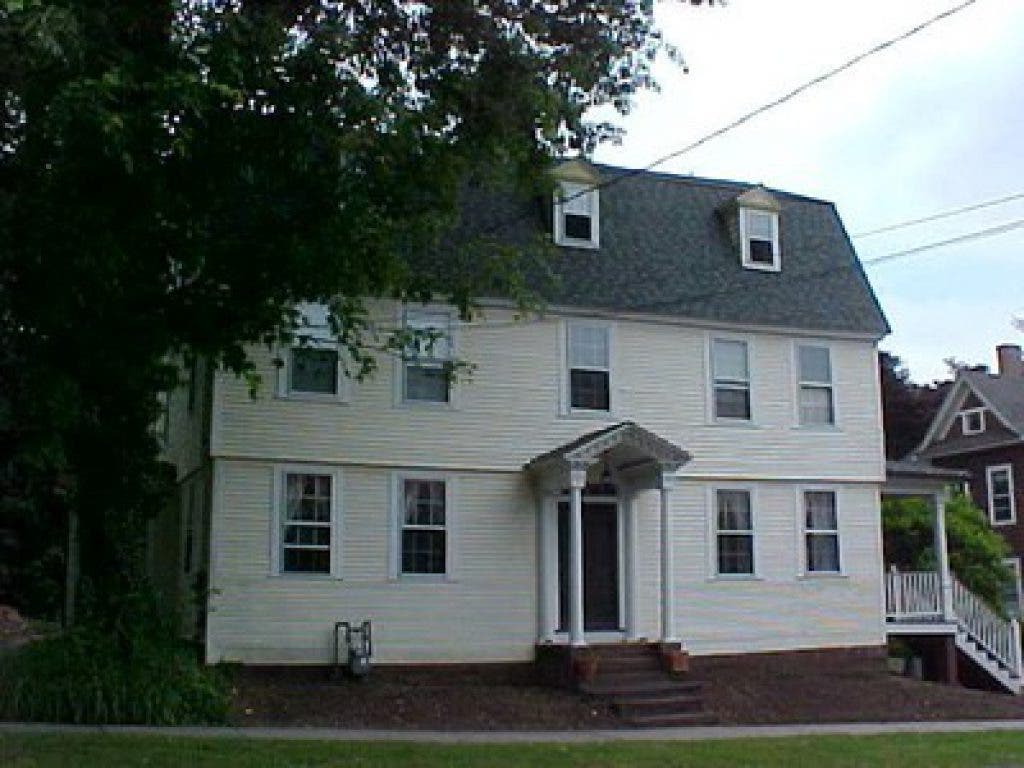
In your rush down College Street, you may not notice the many historic houses north of Broad Street. The house at 148 College St., shown here, was built about 1820 by Randolph Pease, who also built the Greek Revival building across the street in 1830 (an article on that house is coming shortly). This was the home of Huntington's Bookstore in my childhood.
The Colonial era is represented by the Hezekiah Hurlbert, Jr. House at 156 College St. and the Joseph Hall House at 202 College St., both to your right. Both have double overhangs along the facade, but Hall's house has a gambrel roof.
Take a new look at an old street.