Community Corner
Westport's Revolutionary History
Tomorrow marks the anniversary of an important Revolutionary War event in Westport.


This week, many of us have been celebrating renewal and rebirth. Passover commemorates the Israelistes’ deliverance from slavery in Egypt, and Easter commemorates Jesus’ resurrection. Tomorrow, as a town, we may also remember an event of local interest, though no rituals or parades that I know of will attend this anniversary.
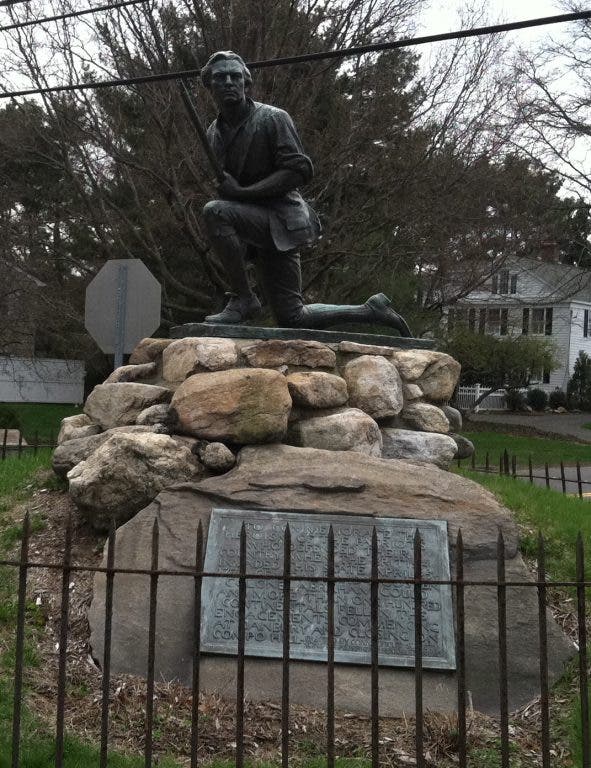
Though I’m not a student of history in an academic sense, I’m interested in the life of this town, in the history that we share as its inhabitants. Passing the Minuteman statue on Compo countless times on countless walks to the beach triggered my curiosity about Westport’s Revolutionary War history. And the Westport Historical Society provided enough information to shed light on the events that transpired here before Westport even existed as a town of its own.
On the afternoon of April 25, 1777, a fleet of over 20 British vessels sailed to what we know as Compo Beach carrying horses, six cannons, and approximately 1500 British Regulars and 300 Prince of Wales Royal American Volunteers. The latter were largely Fairfield County men who were loyal to the British crown and prepared to march through their hometowns perhaps to face down relatives and childhood friends.
Find out what's happening in Westportfor free with the latest updates from Patch.
Flat boats ferried personnel and their accoutrements to the shores where Westport’s children will soon be sifting sand into colorful plastic buckets, perhaps under the shade of striped umbrellas, perhaps arm’s reach from coolers containing juice boxes, fresh fruit, and other assorted snacks.
The British military’s mission on that long ago day was to proceed to Danbury and take possession of the Patriots’ military supplies, which were virtually unprotected as many of the Continentals had joined George Washington’s New Jersey army. By 11:30 p.m. on that night, the British contingent had begun their march toward Danbury by way of Compo Road.
Find out what's happening in Westportfor free with the latest updates from Patch.
In the meantime, alerted to the invasion, a group of Patriots—or, if you prefer, rebels—had stationed themselves behind a stone wall at the intersection of Country Road and Compo. They engaged with the Red Coats there, but the rebels were outnumbered, and the British continued moving east, eventually stopping in Redding for a few hours of rest before proceeding to Danbury. Once there, they destroyed the Patriots’ military supplies, which included enough tents to shelter most of Washington’s army.
The rebels could now only hope to block the British from returning to their ships. But a number of disparate factors conspired against them—stormy weather, the realization that the British outnumbered them, and fears of reprisal among militia who could not necessarily distinguish friend from enemy in Fairfield County, which then had a reputation as something of a Tory stronghold.
A Patriot who took the lead in rousing the militia was Norwich, Conn. native Benedict Arnold, whose change of allegiance was still two years away. As the weather cleared, he succeeded in swelling the militia numbers. They stationed themselves at Old Hill Road amid blue skies, light breezes and spring blossoms dotting the landscape pink and white to meet the Red Coats.
The short version, which will suffice for our purposes, of the skirmish that ensured is that the British, no doubt aided by their local volunteers’ intimate knowledge of the landscape, located a route around the rebels. They succeeded in outwitting Benedict Arnold and his militia by separating into three groups. The first acted as decoys to distract the Patriots while the second secured a route to the beach around the Patriots’ blockade. The third group, which included prisoners and the wounded, followed the second to the shores of Compo Beach.
The militia, historians have reported, were hesitant and demoralized, and Arnold, who twice had the horse he was riding shot out from under him and narrowly escaped capture, famously declared he “wish[ed] never to see another of them in action.” But despite this less-than-glowing account of the militia and their mission's success, the British did not attempt another invasion of inland Connecticut.
Something to think about next time you find yourself driving along Country or Old Hill or past the Minuteman on Compo, immortalized as he gazes contemplatively into the distance.