Neighbor News
Hurricane Sandy Relief at Chincoteague Island on Virginia's Eastern Shore
U.S. Fish and Wildlife Service and TNC Building Oyster Castles to Address Wave Attenuation and Improve Habitat at Chincoteague
It’s a real win-win proposition when environmentalists and conservationists can protect shoreline from erosion and provide habitat for shellfish and marine life -- with volunteer builders employing the same natural habitat technique.
Last weekend, about 25 volunteers from Virginia, Maryland, Washington, DC and even West Virginia donned chest-high boot waders and headed into the Assateague Bay at Chincoteague Island pulling tiny boats with what looked like cinder blocks. The volunteers, coordinated by The Nature Conservancy and hosted by the U.S. Fish and Wildlife Service refuge managers, came out to build 2,000 feet of oyster reef.
Oyster ‘castles’ are named for their shape, as they look a lot like castle turrets. The reef arrays are made of concrete blocks that fit together like Legos ™, which is what makes them impenetrably strong. Oyster larvae are just as happy to latch onto them as they would be with a natural material.
Find out what's happening in Washington DCfor free with the latest updates from Patch.
“We are really excited about this partnership with the U.S. Fish and Wildlife Service here at Chincoteague National Wildlife Refuge,” said Gwynn Crichton, senior project scientist from The Nature Conservancy. “It’s an incredible opportunity to demonstrate how natural infrastructure like our oyster arrays, harnessing the power of nature-based solutions, can be part of the solution to sea-level rise and the risks associated with storm surge.”
“There is not enough money in the federal or state treasuries to address the resiliency issues we need to along the mid-Atlantic. We love these kinds of low-cost, sustainable and efficient coastal resiliency projects that work with nature,” said Kevin Sloan, the U.S. Fish and Wildlife Service’s Chincoteague National Wildlife Refuge manager. “We want to work with nature because we could jeopardize the very ecosystems we are trying to protect, and that are protecting us now from storm surge, by using too many over-engineered approaches,” said Sloan.
Find out what's happening in Washington DCfor free with the latest updates from Patch.
The labor-intensive work is taking place over multiple days at two sites that experienced significant damage from Hurricane Sandy: Tom’s Cove, adjacent to Beach Road, and Assateague Bay, adjacent to the Service Road. When completed, there will be an estimated 1,400 feet of living shoreline at Tom’s Cove and 2,050 feet in Assateague Bay, made from a total of 13,800 marine-friendly oyster castle blocks. The National Fish and Wildlife Foundation of Washington, DC administered the funding for the Tom’s Cove side. A total of $570,000 was provided to both sites for oyster castle reef work.
Bo Lusk, TNC’s coastal scientist and on-site project manager, noted, “We are going with a non-conventional way of protecting the shoreline with the added benefit of having all these oysters out here keeping the water clean. We are getting more ‘bang for the buck’ by protecting shoreline with non-traditional reef. Once the oyster castle blocks are in-place, oysters will attach to them and the reef will be covered with oysters in just a few years.”
“As time goes on, these reefs will keep growing and keep up with the wave surges as water gets higher here at Tom’s Cove," said Lusk. "With a regular breakwater we would need to have to continue to build-up (the height) and it would require maintenance and fixing.”
Amanda Bassow, director of the Northeastern Regional Office of the National Fish and Wildlife Foundation (NFWF) also noted that building castles is a fun activity for families and citizen marine scientists who want to get involved in coastal resiliency. “We are proud of our partners in government and non-profit organizations who can create these kinds of nature-based solutions.”
A portion of the funding for the Chincoteague National Wildlife Refuge comes from DOI's Hurricane Sandy Coastal Resiliency Competitive Grant Program administered by the National Fish and Wildlife Foundation.
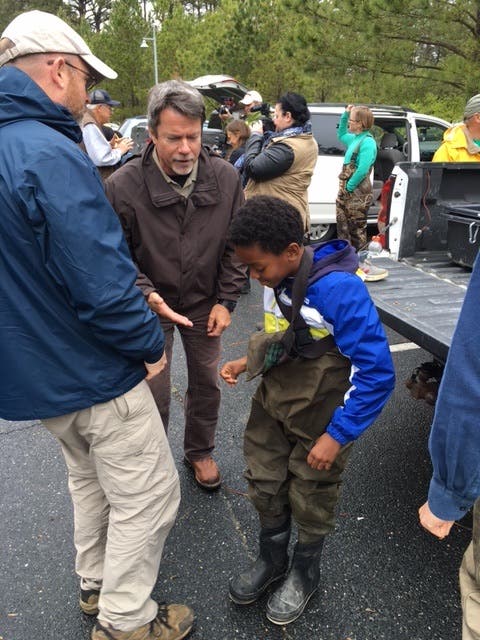
Photo: Chincoteague National Wildlife Refuge Director Kevin Sloan helps a young volunteer try-on his first pair of waders