Politics & Government
Bromeliad Restrictions Deferred by Miami-Dade Commissioners
A proposed resolution by Miami-Dade County Commissioners was in response to Zika concerns.


MIAMI — Fearing a potentially devastating blow to the county's $2.7 billion horticultural and agricultural industry, a Miami-Dade commissioner has voluntarily deferred a measure that would limit —and some argued effectively ban — new purchases of bromeliad plants by the county in an effort to protect against Zika.
"It's all well-intentioned for the citizens of this community," explained Commissioner José “Pepe” Díaz in deferring his measure after an outpouring of concern by plant growers and fellow commissioners at a Tuesday meeting.
The proposed resolution would have directed county purchasing agents to "make every effort" to prioritize the use of plants in county landscaping that do not pose a threat of becoming mosquito breeding grounds and limit the use of bromeliads in county landscaping whenever possible. It also would have asked purchasing agents to include a provision in all new, renewed, or extended county contracts advising vendors to make every effort to prioritize the use of plants in county landscaping that conform to those guidelines.
Find out what's happening in Miamifor free with the latest updates from Patch.
Local growers of the plants — including the 3,000-member Dade County Farm Bureau "implored" commissioners to vote against the measure, arguing that there was no evidence that bromeliad plants attract the Aedes aegypti mosquito species, which has been linked to the Zika outbreak in South Florida.
"Anything could become a mosquito breeding ground, including tree joints, gutters, potholes, soda cans and ditches," insisted Marisol Diaz of the Farm Bureau.
Find out what's happening in Miamifor free with the latest updates from Patch.
“Our fear, commissioners is that this resolution will have a small impact on Zika but an inordinately large impact on the economy and the jobs of this county," she said. "Public health is always paramount, however, do you believe in compromising an industry with a multi-billion impact on the county over a simple hunch?"
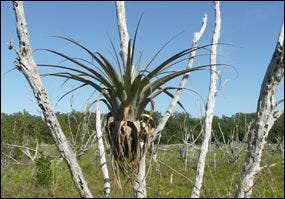
According to the U.S. National Park Service, the leaf bases of some bromeliads, like the giant airplant (T. utriculata), catch and hold water as a way of dealing with dry conditions. "These tank bromeliads provide a nearly continuous water source that is used by a wide range of animals. A careful look down into the leaf bases may reveal a tree frog, mosquito larvae, centipedes or even a snake," NPS said.
And therein lies the problem, according to Commissioner Diaz and some county officials who believe that a reduction in bromeliad use by the county would result in a reduced risk of Zika.
A representative of the Florida Nursery Growers and Landscape Association insisted that one bromeliad plant holds only about six ounces of water compared to an unmaintained swimming pool that holds thousands of gallons.
Howard Frank, a retired professor of entomology from the University of Florida, who said he did extensive research on mosquitoes and bromeliads, told commissioners that the plants tend to host different species of mosquito larvae that actually diminish the Zika-carrying species.
"In fact their presence is beneficial," he explained. "They out compete the Aedes aegypti mosquito, the vector of Zika disease. They out compete it by starving it to death."
While Diaz insisted that his measure would not constitute a ban, Commissioner Dennis C. Moss and others questioned whether it would have effectively imposed one.
"Essentially, even though you are not saying 'it’s a ban' it basically boils down to being a ban," Moss explained
Photo of giant airplant courtesy U.S. National Park Service
Get more local news delivered straight to your inbox. Sign up for free Patch newsletters and alerts.