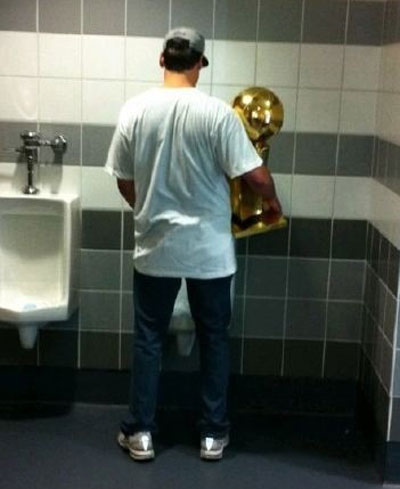
How important is an owner to a professional sports franchise? The Mavericks won 40% of their games from 1980 to 2000. When Mark Cuban purchased the team for $285 million in 2000, they won 69% of their games from 2000-2010, including a Finals trip. When the Mavericks lost the 2006 NBA Finals, it was reported that Cuban had not left his house for 3 weeks. Cuban bought the team a custom plane, with seats designed to comfortably accommodate 7 footers, and redesigned the locker room for the team, converting it into a “clubhouse” and a place to hang out.
On the other hand, Los Angeles Angels owner Arte Moreno had been criticized by fans for not spending more money on free agents (prior to Pujols). He claimed being frugal when it comes to free agents makes tickets more affordable to fans. Although the Angels may be less successful in the win column, splurging on free agents would reduce his profits.
Find out what's happening in Wheatonfor free with the latest updates from Patch.
Something UCLA economics professor Lee Ohanian teaches is the tension between winning and profits. If you want high fan attendance, you better have a great team or really cheap prices. To have a great team though, you may have to spend a lot. What’s the right route? Spend a lot of money and hopefully have a winning team, or spend very little money and have a very mediocre-average team? How do you price tickets? How much do you pay the players?
Find out what's happening in Wheatonfor free with the latest updates from Patch.
Ticket prices don’t always have to be high. Moreno knows he can maximize profits when prices are where marginal revenue equals marginal cost. However, ticket prices can be lower than expected because of the profits made from food and parking. More fans are drawn to games with lower ticket prices, but a hefty profit is still made from the concession stand, a theory further explained by La Trobe University economist Liam Lenten.
Moneyball is the best example of the relationship between economics and sports. The 2002 Oakland Athletics team had a $40 million budget compared to the MLB average budget of $70 million. The Yankees more than tripled the A’s payroll, with a $125 million budget. A’s General Manager Billy Beane hires Paul DePodesta, a Harvard economics major, who uses sabermetrics to buy a baseball team of guys that know how to get on base. The A’s managed to succeed without having to spend a lot of money.
Obviously, professional athletes make much more money than the average employee. However, the economic forces that determines the salaries are the same. According to UW-Parkside's Center for Economic Education, the salaries that these players are paid are based on how much the athlete produces and how much money the player can be traded for, which demonstrates the economic concept of marginal revenue product of labor.
Cuban is a die-hard sports fan, and would do anything to have the Mavericks win. Although he doesn’t have the highest profits in professional sports (and he doesn’t need them), he does everything he can to help the team win. As a fan, owners like Cuban do it right – a pretty competitive team with a decent roster. Fans of the Marlins (there’s a few) have to deal with owner Jeffrey Loria’s decisions to trade away multiple franchise players and put all the money into a new stadium that includes a nightclub, swimming pool, aquarium – amenities not necessarily helpful when it comes to playing in October. When it comes down to it, the players are the ones performing on the court, but the owners are largely responsible for them being there. The ratio of payroll to ticket prices to wins is something that owners will always to have to manage. Dallas is lucky Cuban loves basketball.