Crime & Safety
Maryland Governor Rolls Out Violent Crime Reduction Plan
"Enough is enough," Gov. Larry Hogan said of violent crime in the state of Maryland. "If you do the crime, you do the time."


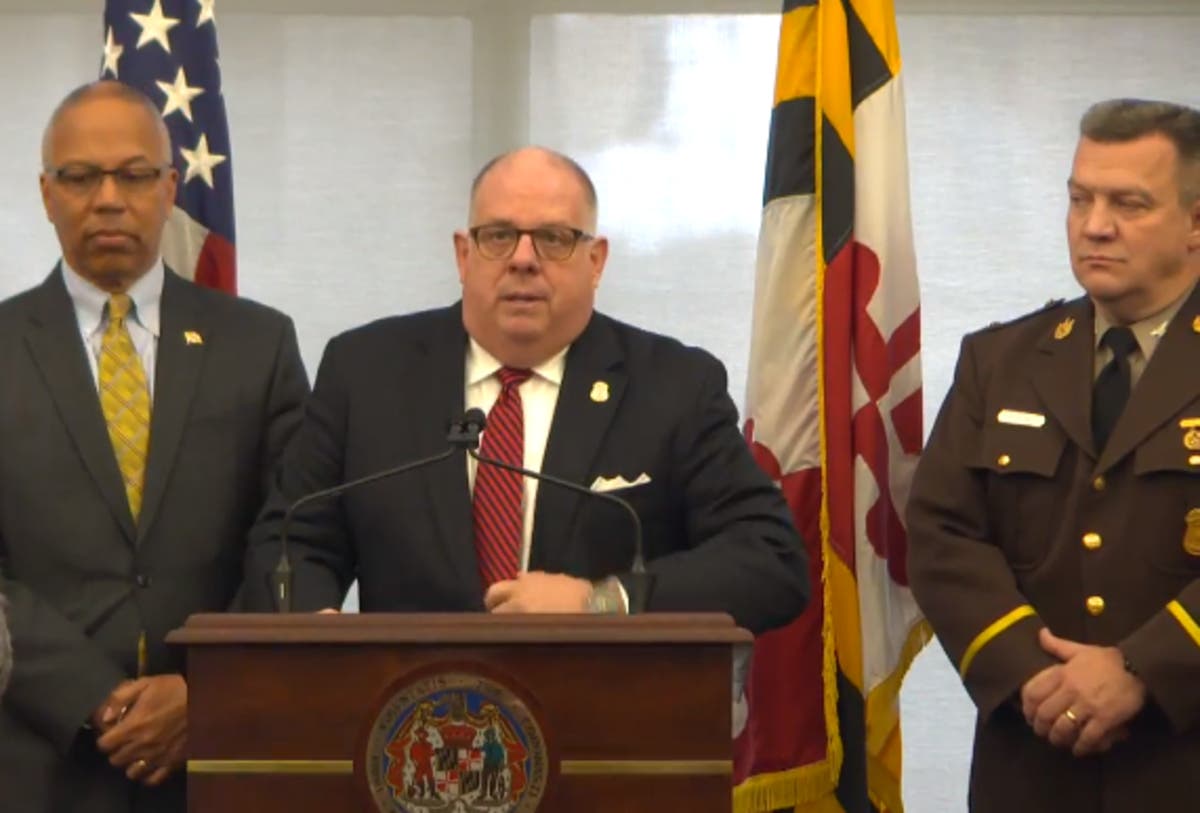
BALTIMORE, MD — Gov. Larry Hogan announced a multi-pronged plan to combat criminal enterprises he said were “terrorizing” Maryland residents. The measures ranged from bolstering police presence in high-crime areas to legislation that would prevent some gun-toting criminals from having their sentences suspended.
"We are saying enough is enough," Hogan said.
Hogan's plan focuses on targeting violent repeat offenders. There will be additional boots on the ground to find those who are wanted and stronger laws to ensure they stay behind bars for their sentences. Personnel from federal, state and local law enforcement were all part of the plan, which called for the demolition of blighted properties, additional officers and the creation of an intelligence-sharing network, among other elements.
Find out what's happening in Dundalkfor free with the latest updates from Patch.
Before outlining his plan to dismantle violent criminal enterprises, Hogan provided these statistics from law enforcement agencies:
- More than 330 drug trafficking organizations were identified within Maryland in 2016.
- More than 10,000 gang associates have been identified in Maryland.
- More than 5,000 firearms in Maryland have been involved in crimes.
- Nearly 90 percent of homicide victims in Baltimore have been arrested on average more than 10 times.
- Almost 50 percent of Baltimore's homicide victims have been have been arrested for gun crimes.
"Let me be crystal clear," Hogan said. "I have absolutely no tolerance whatsoever for these repeat violent offenders or these criminal gangs causing lawlessness in our streets."
Find out what's happening in Dundalkfor free with the latest updates from Patch.
While Baltimore was where he said criminals had a "stranglehold," Hogan said that the plan called for sharing information and working to reduce violent crime across the board. He noted that criminals do not adhere to jurisdictional boundaries.
Three pieces of emergency legislation will be introduced on the first day of the legislative session in Maryland, he said.
- The first, a "truth-in-sentencing initiative," requires second-time violent criminals to serve their full sentences, and makes them ineligible for parole.
- The second doubles the minimum sentence from 5 to 10 years for repeat offenders using firearms in felony and violent crimes. The bill requires time be served consecutively to any other sentence, and includes additional penalties for using firearms in drug trafficking crimes.
- The governor’s third bill will strengthen Maryland’s anti-gang and RICO statutes by expanding the list of gang-related crimes that can be prosecuted across jurisdictional lines, according to the administration.
"It is unacceptable" that people who commit gun crimes, "especially in Baltimore City... have their sentences suspended," Hogan said. "If you do the crime, you do the time."
Hogan noted that while Baltimore was a nexus of criminal activity, it was not the only location in the state where it was occurring.
“Gang violence and violent crime is not limited to one city or one county – it is infecting communities everywhere,” Hogan said. "Our focus is to give law enforcement officers, prosecutors, and judges the tools they need to get these violent criminals off the streets and into prison."
The centerpiece of his statewide approach to dismantling violent criminal networks is a new data-sharing system called the Maryland Criminal Intelligence Network. It will connect state-funded operational programs with 36 task forces to "break down jurisdictional barriers," according to Hogan, who said the network was made possible by Maryland’s new Racketeer Influenced and Corrupt Organizations Act (RICO) statute, which passed during the 2016 session.
Hogan also signed an executive order creating the Governor's Council on Gangs and Violent Criminal Networks, consisting of members of local, state, and federal law enforcement and criminal justice agencies.
"Our administration is committed to doing whatever we can to assist local law enforcement in their mission to identify, disrupt, and dismantle these violent criminal networks and gangs and to assist them in getting criminals off the street and we will target repeat violent offenders, especially those who have committed a crime with a gun," Hogan said. ""Their stranglehold on Baltimore City and their poisoning of too many of our communities is far-reaching."
Freeing Baltimore City From The 'Stranglehold': Baltimore-Specific Measures
Hogan said that criminals were "terrorizing Baltimore City" and introduced several Baltimore-specific measures to bring violence under control.
Maryland State Police will work with Baltimore Police to serve high-priority warrants, and the U.S. Marshals Service is adding 80 more marshals and federally designated task force officers to help with warrant service.
More than 200 state parole and probation officers will partner with city officers to locate repeat violent parole offenders, according to the governor.
State police agencies will expand their patrols in Baltimore City on land and by boat, including Maryland State Police and the Maryland Transportation Authority, increasing visibility in high-crime areas.
Baltimore's police commissioner said he appreciated the support.
“I know the Mayor and Governor are working collaboratively with the Baltimore Police Department to reduce violence in Baltimore," Baltimore Police Commissioner Kevin Davis said. "Designating additional state resources and enhancing ongoing initiatives are appreciated by me and the men and women of the Baltimore Police Department."
In Baltimore, Hogan also called for housing officials to identify vacant and blighted properties where gang activities were happening, so that the structures' demolition could be expedited.
"We want to give these violent criminals fewer places to hide," Hogan said.
The Maryland Department of Housing and Community Development would work with the city and Maryland Stadium Authority to identify vacant properties in the most dangerous areas for this initiative, an extension of "Project C.O.R.E.," a local-state partnership that has already removed more than 1,200 blighted Baltimore properties.
"Keeping Marylanders safe is our number-one priority," Hogan said, "and as long as I am governor, we will continue to do everything we possibly can to empower our law enforcement agencies and our prosecutors and judges with the tools and resources they need to finally get these violent criminals off of our streets and behind bars."
Watch Gov. Hogan explain his planat Tuesday's press conference:
Still image from Gov. Larry Hogan/Facebook.
Get more local news delivered straight to your inbox. Sign up for free Patch newsletters and alerts.