Community Corner
Belmont Author Reveals The True 'Whitey' Bulger
Dick Lehr will speak tonight, Tuesday, June 4 at the Belmont Public Library at 7:30 p.m.
It sounds like a movie plot. A serial killer, a kingpin of crime, finds a way to subvert law enforcement to advance his schemes and cover his murders.
In the 1970s and 1980s, however, in the Boston branch of the FBI, Agent John Connolly had as an informant, his top echelon asset, James “Whitey” Bulger. In time, the informant corrupted the agents in charge of him until he was in charge of them.
John Connolly and Whitey Bulger grew up in the same South Boston projects. Connolly apparently never lost his hero worship for Whitey, the neighborhood thug. The FBI handler and the killer eventually became partners in crime, including murder. When the judge sentenced Connolly to 40 years, he commented that the agent had gone over to the dark side.
Find out what's happening in Belmontfor free with the latest updates from Patch.
Belmont resident, journalist and professor of journalism, Richard "Dick" Lehr has been chronicling that dark side since a reporter for the Boston Globe. In 1988, his paper ran a series on the life and politics of Billy Bulger, whose fame equals that of his famous brother. William "Billy" Bulger was once President of the Massachusetts Senate and then President of the University of Massachusetts. His lawful power and prestige parallel his brother Whitey’s life and death control over others.
The explosive 32 words out of thousands in the Globe series connected Whitey, Billy Bulger’s brother, to the FBI as an informant. That started the avalanche of events, which lead to Connolly’s indictment and Whitey’s fleeing from justice until 2011.
If citizens ever needed a reminder of the necessity of a free press, vigilant, keeping an eye on power, here it is.
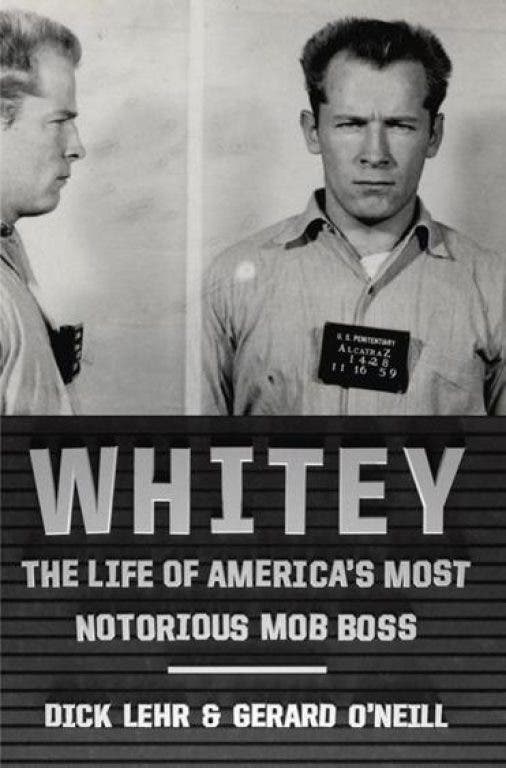
In Whitey: the Life of America’s Most Notorious Mob Boss, Lehr and his co-author Gerard O’Neill have researched, interviewed and documented nearly every line of the book. Readers will find stunning the cruelties of Whitey Bulger, who encouraged the myth of Robin Hood to his neighbors, when in fact he was the Caligula of Southie.
Find out what's happening in Belmontfor free with the latest updates from Patch.
Bulger terrorized his community and through violence and drugs destroyed many lives. Corruption allowed Whitey to run free until called to account, culminating in the upcoming trial for Bulger’s 19 victims.
Lehr will be reading from his book at the Belmont Library Assembly Room on Tuesday, June 4 at 7:30 p.m.
Belmont Patch reached Lehr at his home in Belmont.
Patch: With 19 to choose from, you begin your book with Whitey’s murder of Debra Davis in 1981. Why start with this one?
Lehr: The Debra Davis murder is one of the most heinous, and we wanted to begin our biography by dropping the reader right into the worst of Whitey, at his height of underworld power and terror, so that there would be no mistaking his monstrosity, and, then, after opening with this scene, step back and begin at the beginning, with a telling of the Bulger family history.
Q. A novel would not be believed: one brother excels in politics and the other in crime. Are Billy and James Bulger more similar than different? Was brotherly love another name for ruthless self-interest?
A. One of the themes in Whitey's biography is the lifelong bond between him and his younger brother Bill. They do share many personality traits, although Whitey is certainly a one-off -- a psychopath and cold-stone killer. We track their loyalty through their lives, giving that a new depth, and we establish that very early on, when Whitey goes to prison in the 1950s for bank robbery, brother Bill emerges as the family's point person for him.
Q. Penitentiaries are where inmates can be penitent. Whitey Bulger appears beyond rehabilitation, not deserving a parole, but he got one. How did he draw upon a famous Congressman (Drinan) and even a Speaker of the House (McCormack) in a long pattern of manipulation?
A. Based on new records, we're able to show how Whitey benefited from an access to political power that few, if any, prison inmates enjoyed -- and would love to have had! Through his family, House Speaker John McCormack showed great interest in inmate Whitey Bulger in the federal prison system, and new records show how that helped Whitey.
Q. J. Edgar Hoover directed his agents to infiltrate organized crime as they did the Communist Party. The use of informants like Bulger is controversial – what are the unintended consequences in Whitey?
A. The unintended consequence of the FBI's flawed and lawless informant program was the creation of the monster like Whitey Bulger. Corrupted FBI agents protected Whitey, enabling him to rise to power in Boston's underworld and then conduct a reign of terror for more than a decade.
Q. Advocates for ex-FBI Agent John Connolly, now in prison for murder, proclaim him innocent. What happened to Connolly so that he could not tell the good guys from the bad?
A. Why Connolly went so bad is the stuff of shrinks. It's a mixture of his own ambition intersecting with the FBI's perverse informant program, and then there's Connolly's twisted neighborhood loyalty to the gangster Whitey Bulger, who was older and whom he'd admired as a kid. It's a toxic brew, and while Connolly has stayed loyal to Whitey, Whitey has dumped him.
Q. When Whitey’s six-year-old son dies in 1974, readers may feel sympathy for the bereaved father. But Whitey feels sympathy for no one. How does the work of Dr. Hervey Cleckley [The Mask of Sanity] give readers the tools to understand the enigma of Whitey Bulger?
A. Actually, Whitey’s grief – the grief any father would feel at the loss of a child – is one of the few truly human moments in Whitey's life, an exception for a self-centered psychopath.
We relied on the pioneering researcher into psychopathy, Dr. Hervey Cleckley, as a way to give readers an insight into the criminal mind, and hopefully by doing that, an insight into Whitey.
Q. The old joke is that the son kills his parents and then pleads for mercy as an orphan. When the trial starts, what scam, that is, defense do you expect Whitey’s lawyers to offer? Will it have something to do with LSD?
A. Whitey's lawyers are claiming he had legal immunity to commit his crimes. It's a Hail Mary defense, according to most lawyers. We'll see. We did cover in the book the possibility of the LSD defense. While imprisoned in Atlanta, Whitey volunteered for experiment s with the drug.
We have a brief scene from the 1980s where Whitey tells [FBI Agent] John Morris that if he ever gets caught he might use the LSD as a defense, saying the LSD made me do it. But so far Whitey's lawyers have not given any indication that they're going to raise LSD. Doesn't mean they won't.
Q. Finally, 60 Minutes may interview Whitey about his years on the run. If you had the chance, what would you ask him?
A. Two key areas where the public's understanding could be deepened include: 1) any information Whitey has about the involvement of FBI officials beyond the corrupted agents on the ground in Boston; 2) any ongoing contact, if any, that Whitey had with his brother Bill and the Bulger family during the fourteen years, beginning in late 1996, when Whitey lived in Santa Monica with his companion as Charlie and Carol Gasko.
Editor’s Note: "Black Mass" also by Dick Lehr and Gerard O’Neill, about the unholy alliance between the FBI and the Irish mob, is being made into a movie, directed by Barry Levinson.