Neighbor News
J G Whittier & The King's Missive
In 1880 James Ripley Osgood, a Boston publisher commissioned a ballad from Whittier for the "Boston Memorial Book."

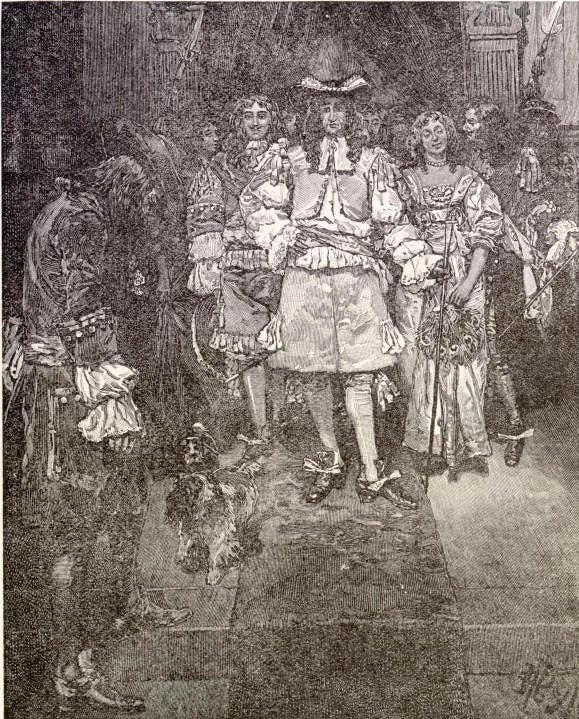


To read full poem click link Narrative and Legendary Poems: The King’s Missive
The missive was dated September 9, 1661. The court records of November 27, 1661, show that such a document was received from the King and was under consideration, though the missive itself is not recorded. They state that restless spirits have filled the royal ears with complaints, and have by unwearied solicitations procured from him a letter forbidding the corporal punishing or death of the Quakers, and “that we may not in the least offend His Majesty, this court doth hereby order and declare that the execution of the laws in force against the Quakers as such, so far as they respect corporal punishment or death, be suspended until this court take further order.” In his book Besse gives an order from the court to the jailor in Boston, dated December 9, 1661, in these words: “You are required by authority and order of the General Court forthwith to release and discharge the Quakers who are at present in your custody. See that you don’t neglect this. By order of the court. Edward Rawson, secretary.” This looks like a general jail delivery. From The Dial Volume 2
Some background of the events that brought three Quaker men together and how Samuel Shattuck came to deliver The King’s Missive
Find out what's happening in Salemfor free with the latest updates from Patch.
On Sunday June 27, 1658 Nicholas and Hannah Phelps hosted a Quaker Meeting in their home. The Phelps Farm (picture above) and Mill was part of West Peabody located five miles from the Puritan meeting house in Salem. The Puritan government had passed strict laws forbidding Quakers to be in the colony.
Law officials John Endicott and William Hawthorne labeled Quakers, or Society of Friends, as “dangerous intruders invading our borders” and “wandering vagabonds.” Despite the tenacious efforts of the magistrates who wanted to eliminate the “vile heretics,” which included branding, whipping and cropping, the Quakers met in private homes to worship and welcome their “Friends” from abroad.
Find out what's happening in Salemfor free with the latest updates from Patch.
Robert Adams of Newbury MA escorted two Quaker missionaries, William Brend and William Leddra to the Phelps meeting. The law officials were tipped off and stormed the Phelps home. They arrested a few and issued court appearances for the remainder. Brend and Leddra escaped, but were later apprehended in Newbury. There was a trial and the court ordered fines for some and imprisonment for others. Leddra and Brend were brought to the Boston goal where they endured excessive beatings. Shattuck, Phelps, and other friends were placed in the Ipswich jail where they were severely whipped. The Records and Files of Essex Quarterly Court
Within months, Nicholas Phelps, Samuel Shattuck and Josiah Southwick were called before the court again. This time they were banished on pain of death with two weeks being allowed to settle their affairs. Following their banishment, Shattuck, Southwick and Phelps sailed for England to appeal to King Charles II to end the Quaker persecutions. For more info go to Salem’s Quakers and Their Lost Memorial
Charles II had Quaker sympathies and was good friends with William Penn whom he granted territory to which became Pennsylvania. A list of the cruel punishments and injustices the Quakers had endured in the colonies was presented to Charles: “There was a Vein of innocent Blood open’d in his Dominions, which if it were not stopt might over-run all. To which the king replied, ‘But I will stop that Vein.’”
On September 9, 1661 King Charles II issued an order to the Bay Colony to cease the persecution of Quakers. Charles II instructed Governor Endicott to cease the execution of Quakers and to place their fates in the King’s hands where they should be sent to England for trial. Samuel Shattuck was selected to bear a letter to America entitled “The King’s Missive.” The London Friends hired Ralph Goldsmith to escort Shattuck and Phelps back to America. Goldsmith was paid £300 for the service. The ship entered Boston Harbor on a Sunday in the latter part of November, 1661.
In his poem Whittier will elaborate on the transformation that Shattuck (symbolic representative of all Quaker friends) will encounter when the message from the “Merry Monarch” is placed before Endicott. The “knave” is now addressed as “Mr. Shattuck” and the proud Endicott removes his hat and bows to Shattuck. Endicott promised “implicit obedience” stating the release of all Shattuck’s friends.”
The prisoners were released from the jail, and they and their friends outside where for the first time permitted to meet together in Boston, and praise God for their deliverance. According to “Drake’s History of Boston,” an order was issued for the discharge of the Quakers then in prison. At this time William Salter was the prison-keeper as records reveal there were twenty-eight convicted Quakers lying in Boston jail, one of whom, Wenlock Christison, was under sentence of death. The “King’s Missive” did stop the executions, but punishment of the Quakers by the Boston government still continued. It was a pivotal point for Quakers, but they had a long haul ahead.
A passage from Charles Frederick Holder from The Quaker and the Puritan--A Thrilling Passage in Colonial History:
Such was the first victory of this sect, and in all their later troubles, as they were attacked time and again, they invariably won by passive resistance. The Quaker was the embodiment of modern culture cropping out two hundred years ahead of its time. They stood for everything that is held to be best to-day. They believed in simplicity of life, in the Bible, in Christianity. They held that a man and woman should be devout or good every day. They believed in the political equality of all men. They held that every citizen had a right to his religious opinions. They denounced slavery in 1660. They held up war, the killing of man, as an evidence of barbarism. In fact, to obtain an idea of the belief of the little-understood Quaker, as his enemies called him, it is only necessary to select to-day the best in life and religion as held and believed by the greatest number of Christians, and that will be the belief of the Quaker.
In March 1881 Whittier published a letter in the “ Boston Advertiser “ addressing the criticism “King’s Missive.” He replied to a paper that was read before the Massachusetts Historical Society by Rev. Dr. George E. Ellis, an “ingenious defender of the Puritan clergy and government who also made “championship of Endicott and his advisers.” Ellis accused Whittier for using poetic licence to raise the Quakers up as heroes when they were “ ignorant, low fanatics.” Whittier stated he “has preserved with tolerable correctness the spirit, tone, and color of the incident and its time.” Whittier referenced several reputable sources to defend his ballard. He cited from court records and letters to validate the persecution of the Quakers. In his own words he was “holding their doctrine and reverencing their memories.”
Ellis may have been correct when he stated that the Quakers were a little fanatical. If Whittier was a Quaker in the 17th century he would not doubt have joined the ranks of the “rebel rousers.” Had he not had the Quaker training of his day he would have been found in the ranks of the early volunteers fighting for the cause on the onset of the Civil War. Instead he chose a more passive weapon, his pen which packed a pretty intense blow and always hit the mark..
Amesbury author Edith Maxwell is a volunteer at the Amesbury Whittier Whittier Home and Clerk of Amesbury Friends Meeting. “The King’s Missive” she noted that “Whittier focused on the Friends’ long tradition of acting in a risky fashion in the name of social justice, and he was able to refute criticisms of the poem in an exchange of letters in the newspaper. Even today we strive to live as ‘risky Quakers’.” Maxwell has included Whittier as a character in her forthcoming murder mystery series set in 1888 Amesbury, which features a Quaker midwife solving crimes. (Delivering the Truth will release in April, 2016.)
A little added tidbit Ever wonder what influenced Nathaniel Ha[w]thorne to write on the Quakers? Well his grandfather Captain Daniel Hathorne married Rachel Phelps, granddaughter of Nicholas and Hannah Phelps. According to Marilyn B Moore in “The Salem World of Nathaniel Hawthorne,” Hawthorne heard the stories of the Phelps farm and the Quaker persecutions from his maternal grandmother.
Sources to consult
THE KING’S MISSIVE Henry J. Cadbury Quaker History Vol. 63, No. 2 (Autumn 1974), pp. 117-123
The Peabody story: events in Peabody’s history, 1626-1972 John Andrew Wells
History of Salem Volume 2 Sidney Perley
Collection of the Sufferings of the People called Quakers Joseph Besse
At Odds: My Puritan and Quaker Heritage Ancestory Archives via Laura George
John Greenleaf Whittier: His Life, Genius, and Writings W. Sloane Kennedy
The Works of John Greenleaf Whittier, Volume 9
The Annals of Salem: from its First Settlement by Joseph Barlow Felt
Hannah Baskell Phelps Phelps Hill A Quaker Woman and Her Offspring by Gwen Boyer Bjorkman
The King’s Missive Henry J. Cadbury Quaker History Volume 63, Number 2, Autumn 1974 The history and antiquities of Boston Samuel Gardner Drake
The Journal of the Friends’ Historical Society: Journal supplement, Issues 12-13 By Friends’ historical society, London
Historical Letters on the First Charter of Massachusetts Government By Abel Cushing
Nutfield Genealogy Joseph Southwick Abolitionist