Community Corner
Getting to the Meat of It
Learn how to be a more conscious omnivore, even on a special diet.
I subscribe to In Defense of Food author Michael Pollan's mantra: “Eat Food. Not too much. Mostly plants.” I pretty much eat small portions of meat and lots of plants. I am an omnivore on a special diet, and I'm out to do it the best, most healthful, way possible.
As food detectives, those with special diets must take special consideration when choosing what we put into our bodies. Nowhere do I find more of an emotional dilemma than when selecting protein from meats. Cooking for those with special diets often means using the most basic ingredients: Fruit, vegetables, beans, rice, grains and, yes, meat.
You would think finding those simple ingredients would be a tad more simple. But our food industry likes to add things, some not-so-healthy things, to our supply. For example, why does a package of dried fruit need sugar and a slew of incomprehensible ingredients in it? It's dried fruit. I think the list should stop there. Look on any box of packaged food not in the health section, and everyone knows they will find a list of four and five-syllable words designed to enhance the flavor, visual appeal or shelf life of the product.
Find out what's happening in Ferndalefor free with the latest updates from Patch.
And the same is true for meat. With the factory farm variety, who knows what can be pumped into it. Dyes, preservatives, salt, MSG and a bevy of “enhancers” can be found in the meat section of the grocery store. I try my best to eat wisely and frugally. I include meat because it's the easiest, cheapest way to add protein to some of our meals. But there are ways to make better choices.
I look for meats that do not use antibiotics, fillers, steroids or hormones and come from grass- or vegetarian-fed animals. Cows were meant to eat grass, yet some factory farms keep them alive by pumping them full of antibiotics when their stomachs, meant specifically to digest grass, become infected after they've been forced to eat corn or other things instead. It is a painful life for the cow and not so great for us to eat, either. For poultry and pork, look for chicken from family farms that is free range and vegetarian fed.
Find out what's happening in Ferndalefor free with the latest updates from Patch.
Here are some other suggestions for omnivores:
Try going meatless a few nights a week
Cut up an eggplant, brush with olive oil and roast in the oven or on the grill. Slice and add to your marinara sauce for a “meatless” pasta night. On another night, make a frittata or omelet with grilled potatoes and tossed salad. One of our favorite meals just happens to be grilled cheese and tomato soup. My little one prefers broccoli with his sandwich. We never miss the meat.
Buy the organic brand
At almost every grocery store, you can find Laura's Lean Beef products. Laura's offers organic, grass-fed beef. I would spend the extra buck for this brand any day.
Find a good deli
- I recommend . Jason from the deli department told me that most of their meat comes from factory farms, but they take extra steps to purchase options from local farmers that is free of antibiotics and fillers. It is all gluten-free. The deli also stocks beef and pork from C. Roy Meats, a family farm in Yale, MI. The farm raises natural, organic and grass-fed animals that are all free of hormones, steroids, antibiotics, MSG, nitrates and preservatives. As for chicken, Jason told me they get poultry from Miller's farm in Indiana, which is raised Amish style with USDA inspections. The birds are free-range, vegetarian-fed and contain no antibiotics or hormones. The chickens contain no broth, MSG or fillers that would contain allergens. So, all in all, a pretty legit way to purchase meat. To top it all off, the staff is incredibly friendly. I told them that I was making pulled pork in the slow cooker, and the butcher was quickly on hand to offer me suggestions on both cuts of pork and cooking methods. I ended up with the very appetizing “pork butt.” I'm glad I listened to the suggestion.
- Another quality deli selection is , which is where I got the locally made and gluten-free Hot Rod Bob's barbecue sauce in the pulled pork recipe. The deli offers USDA Certified Black Angus Natural Beef from Creekstone Farms, which doesn't add antibiotics or hormones. The deli also has Miller's chicken and Boar's Head lunch meats, which are gluten-free. If you are concerned about cross-contamination, the staff will wipe down a slicer for you.
Best bet: Royal Oak Farmers Market
- Beef: John Henry's of Millington (in Michigan's Thumb) offers beef free of hormones and antibiotics. On top of that, John Henry's beef is grass fed on pasture all summer long and fed hay and silage in the winter months. It's website says its fresh meats “contain no artificial tenderizers, coloring or preservatives. We cut and package all our own meats in our USDA inspected kitchen to ensure the utmost care is taken.”
- Pork: John Henry's also says its pigs “are able to be outside rutting around in the dirt. They are raised by our good friend and neighbor who has been raising pigs the natural way for over 40 years.” They are fed some all natural grains and no soy, animal bi-products, antibiotics or hormones.
- Poultry: Otto's Chicken is a family owned farm in Middleville, MI, that raises hormone- and antibiotic-free chicken. According to the farm's website, Gary, a fourth generation poultry farmer, and his wife, Becky, established Otto's 11 years ago. This is the part that makes me want to spend some extra bucks on this chicken: “You are sure to love the taste of this locally raised chicken that has had access to fresh, natural food and clean water as well as plenty of space for roaming around. Exercise and diet are very important in the health of the chicken, and healthy chicken is tasty chicken!” The website goes on to say that the chicken is not “free range” but has plenty of space to roam. John Henry's also offers poultry “raised by our neighbor,” which contains no antibiotics or hormones and the birds are free range with plenty of sunshine and air. They are given natural grains and are not fed soy or animal bi-products and are allowed to go out on pasture to eat bugs.
Raise your own food
Some that would allow back yard chicken coops. What a good idea! I am lucky in that my aunt raises chickens on her farm in mid-Michigan and usually has a bird or two, as well as a few dozen eggs, to offer me when I see her. I am thankful for her generosity, because my family gets tons of meals out of the farm-fresh gift. Roasted chicken for dinner is then turned into stock and soup. The eggs are a meal or three in themselves and nothing to ruffle my feathers over because my aunt practices organic and humane farming.
Find a local farmer or join a CSA
Some Community Supported Agriculture (CSA) farms offer grass-fed beef and more humane choices if you are an omnivore like me. Click on the Eat Wild link for a list of local farms and CSAs that offer grass-fed meats, dairy and eggs.
Pulled Pork Sandwiches
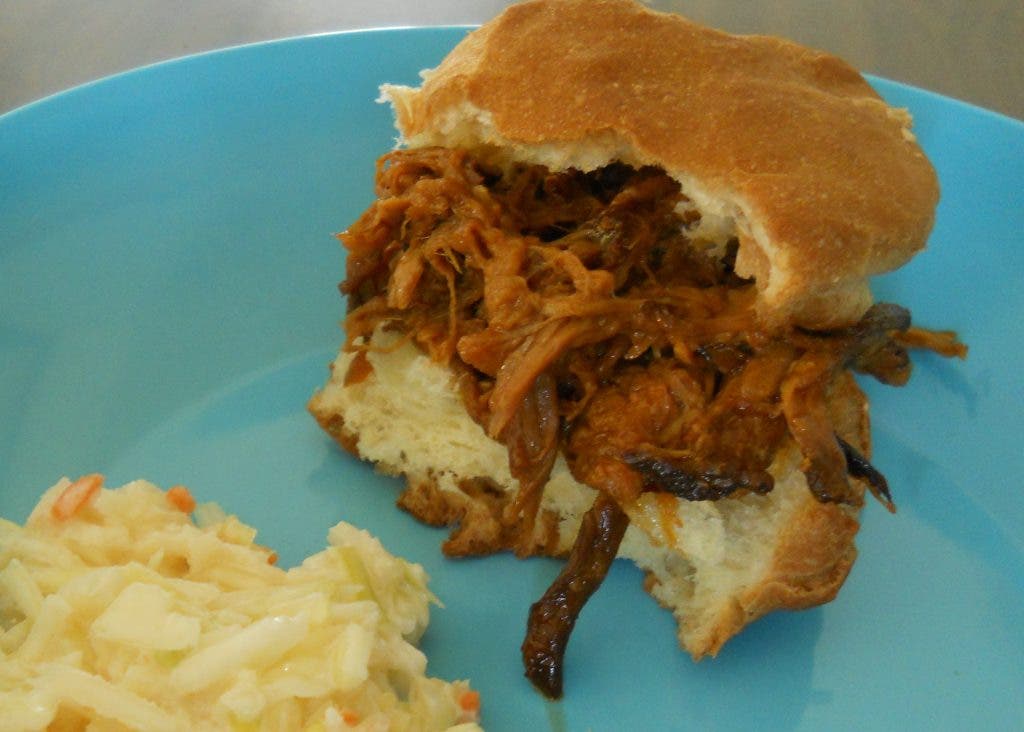
I made this for Mother's Day weekend, served with corn on the cob and coleslaw. It was an economical way to serve a lot of people, and went well piled onto a gluten-free bun from Celiac Specialties. I simply browned the meat, added the sauce and veggies and put it all in the slow cooker overnight. The 5-pound pork butt I got from Western Market's deli could easily serve seven adults. There were five adults and two children present and we all went home with leftovers.
- 4-5 lb. pork roast or butt
- 1 medium sweet onion sliced into large chunks
- 1 sweet red pepper, sliced into large chunks
- 1 jar barbecue sauce*
- Enough broth for deglazing
- 1-2 tsp. cayenne for extra heat, ½ cup apple juice for extra sweetness
Brown pork on all sides and transfer to large slow cooker. Add onions, peppers, and barbecue sauce. To deglaze the bottom of the pan used to brown pork, add 1/3 cup or so of broth (Kitchen Basics is gluten-free) and scrape bottom of pan. Add to slow cooker along with any additional spices or juice. Turn on high for first hour, and cook on low 5-8 hours. Pull apart with two forks and mix into sauce. Let simmer for at least ½ hour in sauce before serving.
*Barbecue sauce
Can't find gluten-free barbecue sauce? Make your own.
- 1 can (14.5 oz) diced tomatoes
- ¼ C. packed brown sugar
- 3 tbsps. cider vinegar
- 2 cloves garlic, halved
- 1 ½ tsps. salt, dried oregano leaves and paprika
- ½ tsp. ground red pepper (cayenne)
Blend all ingredients in food processor or blender and add to slow cooker.