Community Corner
DIA Helps Bring Portrait Home to Northville
William H. Maybury painting installed at Northville District Library


Since late June, downtown Northville has been graced with replicas of six masterpieces from the collection of the Detroit Institute of Arts as part of the popular t program. The masterworks, which extend from to the , augment the numerous local public art pieces permanently on display throughout the community.
While these works by Frederic Edwin Church, Gari Melcher and other world class artists are exceptional copies from a variety of periods and subjects, Northville’s newest addition from the DIA combines artistry with local lore — an original portrait of William H. Maybury, the bulwark behind Maybury Sanatorium, the renowned tuberculosis sanatorium that is now .
The portrait was installed Wednesday in the ’s Local History Room as part of a joint agreement between the U.S. General Services Administration and the DIA.
Find out what's happening in Northvillefor free with the latest updates from Patch.
How the portrait of this notable Detroiter and local luminary landed at the Northville District Library is part sleuthing and part serendipity as the Northville connections go beyond the subject himself.
A New Deal project
The Maybury portrait by J. Raeburn Middleton, a Scottish-born painter, was completed in 1934 under the auspices of the Public Works of Art Project (a precursor to the Works Project Administration). The PWAP was the first of four federal arts projects during Franklin Roosevelt’s New Deal administration. According to the Smithsonian, the PWAP was the first federal program to support the arts nationally, employing thousands of artists during the Great Depression. The program lasted only six months from mid-December 1933 to June 1934. In 1934, the federal government began loaning or allocating the moveable PWAP artworks created under the New Deal programs to non-profit institutions and public agencies.
Find out what's happening in Northvillefor free with the latest updates from Patch.
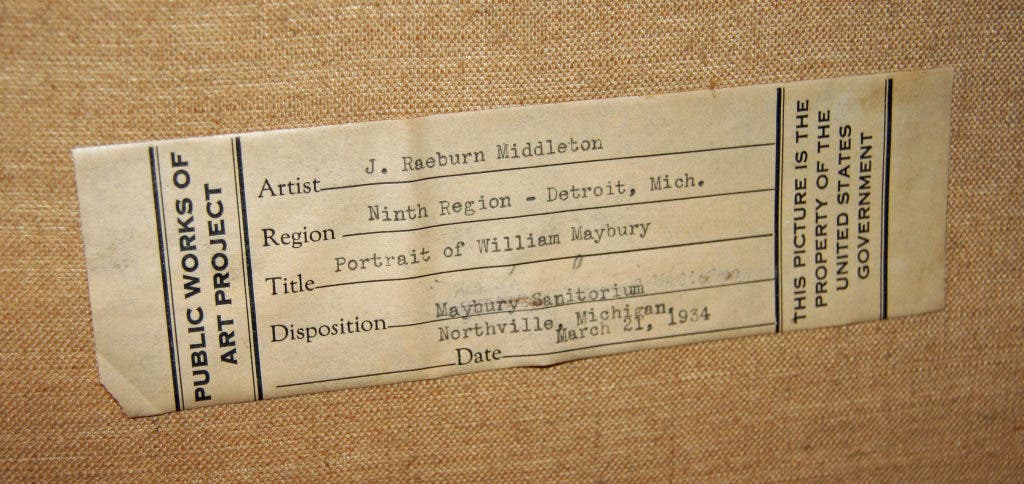
A PWAP label on the back of the Maybury portrait (see photograph) is dated March 21, 1934. According to DIA research, the portrait was placed on deposit to the Maybury Sanatorium in 1935, where it remained until 1965, when it was returned to the DIA.
Housed in storage at the DIA for the past four-plus decades, the portrait came to light when one of the DIA’s registrars discovered the portrait on its list of WPA art. Working with the U.S. General Services Administration, stewards of the PWAP and WPA artworks (the federal agency has been working since 2000 to inventory New Deal art, and has located more than 20,000 works from that period), the painting was taken out of storage and turned over to the DIA’s painting conservator and its curator of American art to determine its conservation status and back story.
Maybury legacy
The label on the back of the painting gave the most obvious clue as to the subject of the painting.
William H. Maybury was a native Detroiter and well-to-do bachelor who retired from the real estate business at the age of 37. When his cousin William C. Maybury was elected mayor of Detroit in 1897, Maybury jumped into public service. In 1917, the City of Detroit purchased eight farms in Northville Township and began development of a 900-acre tuberculosis sanatorium.
Maybury was put in charge of the project and oversaw the construction of the facility that opened in 1921 to help fight the raging war on tuberculosis. He advocated for the development of the Children’s Unit and helped bring the sanatorium international acclaim. The facility was renamed in his honor in 1927.
In an ironic and cruel twist of fate, William C. Maybury contracted tuberculosis in the fall of 1931 and died at the farmhouse (the only original building remaining on the site today) on the sanatoriam property on November 4.
The sanatoriam remained open until 1969. In 1972, the Parks Division of the Michigan Department of Natural Resources took possession of the property from the City of Detroit to create the first state park in Wayne County. Maybury State Park officially opened on May 1, 1975.
Portrait restoration
Noting that the Maybury portrait’s local historical significance outweighs its artistic value, the DIA suggested to the U.S. GSA that it seek a local site to display the painting. The Northville District Library met the government’s requirements for housing the portrait that included climate control within the facility and a full-time professional staff. The U.S. GSA retains stewardship of the portrait with the DIA serving as local guardian.
The DIA also agreed to undertake restoration of the portrait and create a frame.
Alfred Ackerman, Head of Conservation and Painting Conservator for the DIA — and a 22-year Northville resident — restored the Maybury painting. Ackerman’s restoration of the portrait involved “knocking back” some of the deeper cracks that exposed the painting’s canvas, and touching up faded paint (see before and after images).
He noted that while repairing the painting he discovered beneath Middleton’s signature the notation “from a photograph.”
Ackerman pointed out that the portrait is very similar to a photograph of William Maybury used in his obituary in the Detroit Free Press. This may be the possible source for the painting likely completed in the earliest months of 1934. A photograph would have been a suitable visual source since Maybury died three years before the portrait was commissioned.
While much is known of the portrait’s subject, there is little information about the artist. Ackerman noted that Middleton was a member of the Royal Scottish Academy and likely came to the United States in the first quarter of the 20th century. He said a connection to the famed Scottish portrait painter Henry Raeburn whose works are in the DIA’s collection has not been determined.
While an appropriate frame was found for the painting, Ackerman said he would like to replace it with something with greater local meaning. His said he hopes to use wood from felled black cherry trees on the Maybury State Park site to create a new frame.
Homecoming
Yesterday morning, as the library doors opened to morning patrons, Ackerman and Jim Storm, the DIA’s Mount Designer and Fabricator, consulted with library director Julie Herrin, assistant director Anne Mannisto, and adult services librarian Wendy Mutch for the installation of the painting on the east wall of the Local History Room.
For Mannisto, the placement of Maybury’s portrait in Northville’s library was particularly poignant. Her parents lived in one of the former staff residences on the site in the years between the sanatorium‘s closing and the building of the park.
With his starched band collar, pince-nez spectacles and white moustache, Maybury is a somewhat imposing presence in this quiet corner of the library.
After 47 years, William H. Maybury is back home in Northville.
Correction: The painting is located on the east wall of the Local History Room in the library.