Community Corner
On Walton, The Haven Once Thrived As Mental Hospital, School Behavior Program
It is rumored to have treated Hollywood entertainers and eventually burned down on site of Grosse Pines sub.
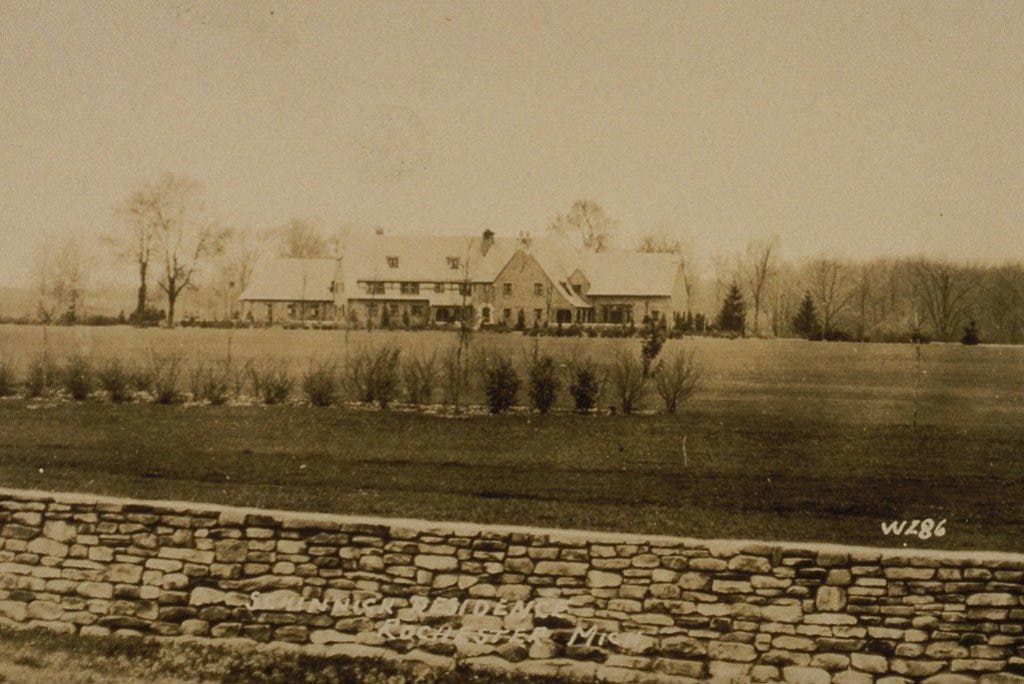

The Haven Sanitarium, a mental facility rumored to have treated the rich and famous, including Hollywood movie stars, once stood along Walton Boulevard near Old Perch on land now occupied by the Grosse Pines subdivision.
Once the opulent home of industrialist Fred M. Shinnick and his wife, Lillian Graham, The Haven became a working mental institution from 1933 to 1968. The structure stood for another five years before succumbing to deterioration and vandals and burning to the ground in 1973.
Here's the story of the rise and fall of the Haven.
Find out what's happening in Rochester-Rochester Hillsfor free with the latest updates from Patch.
The Shinnick family retreat
Shinnick built the lavish estate in the 1920s. As Deborah J. Larsen notes In Hometown Rochester: A History of Avon Township, Rochester and Rochester Hills, Michigan, Rochester was an attractive community for Detroit-area business leaders looking to build mansions and family retreats in the country.
“One of the first to be built was the home of Fred Marvin Shinnick,” wrote Larsen.
Find out what's happening in Rochester-Rochester Hillsfor free with the latest updates from Patch.
Shinnick served as secretary and treasurer of the Briggs Manufacturing Co., which was the world’s largest supplier of automobile bodies and other car parts at the time. According to the company’s website, Walter Briggs founded the company in 1908 and became so wealthy that he purchased the Detroit Tigers baseball team in 1935 and still owned the team when it won the 1945 World Series.
Shinnick also amassed a fortune and built his lavish home on 70-plus acres of farmland in 1926-27 and called it The Haven. Construction costs were estimated to be upward of $300,000.
According to the article “In Sickness and in Health: Rochester 1800s through 1900s” by Kathy Dziurman, published in Stories from our Lively Town by the Rochester Hills Museum at Van Hoosen Farm in 1998, the English Tudor-style home truly was a haven: It boasted 30 rooms, acres of landscaping, a lake, a caretaker’s house and other outbuildings. A stone gate and fence greeted visitors entering the estate.
Now a mental hospital
The Shinnick family lived in the home for a short time before announcing plans to convert the mansion into a mental hospital in 1932.
But why spend tremendous sums of money on such an extravagant home, only to convert it to a hospital five years later? As Larsen suggests on the
blog Remembering Rochester, the Great Depression may have had something to do with it. Huge homes such as The Haven were becoming too expensive to maintain and were often “converted to other uses” during those years of economic hardship.
For the next six years, the Shinnicks operated The Haven Sanitarium, which assisted patients dealing with alcoholism and mental illness, out of their home.
The April 6, 1945, edition of the Lake Orion Weekly Review noted in a segment titled, “Happenings of 10 Years Ago,” that “Capt. S. Brines of Detroit, father of Mrs. A.J. Huggett, has been at ‘The Haven,’ a private sanitorium (sic) operated by Mr. and Mrs. F. Shinnick in their beautiful home in Rochester, the past two weeks.”
According to Fred Shinnick’s obituary published in The Rochester Clarion on Nov. 4, 1965, he operated The Haven until he retired in 1938. His son, Graham, assumed management of the hospital, while “another son, Fred Shinnick, Jr., operates the new Avondale Nursing Center on Walton Blvd. where Mr. Shinnick died.”
As with most facilities like The Haven, area residents were occasionally unnerved by its presence in their community. Patient escapes, though rare, were announced in the local paper — which, as Larsen points out on Remembering Rochester, only served to “spook” residents, especially children.
Larsen points to one such account published in March 1938 in The Rochester Era, which reported that a patient had “escaped and fled across the fields.” The patient, who was also referred to as a “lunatic” and “prisoner” in the article, had apparently been handcuffed, as police “found the broken bonds” that the escapee had “cut with a hedge clipper in a garage back of the sanitorium (sic).”
Responding to a tip, police apprehended the patient on Woodward Street and, “believing him too dangerous to keep at the sanitorium,” sent him to Detroit Receiving Hospital.
The 'best friends' list
By the late 1940s, The Haven was gaining publicity for its youth program, called the Rochester Plan. The Haven partnered with the Rochester School District to assist local children dealing with what was then defined as mental illness. The resulting plan was hailed in newspapers across the Midwest, including Iowa’s Oelwein Daily Register in the article “Rochester Counsels Its Children” by Robert Goldman, published Feb. 22, 1949.
According to Goldman, the Rochester Plan was the brainchild of school Superintendent E. Dale Kennedy, who, having once worked with a teacher considered “neurotic,” promised himself to one day create a program that would help to treat the “maladjusted.”
Goldman noted that Kennedy met with Dr. M.L. Falick, the clinical director of The Haven Sanitarium, and received his support along with Dr. James Clark Moloney, who would “help set it up.” They also partnered with consulting psychologists Dr. Marie I. Rasey of Wayne State University, author of a child psychology and development book published in 1947, and Detroit psychologist Ben Rubenstein. Both received part-time pay.
“After an intensive selling campaign to the board of education, incredulous townspeople and inquisitive students,” Goldman reported, “Kennedy not long ago fulfilled his promise to himself. Psychological counseling was set up Oct. 8, 1946, for Rochester’s 1,400 school children, its staff of 52 teachers and interested parents.”
Components of the Rochester Plan included:
- Group and individual student treatment through art, shop or design work;
- Parent counseling programs with lectures on behavioral problems; and
- Lessons for teachers on how to detect “neurotic tendencies” in children.
According to the article, 80 mothers had attended the lectures; all 52 teachers had enrolled in the lessons; and “no Rochester parent has yet objected and said, ‘You can’t treat my child.’ ”
Goldman shared examples of the types of children and adults referred to the Rochester Plan. They included shy children and those with “smart-alecky attitudes,” bullies and even a parent on the verge of suicide for “mistreating” his child.
Children who didn’t seem to fit in with the “school crowd” were singled out for treatment based on a simple anonymous questionnaire all Rochester schoolchildren were required to answer. The students had to list two fellow students they considered best friends.
“The lists are carefully compared,” wrote Goldman. “Students whose names do not appear on any of the ‘best friends’ lists are interviewed and found to be in need of counseling.”
The creator of the best friends list, Goldman noted, was Rasey, one of the consulting psychologists.
The Rochester Plan was considered highly effective in that it “has improved scholarship and developed a healthy attitude on the part of parents toward mental health problems,” Goldman wrote.
The plan was also well-received throughout the state, as “at least 20 small cities in Michigan have requested information concerning the plan’s operation,” noted Goldman.
The end of The Haven
The Haven closed in 1968 because, as Dziurman noted, it failed to meet the fire marshal’s standards. The Haven was then sold to Dr. Harley Robinson, who “intended to use the site to build exclusive condominiums, however, the site was not zoned for such use.”
As a result, The Haven was abandoned and sat vacant for the next five years, serving as a desolate home to vagrants and an eerie hangout for teenagers until it burned down in 1973.
As for the decades-long rumors that The Haven Sanitarium treated some well-to-do patients, including Hollywood entertainers and members of prominent American families, the evidence to substantiate such information has yet to surface.