
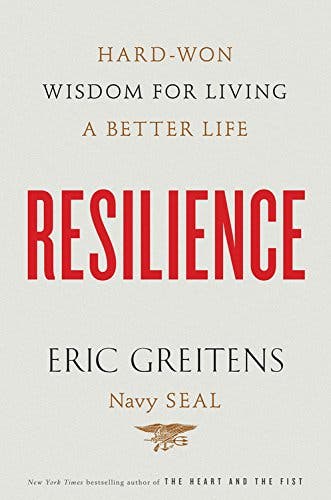
Review by B.W. Durham
“Resilience,” the new book by former Navy Seal and Rhodes Scholar Eric Greitens, is an inspiring guidebook for anyone who has confronted personal loss, harsh challenges in their own life, the death of a loved one or emotional pain.
That is to say… “Resilience” is a book for everyone.
Find out what's happening in Olivettefor free with the latest updates from Patch.
The sub-title of Greitens’ book is “Hard-Won Wisdom for Living a Better Life.” Indeed, “Resilience” offers earned wisdom and insights that can help people forge ahead in times of struggle, and become stronger.
But this is not a “how-to” book. It acknowledges serious traumas that can change peoples’ lives and sometimes nearly destroy them -- depression, addiction, mental disorders, loss of a loved one and debilitating loss of self confidence. The book is not clinical, but compassionate.
Find out what's happening in Olivettefor free with the latest updates from Patch.
Resilience is the quality enabling people to persevere though such hardships, Greitens explains. He cites many cases of how resilience helps people move through struggles and pain to establish new goals and purpose, and become better people.
You need not be depressed or struggling with emotional pain to benefit from this book. Every reader will gain from Greitens’ experience as a Rhodes Scholar at Oxford University; a Navy Seal who received nine decorations including the Purple Heart and Bronze Star; a humanitarian working in Rwanda, Cambodia, India and elsewhere, and founder of “The Mission Continues,” a non-profit that helps veterans find new purpose and meaning in life.
“Toughest of the Tough”
“Resilience” is based on Greitens’ letters to an old friend and fellow Navy Seal -- “one of the toughest of the tough” -- who suffered from Post-Traumatic Stress Disorder after his military discharge. Greitens’ comrade telephoned him to admit he was in deep trouble: He was into alcohol, and was dangerously depressed. Here is an excerpt from the first letter that Greitens wrote to him:
“Walker,
“You told me you cleared your house last week. You got up around 0300, grabbed a pistol, and went from room to room, closet to closet, crevice to crevice, checking… for what you weren’t sure.
“You’ve been doing that a couple of times a month. You’ve been waking up in puddles of sweat. It would be tempting – very tempting – to imagine that you’re just having bad dreams. It would be even more tempting to slap a medical diagnosis on what’s going on and let some doctor pump you full of pills.
“But you are my friend, and it’s not some nightmare memory of war that’s really the problem, and you know it.
“The problems at night may have a little to do with the past, but they have a lot more to do with what you are choosing to do in the present.
“You’re home now, and for the first time in your life, you don’t know what you’re aiming at…”
Greitens’ long letters to his friend are exquisite essays, each with a theme, that draw on his own experiences, commitments, motivations and knowledge as a human being, as well as those of philosophers, poets writers, humanitarians, warriors and world leaders.
When he quotes Earnest Hemingway, who wrote, “The world breaks every one and afterward many are strong at the broken places,” Greitens adds his own qualifier: “Not all of us are strong at the broken places. To be strong at the broken places is to be resilient. Being broken, by itself, does not make us better.”
“When people hear the word ‘resilience,’” Greitens writes, “they often think of ‘bouncing back’…Life’s reality is that we cannot bounce back. We cannot bounce back because we cannot go back in time to the people we used to be. The parent who loses a child never bounces back. The nineteen-year-old marine who sails for war is gone forever, even if he returns…You know there is no bouncing back. There is only moving through...In time, people find that great calamity met with great spirit can create great strength.”
“Moving through…” is a salient concept in Greitens’ viewpoint -- moving through with purpose to achieve meaningful goals.
“Resilience is distinct from mere survival, and more than mere endurance,” he writes to his friend Walker. “Resilience is often endurance with direction. Where are you headed? Why are you going there?”
“It’s not enough to want to be resilient…Philoctetes (a mythical Greek warrior) spent ten years marinating in his pain, believing he had no direction. How many years will you spend marinating in yours?”
In citing Aristotle, Seneca and Sophocles among other philosophers and dramatists, as well as Ralph Waldo Emerson, T.S. Eliot and more, Greitens, who earned a Ph.D. at Oxford, cites meaningful observations about Abraham Lincoln – who suffered from clinical depression much of his life.
Fueling the Fire
Quoting from the article “Lincoln’s Great Depression” by Joshua Wolf Shenk, Greitens writes: “Lincoln didn’t do great work because he solved the problem of his melancholy; the problem of his melancholy was all the more fuel for the fire of his great work.”
This outlook fuels Greitens’ assertions that “We can all build resilience in our lives.” In his letter-essays, he seems to advocate that personal struggles – even depression – can be an ingredient to “move through” personal struggles, disappointments and challenges to discover new ways of living and achieving. As he a told a reporter from “The Navy Times”:
“Resilience, quite simply, is the virtue that enables people to move through hardship and to become better. Everybody has to deal with pain in their lives, everybody has to deal with fear; people have to deal with suffering. But when you build resilience in your life, you find that confronting fear helps you to build courage. You move through pain and you become wiser, you move through suffering and you actually become stronger on the other side. That’s really what the virtue of resilience is about. And we can all build resilience in our lives.”
In the last letter to his friend Walker that ends the book, Greitens writes, “Not all of life is overcoming. Not all of life requires resilience….We should move through fear to courage. We should move through suffering to strength. We should move through pain to wisdom. But sometimes we don’t have to move at all. We simply have to be, and to practice the virtue of restful joy in a world that is not at rest.”
Those are comforting thoughts for anyone. More so than merely comforting, Greitens’ new book is enlightening, optimistic, educational and inspiring. It flows like a river of compassion and hope that anyone can appreciate.
Note:
In 2013 Time Magazine named Greitens one of the 100 most influential people in the world. In 2014 Fortune Magazine named Greitens one of the world’s 50 greatest leaders. The publisher Houghton Mifflin Harcourt launched “Resilience” in 2015. In September Greitens announced his candidacy as a Republican candidate for Missouri Governor in the 2016 elections.
***