Health & Fitness
Google's Founder Launches the Asteroid Rush
If Google's Larry Page is right, asteroid mining may turn billionaires into trillionaires.
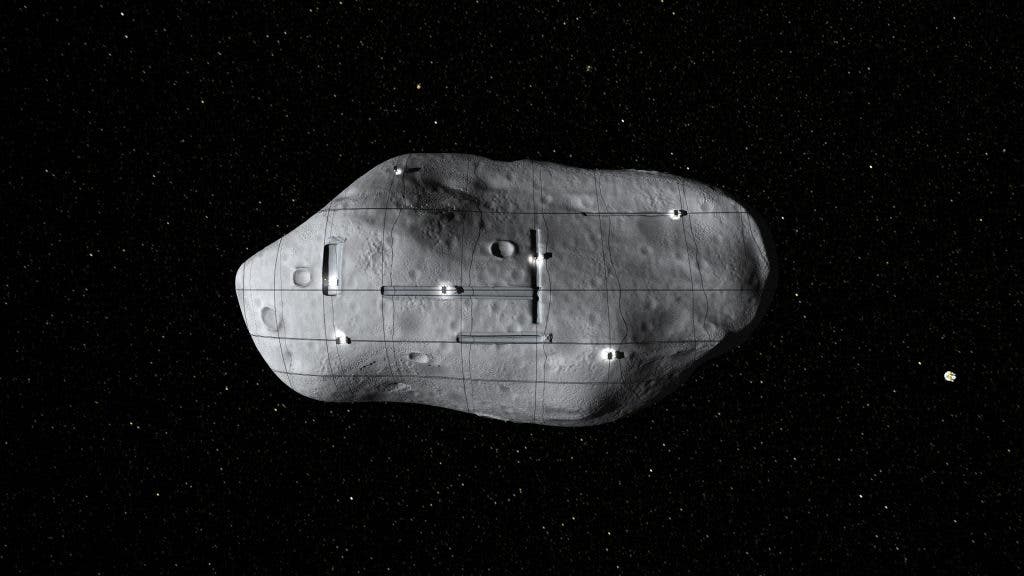


The governmental space races are over, and everyone lost. The US can no longer put a man into orbit. The Russian mafia can still just barely get a small tin can to a low-orbit space station on a 1960s chemical rocket, in a quaint traditional folk dance they have performed in ridiculous costumes since the 1970s. (US astronauts wear the same traditional costumes… real space suits would look more like this).
Japanese government robots can fly to asteroids and bring back samples, but have no idea why they are doing so. After 55 years, trillions of dollars (adjusted for today’s inflation, interest, and opportunity cost), and lots of hype, space remained just the emptiness that ICBMs will fly through on their way back to finish humanity’s perpetual Holy Wars.
Until last week. On April 24, Google founder Larry Page and other notable investors announced the founding of Planetary Resources (and they’re hiring, BTW). Based in Seattle, the company’s goal is actually to gather NON-planetary resources. So as is common with startups, the name makes no sense because it was probably written on a napkin. The idea of mining the asteroids, however, is quite reasonable. In fact, some level of asteroid-moving capability is necessary simply for self-defense. We have to get the asteroids before they get us.
Asteroids are not all in the “asteroid belt”, the low-rent area of the Solar System between Mars and Jupiter. The promised lands of the new Asteroid Rush are the Apollo-Amor asteroids, our nearest and most genocidal neighbors. Their orbits are similar to Earth’s, occasionally becoming too similar and hitting us with million-megaton explosions. (Barringer Crater in Arizona is from a mere megaton-range blast, many have been larger).
Find out what's happening in Bedfordfor free with the latest updates from Patch.
At least 1500 of these near-Earth asteroids are available for prospecting. From time to time one must be captured by the Earth’s L4 and L5 points and be just as close as the Moon. Right now no mountain-sized objects appear in the Lagrange points, so the grizzled pioneer is going to have to go a bit farther afield. However, in space it is energy that matters, not distance. It would take orders of magnitude less energy to move a mountain of platinum-laced nickel-iron back to Earth orbit than to mine the same metal on Earth. It also takes orders of magnitude less energy to process space ores, as nickel-iron asteroids are not the piles of rust or sulfates that come out of Earth’s strip mines. Metal asteroids are made of metal.
Thus the potential for making trillionaires out of our riffraff of billionaires. In a vacuum, a small nuclear-powered kick can move billions of tons millions of miles. The most direct method, suggested by Cox and Cole back in 1964, is to divert a few of our nuclear bombs from their sacred purpose of burning millions of children to death. Small nuclear bombs planted carefully so as to convert just the right amount of asteroid into reaction mass can move even quite large asteroids. More politically correct methods will also work, though they will be more boring.
Since 1964, a lot of rocket engineering has been done (and then scrapped and tossed into museums). In the 1960s and 1970s, NERVA engines were built that could have used water from carbonaceous asteroids. Gerard O’Neill at Princeton developed the concept of “mass drivers”, essentially a nuclear or solar-powered electromagnetic gun that could use rock or iron from solid asteroids as reaction mass. The key is to use the asteroid’s own materials to move it, instead of using the NASA paradigm of buying everything from Earth campaign contributors, er, contractors and never using local resources. In any case, moving asteroids isn’t “rocket science” any more, it’s just engineering.
Planetary Resources has the concept of bootstrapping with local resources solidly in mind. Its first investment will go into building small telescope satellites for asteroid surveys to map all the small near-Earth planetoids, then launch even smaller probes to check out individual asteroids up close. The plan is to target small, 100-ton class water-bearing asteroids first, to use for rocket fuel and space station supplies.
Find out what's happening in Bedfordfor free with the latest updates from Patch.
The mining survey would have the additional benefit of serving as an early-warning system to protect against impacts by “small” asteroids. Small asteroids can still pack a megaton punch, and if one happens to hit a nuclear power could touch off a nuclear war. India and Pakistan are used as examples of nations with inept early warning systems, but even the “superpowers” might panic at an early-morning blast. There are a lot of carbonaceous asteroids, and they are very black and hard to detect.
As experience with handling small asteroids grows, later projects will scale up. First million-ton, then billion-ton metal mountains will slowly spiral into high Earth orbit, to slowly be lowered down the gravity well by magnetic braking or other tortoise-paces method. Manageable-sized chunks will be carved into aerodynamic shapes to aerobrake off the last 17,000 miles per hour and land in… old strip mines, perhaps? Eventually most metal would come from space, and most of Earth’s mines would shut down as uneconomical and unprofitably violating downstream neighbor’s property rights.
If moving billion-ton rocks sounds alarming, remember that we’re talking about changes in speed of a few hundred miles per hour, and travel times of several months. This isn’t like drilling for oil, or fracking for gas, or dam or reactor failures, or any of our other existing industrial potential for instant disasters. Events in space are very slow and very visible, and any errors will be observable for many months. Assuming that some “Space Price-Anderson Act” is not used to dump the liability on taxpayers instead of Planetary Resources, we can be sure that the miners will have a lot of backup ships and safety crews.
Fortunately there are already competing space launch companies. Orbital Sciences, SpaceX, Stratolaunch, and others will provide competition as well as launch services for Planetary Resources. The total bankruptcy (and lack of space launch capability) of today’s major governments may well be a blessing in disguise, as they have less means to interfere with the market-driven development of space industry.
Long term, the most important effect of asteroid mining is not just that it will make our economy richer or even that it will clean up the Earth’s environment. The miners will bring private property rights into space, something that we haven’t even managed to do on the world’s oceans. Where property rights go, civilization will follow. Most of the iron of the asteroids and the He-3 of the gas giants will stay in space, to become the homesteads and wagons of the first of Earth’s children to leave the cradle. Humanity is growing up, and putting away childish things. The Asteroid Rush is on.
-Bill Walker