Business & Tech
Artist Stops in Lawrence While Biking Cross-Country
Emile B. Klein is spending the next five to seven years bicycling all 50 states to observe, interview and paint portraits of everyday Americans in exchange for room and board. He recently passed through Lawrence Township and spoke to Patch.
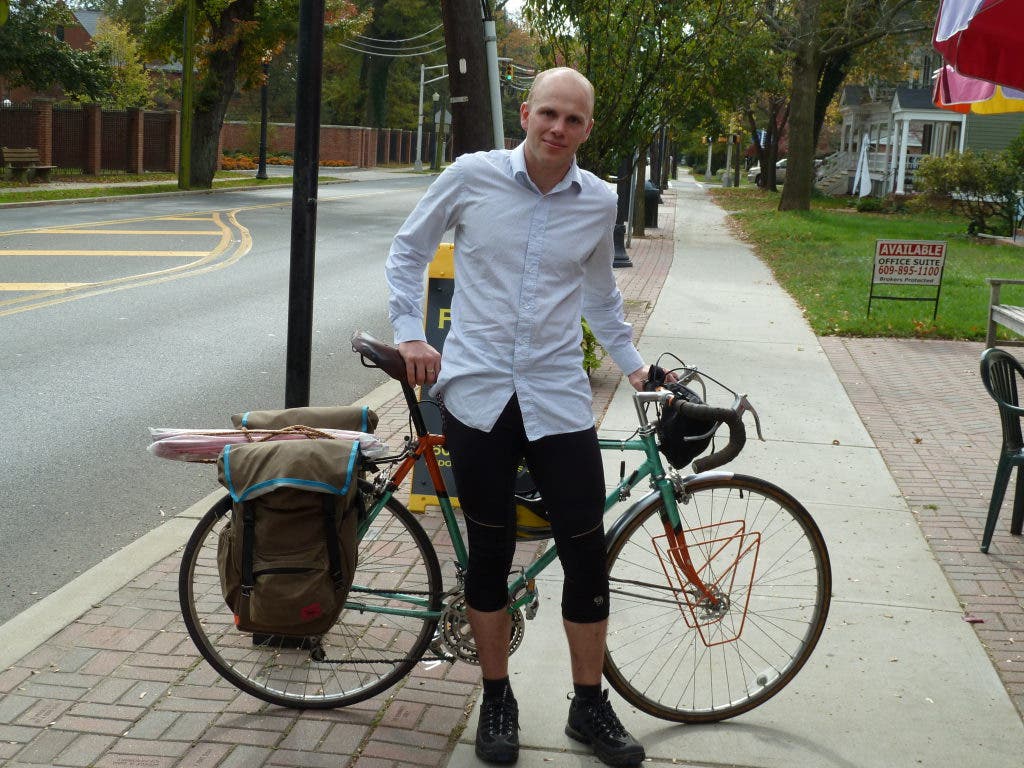


Artist Emile B. Klein found inspiration in Madrid.
The Berkeley, Calif., native who spent six years in Italy studying at the Angel Academy of Art in Florence, was copying a painting by Velazquez in the Spanish national gallery when it hit him: You can always tell an American in a crowd.
That epiphany led Klein to explore “what makes us American.” He had an “innate sense of wanting to know,” while also wanting "to get something of quality into the hands of everyday people … from billionaires to food stamp recipients.”
Find out what's happening in Lawrencevillefor free with the latest updates from Patch.
The “products they own are different, from their electricity, water, heating," he said. "Each is different based on one’s socio-economic standing. To give someone something of quality seemed necessary.” Klein observed the only companies that reach all socio-economic classes seem to be McDonalds and Coca-Cola.
Klein decided to ride his bicycle and get to know people–really know them. Do real outreach to get to know them on a personal level. He also wanted to create a traditional portrait of each person. He said portraits range in value between $4,000 and $250,000–which is out of reach for most people.
Find out what's happening in Lawrencevillefor free with the latest updates from Patch.
"I want people to see job creation is possible if they look at the local level, through trades. You can interact with a community in a way that has purpose. You’ll have a stable living because someone has a need for your service. Local job creation with interest in local needs. This solves the unemployment issue."
His goal is to paint seven portraits in each of state over the course of the next five to seven years. Last month, he passed through Lawrence Township.
Though he just started, he already has spent a night in a crack hotel and followed it the next night by staying in a mansion. It was this experience that made him learn to really appreciate life.
The Project
To launch the project, Klein looked for American craftsmen and sponsors.
“All of the people I choose to work with are all small U.S. businesses making something of high caliber. That was a conscious decision. I have a high interest in propelling forward the concept that there are craftspeople making products of high quality and prices that are accessible.” He wants to encourage job building in the United States through craftsman work and trades.
The project is called “You’re U.S.” (www.youreus.com). Though Klein rides by himself with his iPhone, he has amassed a team of writers, oral historians, three board members and many volunteers. In addition to staying with people and painting their portraits, Klein also compiles their oral histories. “You’re U.S.” is compiling these histories and creating a biography of his work along the way, interviewing many others and learning about their history as well. He is a very good listener.
The main fiscal sponsor of “You’re U.S.” is the New York Foundation for the Arts (www.NYFA.org). National Public Radio’s Snap Judgment program (www.snapjudgment.org) has worked with Klein to produce several of his encounters in order to reach a wider audience, hopefully as soon as January 2012, to allows sufficient time for editing.
Klein is enthusiastic about all of his sponsors. Sponsors include Eric Silver at Blue Ridge Oil Colors who supplies his high quality paints. Bilenky Bicycles in Philadelphia is currently creating a new bicycle frame for him. Klein describes them as the “top U.S. bicycle frame builder.” Swift Industries, located in Seattle, Washington, provided his panniers in order that he can carry a tent and other supplies with him as he cycles throughout the country.
The Ride
Klein said he lost 15 pounds his first week while cycling through Florida. He would cycle through towns without a grocery store, diner or café and the only places to buy food were gas stations, which do not sell fruit, vegetables, or anything healthy, only Slim Jims and the like. As a cyclist he knew he had to keep filling himself with healthy foods.
After riding for 40 miles, he found a Wal-Mart. Though he believes Wal-Mart has diminished job creation in the towns where they are located, he found that, in some areas, they are the only places that sell bike parts, food and fulfilled his needs. He gained an appreciation for them on that leg of the trip, but prefers buying local and supporting local economies whenever possible.
Though not a sponsor, Klein eats a lot of Luna Bars, which he highly recommends for fuel. On the road, he makes his own energy bars. “Eating healthy is incredibly important,” he says.
Living Local
Klein envisions a “Socrates-style town where everyone has a responsibility to make the town a functioning place. I want people to see job creation is possible if they look at the local level, through trades. You can interact with a community in a way that has purpose. You’ll have a stable living because someone has a need for your service. Local job creation with interest in local needs. This solves the unemployment issue. For example, shoe repair places are still around. There is still a need for tradespeople as a viable work source.”
It is an issue close to Klein’s heart. In addition to being an artist, cyclist, and advocate, Klein is a trained organic pastry chef. He said pastry chefs are the hardest working people he knows because they are constantly on their feet and working non-stop. It is this hard work ethic that carries him through this project.
Last month he was in Clinton, N.J., staying with a family with five children and a mother and father. Six years ago the family purchased a “haunted house.” Snap Judgment recently taped a program about the family.
“Two years later, the husband, the breadwinner, had cognitive loss as result of cancer. He then lost his job. His wife took two menial jobs to feed the family.” Klein continues to say “these are the types of people who are breaking the standard. They are living in a nice house in the wealthiest part of the state, yet they are on food stamps.” He describes them as being “counter to the general perception of what someone thinks about this area. People are not all living that situation.” What happens inside a family life, is not always how it looks from the outside.
“Being flexible is the very important,” Klein says. The schedule doesn’t always happen the way it is supposed to sometimes because the family is busy, or perhaps a snow storm or other related weather issue. In this case, he thought it would take about a week to create a portrait of the husband, but when we met, he thought it would take another week. He wants it done just right.
Portraits of Individuality
Klein’s goal is “to get to know people as individuals and to honor their individuality.” There is no monetary or political goal behind his project. He just wants “to show people in their best light and to create empathy.” Each of his portraits takes about 10-12 hours over five days. This includes time getting to know the subject and breaking down social barriers. He lives within their lifestyles to get to know them better.
While in our area, Klein “hopes to record many more oral histories and the communities have been assisting in making that happen.
After leaving Central Jersey, Klein is heading to South Jersey where he will meet with Flavia Canfield, a long-time political organizer in Vineland. After that he will stay in South Jersey and meet with Grant Harris, of the Harris Family Rodeo. Then with Albert Appel of the Appel Family Farm, as well as some of Appel Farm’s art students (http://www.appelfarm.org/). He is most interested in learning more about the art classes given at Appel Farm to underprivileged children.
Klein is seeking someone to paint in Camden, “perhaps a student at Appel Farm.” He has heard both the “sad things, and the people doing great things in Camden. I want someone from there to be heard and give a new perspective” about the city.
Klein is donating all of his interviews, both four which will lead to portraits, and at least three other audio interviews. He has also conducted many “spur of the moment” interviews, but not everyone was willing to have their stories recorded. He says “that’s understandable, it's personal.” Raw interviews will be given to the New Jersey Digital Highway (www.njdigitalhighway.org), “who may release them as soon as they like.” The NJ Digital Highway is the statewide repository for NJ cultural heritage organizations.
Linda Langschied, digital projects librarian for the Scholarly Communication Center at the Rutgers University Libraries, is excited about the possibilities. She said “Emile's New Jersey portraits, oral histories and biographies are intimate looks at our state's diverse citizenry, and the stuff of tomorrow's history. We are truly delighted and grateful for his generous contribution.
"Those who know of Emil's work will, of course, readily find his materials at youreus.com. NJDH extends that availability by placing Emile's artwork and corresponding materials in a somewhat surprising context - that of a portal that serves up NJ historical documents and images. I love that together we have interwoven our projects into each other's cultures of art and history, and and by doing so creating diverse pathways to Emile's truly awesome collection!”
Langschied said the NJDH’s “users tend to be historians, teachers, students, and just plain history buffs! It past practice is a good indicator, I think that the uses of the materials will be as varied as the users themselves. The NJDH collection does have a keen focus on our state's people: our inaugural collection focused on New Jersey immigrants. Emile's 'people-focus' will, I'm sure, resonate with our users.”
Opposites
As he was leaving Florida (the first stop on his travels) someone suggested he go to a certain town near St. Petersburg, FL. There he met a man who told him, “You want to hear my story, I’m a seven-year ex-con. We’ll do the interview tonight.”
Klein was very friendly and agreeed to do the interview. “It was an amazing and fantastic interview. After a while, he asks if I can do him a favor – he pulls a Western Union scam. I tell him, we’ll work it out in the morning.” The conversation continued to get heated. The two men were staying in a seedy hotel with adjoining rooms with paper-thin walls.
As luck would have it, along the way to Gibsonton he had met a cycling enthusiast. Klein texted him (he certainly couldn't talk to him with paper-thin walls). The man agreed to meet Klein and took him, and his bicycle, to his mansion where Klein proceeded to paint his portrait while getting to know him better. Fortunately, that part of the story had a happy ending.
The next state Klein plans to visit is Delaware. He is always on the lookout for people worth representing in the chapters of "You're U.S." He finds “local leads bring about the greatest results.” Klein’s travels can be followed on Facebook, Tumblr, and Twitter through the "You’re U.S." website at www.youreus.com. He posts pictures and stories on a daily basis.