Schools
Schools Superintendent Addresses Full-Day Kindergarten; Results of Language Arts Audit
Brian Osborne holds a Town Hall-style meeting for elementary school parents at Tuscan School.

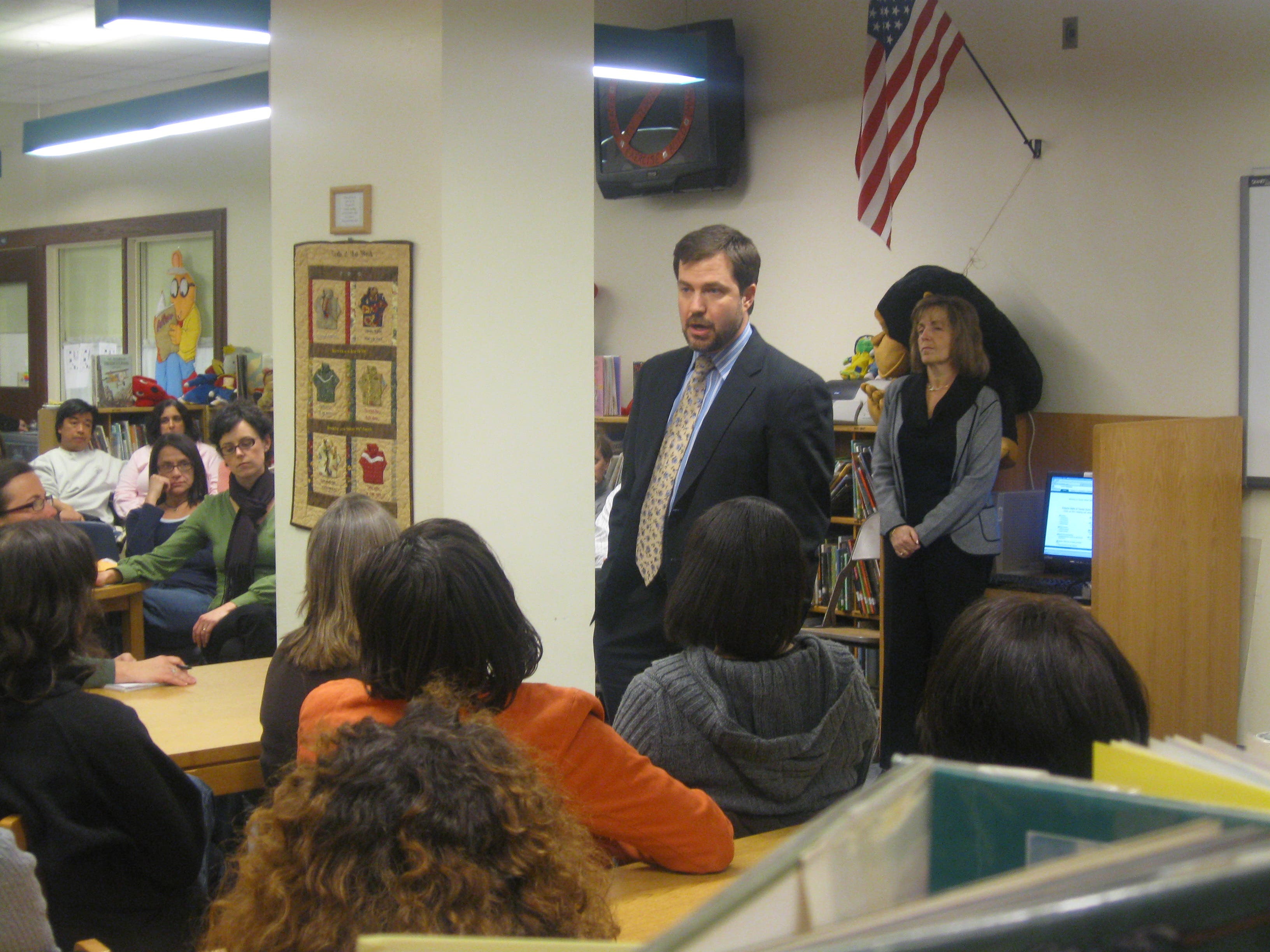
Osborne took questions for about 75 minutes and alluded several times to plans to confront the achievement gap—the phenomenon of minority and disadvantaged students underachieving academically.
According to Osborne, the district's plan for universal, full-day kindergarten has a direct correlation to bridging the achievement gap, since wealthier children whose parents can afford to send them to private school wouldn't be given a head start. The full-day kindergarten initiative began with three sections in the 2007-2008 school year and 17 this year. Next year, it will be universal for all 5-year-olds in the district.
Find out what's happening in Maplewoodfor free with the latest updates from Patch.
"To us, it was an equity issue," said Osborne, who mentioned that adding full-day kindergarten for income-eligible 3- and 4-year-olds is close to Gov. Corzine's heart, but the state's budget predicament won't allow him to pursue it. "We saw that in first grade, there were some pretty big inequities in readiness for school."
Despite the district's own budget crunch—and the Board of Education won't find out from the state until March 12 how much funding to expect—Osborne vowed to hire more elementary school teachers to maintain class sizes. Enrollment surged this year and is expected to go up again next year, and an unknown quantity is how many private school students will be enrolled due to the economic downturn.
Find out what's happening in Maplewoodfor free with the latest updates from Patch.
Several parents, including Maplewood author Marina Budhos, whose son attends Jefferson, brought up last year's language arts audit, expressing concern over the consistency of instruction classroom-to-classrom, and asked how the results of the audit were being utilized.
According to Osborne, the recommendations made by Phi Kappa Delta in its 186-page report have been accepted but will take time to implement. Three of the central items are inventorying materials used by teachers in the district to determine which should be part of a core curriculum; instituting standard assessments; and drawing upon local knowledge and expertise to develop curriculum guides.
For grades K-5 specifically, Osborne said there would be an emphasis on identifying core texts accompanied by leveled readers for students with different abilities. Another area of focus will be incorporating more non-fiction into the curriculum, since research shows that some students haven't developed the necessary skill set to process non-fiction when they reach middle school. "It has a lot to do with overuse of fiction to build literacy skills," said Osborne.
Get more local news delivered straight to your inbox. Sign up for free Patch newsletters and alerts.