Health & Fitness
Radiological Preparedness Needs More Funding for Molecular Biology Research, Better Outreach


This is the second of two blogs about Low-Level Radiation and preparedness. The first is at http://middletown-nj.patch.com/blogs/bill-simmonss-blog.
Having a consensus about the health effects of radiation doses below 10 rem is essential for an orderly recovery after a disaster. These decisions are what will affect the most people; it's what will let you back into your home. Given the uncertainty, should the cleanup standard for a terrorist attack be the same as for decommissioning a nuclear plant – no higher than 100 millirem? Or, like our latest Protective Action Guidelines, should it be as high as 2000 millirem (2 rem) in the first year?
Does a stringent standard that is intended to protect against a “taking” during normal nuclear industry operations become one when it bans your return home after a terrorist attack? According to James Conca, the debate becomes “not 'What are you willing to destroy your life over?' but 'What are you willing to destroy someone else’s life over?' You personally might decide to become a refugee over rad levels equivalent to living in Idaho, but do you have the right to make someone else do that?”
Find out what's happening in Middletownfor free with the latest updates from Patch.
Two months after the disaster at Fukushima, the Japanese split the difference and came up with two cleanup standards - one for homes and one for schools. You would think that the stronger standard would apply to where children spend the most time. But after a “growing outcry over health risks”, schools were required to remediate to 100 millirem, while the cleanup standard for homes remained twenty times higher, at 2000 millirem - without a backlash.
This abundant uncertainty is why the outreach to the public needs to get much better: in the minutes and hours after an emergency, before assumptions are made about releases, before instructions, you will be making your own call about what you and your family are going to do. A lesson from Fukushima in April of 2011:
Find out what's happening in Middletownfor free with the latest updates from Patch.
“We don't know the risks for an 'average' person, and we certainly don't know the risks for more radiation-sensitive populations such as children or individuals with genetically based radiation sensitivity. So the immediate logistic responses to the current situation in Japan are based on little more than educated guesswork.”
Investigating Low Dose Damage, Adaption, and Hypersensitivity at the Molecular Level
In 1990, the US Department of Energy began looking for novel research that could improve the link between low-level radiation and disease.
Four years after Chernobyl, it was still too difficult to design a study large enough to determine with certainty that low-level radiation was capable of causing cancer. Epidemiology had stalled – because of the different levels of natural background radiation; an average cancer rate of cancer of forty percent; environmental and lifestyle factors; difficulties determining dose in study and exposed populations; and the cost for the long-term followup of people who had been exposed to radiation.
By 1998 the Low Dose Radiation Research Program had been established, according to its departmental history. A major goal of the Low Dose Radiation Research Program was to use advances in modern molecular biology and instrumentation to answer the “single major question associated with the radiobiology of low dose exposures, 'Are there adverse health effects induced by low dose and dose-rate exposure to ionizing radiation as predicted by the Linear-No-Threshold hypothesis?'.”
The program focuses on radiation doses that are less than 10 rem since this is where most of the projected exposures to radiation will occur after attacks or accidents. These studies could clarify the effects of low dose radiation at the molecular level - damage, adaption, and hypersensitivity.
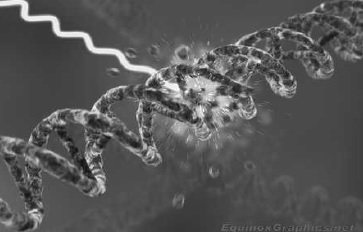
The research funded by the program looks at a biologically-based model of cancer risk to see if the damage and repair caused by radiation is unique. For example, radiation can split water molecules in the body and form free radicals that damage the DNA. But free radicals are also produced every day in our bodies and can lead to cancer, mutagenesis, cardiovascular diseases, and aging when their effects are not slowed or repaired by antioxidants.
Molecular biology research could also identify people who are more sensitive to radiation than assumed in the Reference Man, Woman, and Child models used for determining radiation standards, so that future therapies and policies could be tailored to the individual.
The program is also investigating biomarkers, such as changes in gene expression, that can rapidly measure biological changes to determine individual exposure when monitoring masses of people after an accident or attack.
Change is slow. By 2006, the Committee on the Biological Effects of lonizing Radiation (BEIR VII) of the National Research Council was still unequivocally recommending the use of the LNT model. But in 2011, an EPA report noted “novel low-dose phenomena that could modulate the dose-response relationship at low doses.” While the EPA also continued its strong support for the LNT model, it acknowledged that “new research might conceivably lead to revisions in the future.”
Currently about 40% of the program funds support research projects, but this is the only one in the the US that is funding research about the risks from low-dose radiation, and it faces heavy budget cuts.
The use of molecular biology to gain a better understanding of how tissues respond to very low doses of ionizing radiation is well under way, according to Dr. Roger Howell of the Rutgers NJ Medical School. However, only a few select laboratories can conduct experiments in the very low dose range with confidence.
“Performing measurements at low doses is critically relevant because radiation exposures associated with human activity are almost always very low dose”, according a DOE webpage.to the Low Dose Radiation Research Program webpage. Sustaining the funding for this research will pay off in more rational decision-making during a disaster. As Dr. Brenner concludes:
“If we want to make rational decisions in responding to nuclear accidents or radiological terrorist events, or make rational policy decisions about the future of nuclear power, not to mention the rapid increase in medical imaging such as computed tomography (CT) scans, or even the new airport X-ray scanners, we must redouble our efforts to understand the health risks of low doses of radiation.”
Two legislative changes that could lead to mandatory, widespread planning are discussed at “One Year After Sandy, Two Wishes”.