Home & Garden
Where Is Mary Lee Today? 3,400-Pound Great White's Twitter Following Grows As She Moves
What are the chances she'd attack? Lower than you think, shark experts say, despite fears that date back to the 1916 attacks in New Jersey.


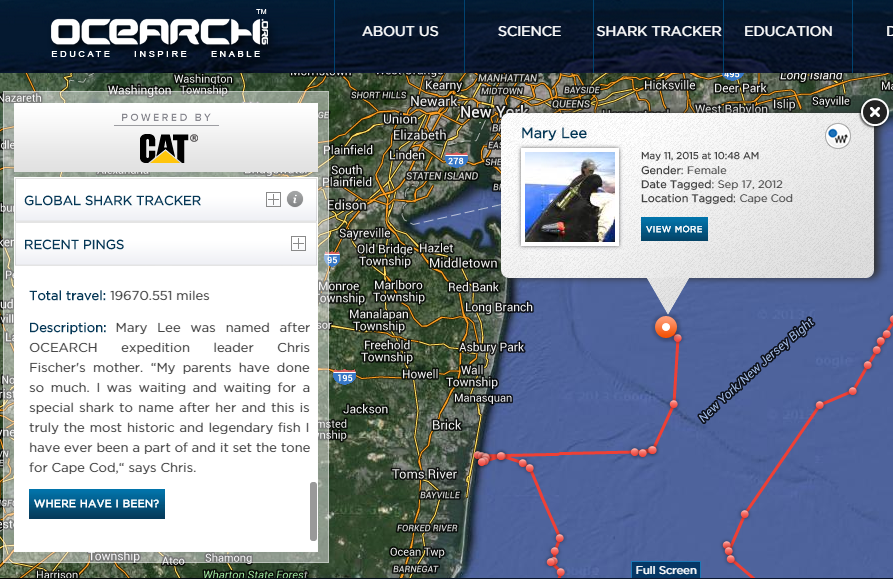
Mary Lee, the 3,400-pound great white shark with the satellite tag who has turned into a Twitter sensation, has moved well offshore as of Monday morning, much to the relief of beachgoers.
The great white, tagged in September 2012 by the OCEARCH research organization, has been causing quite a stir on her migration north, with a Twitter account that tweets her latest pings and engages in ”conversation” with followers. The account had nearly doubled its following by Monday morning, from nearly 16,000 on Friday to more than 31,000 as of Monday morning.
The account isn’t followed only by seaside folks; Twitter users from the Midwest have tweeted @MaryLeeShark asking questions such as “@MaryLeeShark hey Mary it seems like you have tons of endurance any chance of you swinging over to Cleveland Ohio for the marathon Sunday?”
Find out what's happening in Toms Riverfor free with the latest updates from Patch.
While many people have followed the shark with a sense of wonder, her presence -- particularly Sunday when she came as close as about 2 miles from the beach in the North Dover Beaches section of Toms River before moving due east and then northeast; as of 10:48 a.m., her last satellite ping, she was about 25 miles due east of Long Branch -- has made some nervous.
>> RELATED: 3,400-Pound Great White Shark Gets Closer: 2 Miles Off New Jersey
Find out what's happening in Toms Riverfor free with the latest updates from Patch.
That’s due in part to the ”Jaws” effect: the 1974 Steven Spielberg movie about an enormous great white attacking and killing beachgoers in a sleepy Long Island town. The film drew its inspiration from a series of shark attacks in New Jersey in July 1916, where four people, including an 11-year-old boy, were killed. A fifth person was injured but survived. (Peter Benchley, author of the 1974 novel ”Jaws” that was the basis for the film, in 2001 told the New York Times that the 1916 attacks did not inspire the book.)
While the longstanding belief has been that a great white was responsible for all five attacks, shark researchers at the ReefQuest Centre for Shark Research have more recently come to the conclusion that the attacks were likely the work of as many as three sharks, and none necessarily by a great white. That is in part because three of the attacks were in Matawan Creek -- an area of brackish water, which great whites have not been found to inhabit. Those three attacks more likely were the work of a bull shark or a tiger shark, according to the ReefQuest researchers. (The other two attacks were along the ocean beachfront -- in Beach Haven and in Spring Lake, according to a Smithsonian Magazine article from 2012 looking at the 1916 shark attacks.)
Bull sharks are very common in New Jersey waters, according to ReefQuest, and often do swim into brackish water. Tiger sharks are less common in New Jersey waters but also have been known to swim into rivermouths in North Carolina, the report says. Both also are very aggressive species, the researchers said.
“In the final analysis, it seems highly unlikely that a single shark perpetrated all the attacks blamed on the New Jersey Man-Eater. Whether the attacking sharks included a Bull, Tiger or White Shark cannot be concluded at this time, and may well remain forever open to speculation and debate,” the ReefQuest article said.
Shark attacks in New Jersey are rare. The website Shark Attack File maintains a list of shark attacks worldwide going back as far as Colonial times, with information on dates, injuries and fatailities. The bulk of the shark attacks in the United States occur on the coast of California, where there have been 259 attacks, with 27 fatalities, in more than 100 years. In New Jersey, there have been 46 attacks with eight fatalities, according to the site.
Scientists say unprovoked shark attacks are rare and that chances are the sharks have confused humans with seals, a favorite meal. National Geographic published the following statistics on shark attacks:
- You have a 1 in 63 chance of dying from the flu and a 1 in 3,700,000 chance of being killed by a shark during your lifetime.
- Over 17,000 people die from falls each year. That’s a 1 in 218 chance over your lifetime, compared to a 1 in 3,700,000 chance of being killed by a shark.
- In 1996, toilets injured 43,000 Americans a year. Sharks injured 13.
- 1n 1996, buckets and pails injured almost 11,000 Americans. Sharks injured 13.
- In 1996, 2600 Americans were injured by room fresheners. Sharks injured 13.
- The US averages just 19 shark attacks each year and one shark-attack fatality every two years. Meanwhile, in the coastal U.S. states alone, lightning strikes and kills more than 37 people each year.
- Only 5 people die from shark attacks yearly, while millions of people die from starvation.
So what is driving Mary Lee’s movements? More than likely she is following food right now -- and bluefish, which fishermen will tell you is a prime shark bait -- are plentiful. Striped bass also are in the area, according to the Fisherman magazine, so she could be following stripers.
Either way, chances are she’s not interested in humans.
If you want to follow Mary Lee or any of the apex predators OCEARCH has tagged around the world, visit the Shark Tracker page here.
Get more local news delivered straight to your inbox. Sign up for free Patch newsletters and alerts.