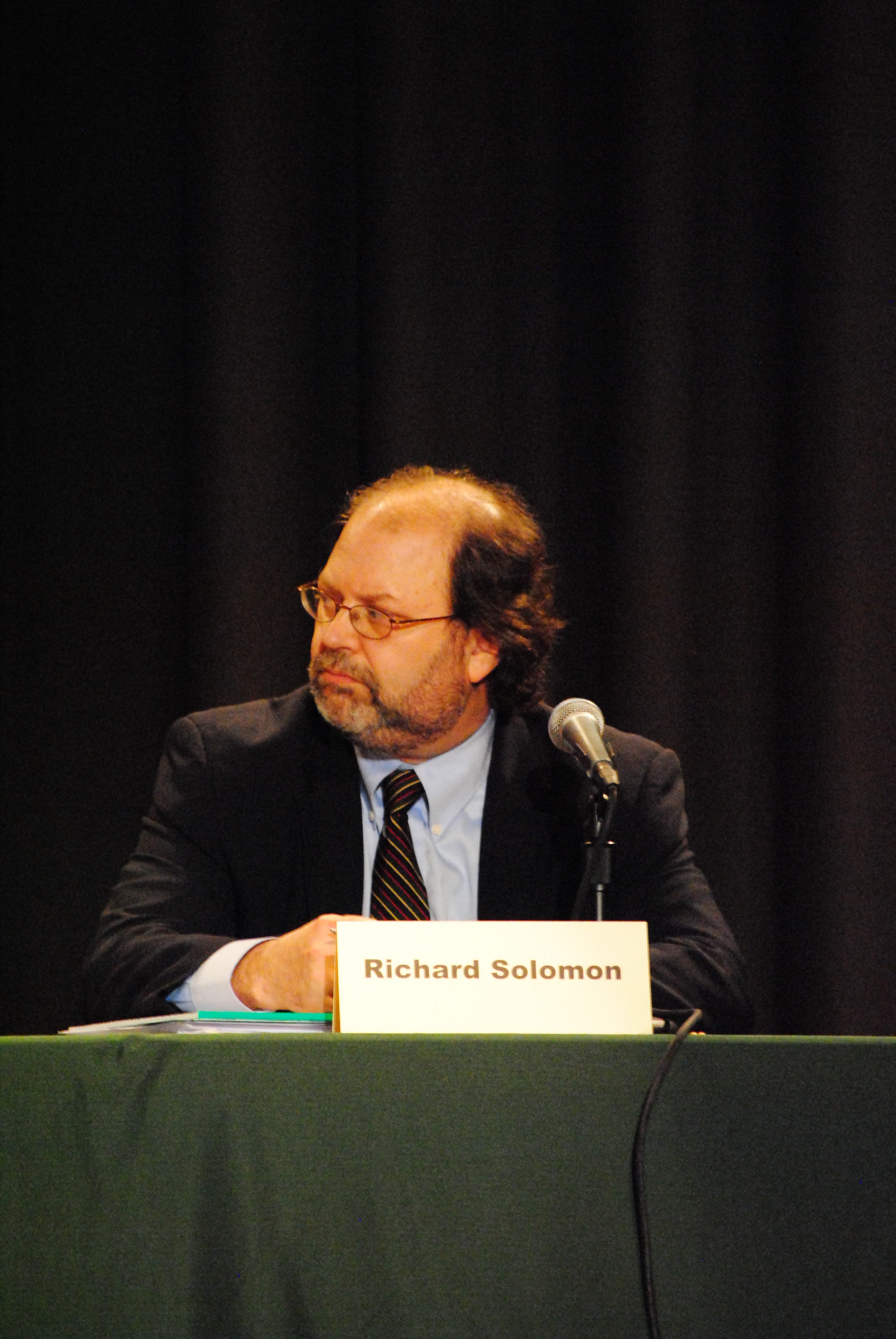
Name: Richard Solomon
Age: 54
Address: 728 Embree Crescent
Find out what's happening in Westfieldfor free with the latest updates from Patch.
Length of Time in Town: 22 years
Family Life: Married to Amy Seid for 23 years. Two Sons Josh (18) and David (15)
Find out what's happening in Westfieldfor free with the latest updates from Patch.
Education:
Union College, Schenectady, NY
Bachelor of Science, Psychology and Political Science, 1977
Professional Life:
-
- Director of Production Management and Ed Sullivan Theater Operations, CBS Broadcasting, Inc.
- Employed at CBS since 1981.
- 2 Emmy Awards.
Community/Political Activities:
-
- Member, Board of Education since 2001.
- Member, Cable Television Advisory Board 1999 – 2001.
Contact Information:
email: rfsolomon@comcast.net
home phone: 908-654-0411.
- What do you think are the three biggest issues facing the Westfield public schools in this election?
- Recovering from the $4.3M cut in state aid imposed on our district by Governor Christie, and its impact on the budget
- Please explain your positions on these issues? (Please keep your answers to 175 words per issue)
There really is only one significant issue facing the Westfield public schools in this election. Everything else flows from it. The fact that Governor Christie has chosen to solve a statewide budgetary problem decades in the making by withholding almost all the state aid that goes to school districts like Westfield presents us with extreme challenges and difficult choices this year and going forward. Every year it is a challenge to craft and pass a budget that reflects the values the Westfield community places on the schools. This year is a game changer. Governor Christie's state aid decision makes it impossible to continue to provide what this community values in our schools. Class sizes will rise, elective choices at the high school will be reduced, extra- and co-curricular activities will be reduced. Since our base budget will go down, and the state will undoubtedly further restrict how much we can raise the budget going forward, it will be impossible to rebuild what we lose. All this makes it that much more critical that we find alternative sources of revenue, as well as adopt strategies that are not only cost effective in the short term, but in the long term as well.
- What is your position on Gov. Chris Christie's proposed constitutional amendment to implement a 2.5% cap on property tax increases? What impact would this impact have on the Westfield public schools? (Please keep your answer to 300 words)
My understanding is that if school districts stay within the 2.5% cap, then they do not have to have their budgets voted on, but that they can raise property taxes above the 2.5% cap by seeking voter approval in a referendum the way we do now. It is good that the Governor realizes not only that there may be instances when a school district would need to raise property taxes above the cap, but that local communities should be able to make that determination for themselves. If this constitutional amendment is adopted, the conversation in Westfield will be much the same as it always has been. What do we value, and how much are we willing to pay for it? The answer to those questions will determine whether or not to propose to the public to exceed the 2.5% cap.
It all comes down to the value we place on things like class size, variety of course offerings, extra- and co-curricular activities, etc, which we have been told over and over are very important to our community. The state uses terms like "a thorough and efficient education" to define what a school system should provide. In my mind a thorough and efficient education should be the absolute minimum of what to provide. Obviously whatever we do should be done as efficiently as possible, but many of the things that define the Westfield public schools, and that our community wants and expects of our schools, go beyond the "thorough and efficient" standard. For example many of the fine arts and athletics programs in our schools, the number of AP and honors classes, elementary foreign language, etc. exceeds the thorough and efficient standard, but our community places a high value on them. As a result we may end up asking the public, in a referendum, to approve a property tax increase that exceeds a 2.5% cap.
- What is your position on the recently ratified contract with the Westfield Education Association? (Please keep your answer to 300 words)
The recently ratified contract with the WEA includes several components that must be taken together to determine (a) the total net salary increase each teacher will receive and (b) the total cost to the district.
The teachers will each receive a 3.9% increase in pay. But they will be giving back to the district an average of about .6% that will be applied to the health insurance premium. In addition, the Governor signed into law a bill that requires each public employee, whose current contract expires on June 30, 2010 or later to contribute an additional 1.5% of their salary toward the health insurance premium. Taken together these two give-backs result in a net salary increase of 1.8% per year in each of the next 3 years.
The 2.1% we are taking back from the teachers will be used to pay a portion of the health insurance premiums, thereby lowering district costs.
In addition, the teachers agreed to eliminate the traditional indemnity insurance plan which is hugely expensive. They agreed to increased co-pays for office visits and brand name, generic and mail order prescription drugs.
These concessions saved over $1M compared with what the costs would have been next year if we had not ratified this contract. The total cost to the district is almost flat next year compared with this year's budget. Perhaps more importantly, the concessions we negotiated put us in a much better financial position in future years.
- How do you propose the Westfield public schools face the increased enrollment projections at the same time as decreasing revenues from state aid and potential caps on property tax increases? (Please keep your answer to 300 words)
Unfortunately our options are limited. The simplest answer is that it may be necessary to allow class sizes to increase at all grade levels. We may have no choice but to cut back on the number of electives offered at the high school or extra- and co-curricular activities at the high school and intermediate schools.
And we will always be looking for other ways to do things including seeking volunteers from the community and staff to continue to provide services without paying for them, reorganizing departments where it makes sense to do so, and seeking contributions to help defray the cost of programs we value.
- What skills do you bring to this position? (Please keep your answer to 250 words)
When I fist joined the Board in 2001, I was convinced that my experience as a manager of over 100 people, some of whom are members of five different unions, and with responsibility for a $15M annual budget, gave me the knowledge and expertise to help improve the Board of Education. What I quickly learned is that private sector experience isn't particularly relevant to a Board of Education.
However, over the past 9 years, having been a member of the Finance, Facilities, Policy and Long Range Planning Committees, I have learned the intricacies of an organization as complex as a school district with 6200 students in grade K-12, 800 total employees, 540 teachers, 10 schools and acres of land. If my professional experience has given me anything it is my ability to process the details while not losing sight of the bigger picture. I understand that the success of our schools, which is measured by how well we prepare each of our students for whatever they choose to do when they graduate, is based upon multiple, inter-related factors. The quality of the teaching staff is crucial, as is parent involvement and community support for the schools.
- Why are you running for the Board of Education? (Please keep your answer to 250 words)
I feel very strongly that public education is the most important thing a community or a society can do. Making sure that each child has the tools to become positive, productive members of society, and to succeed at whatever they choose to do is critical. In a very real sense our future depends upon it. I believe I have the knowledge, skills and perspective to help the Westfield school system continue to provide a first rate education.
- How do you intend on balancing the responsibilities of elected office with your personal and professional obligations? (Please keep your answer to 250 words)
This has been the most challenging aspect of my board membership over the past nine years. Sometimes I have three meetings per week. Often I go directly from the train or bus to a meeting. Sometimes I get home after everyone is asleep. Thankfully my family is very supportive of my involvement on the Board. At the beginning, when our children were younger and more dependent on us for help with homework, or getting from one place to another, it was a clearly a burden for my wife, Amy. Also thankfully, my job has somewhat normal business hours and does not require a lot of travel so I am generally available as needed.
- Are the Westfield public schools better off than where they were three years ago?
Not including what happened this year, over the past several years we have seen state aid remain flat. What that means is that since our budget has continued to go up, the share of our budget covered by state aid has gone down. In order to maintain the core of our program, we have had to cut back in areas that have as minimal a direct impact on students as possible. It means that our administration is very thin and struggles to cope with an increasingly challenging set of circumstances. It means that we have had to make choices not based upon providing the best educational opportunity for our students, but based upon which class or program has smaller participation rates and therefore can be cut.
We have had to reduce our fund balance to under 2% of our overall operating budget, which puts us at risk if a major system (boiler, roof, etc.) in one of our schools fails. And since we have traditionally used fund balance to reduce property tax increases the following year, the reduced fund balance means we have less money to contribute.
So far we've been able to prevent these kinds of things from having much of a negative impact on our mission, which is a testament to the professionalism and expertise of the entire staff. There is no question that the Westfield public schools are not better off than where they were three years ago. Next year, with the virtual elimination of the rest of our state aid the situation will only get worse. In addition, if the budget fails on April 20, and the Town Council decides to make further cuts to the budget, it will be very difficult to recover. The question is not so much are we better off now than we were three years ago, but in three years will we be in worse shape than we are now. If the funding trend continues, I'm afraid the answer will be yes.
Editor's Note: These questions were provided to all four candidates for the Board of Education and these answers are in their own words. Space limits were provided on each question. Editing was done for grammar and style but not substance. These questions and answers are provided to allow you the voter to hear directly from the candidates on the key issues impacting the public schools.
Get more local news delivered straight to your inbox. Sign up for free Patch newsletters and alerts.