Arts & Entertainment
Out of this World! Astronauts Touch Down in Brooklyn
Charles Camarda, Lee Morin and Paolo Nespoli—graduates of NYU and NYU Poly—discuss the future of space exploration

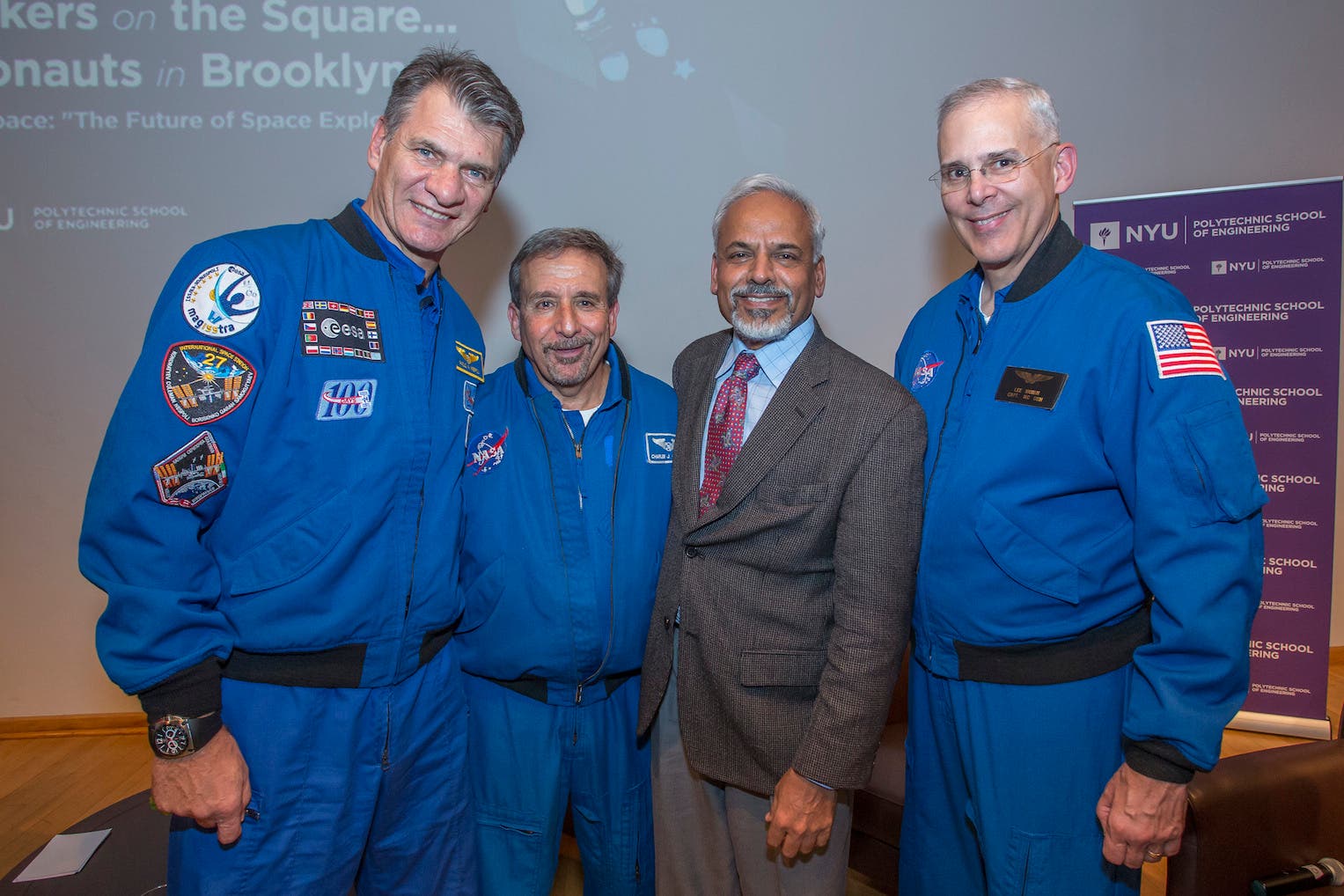
In an out of this world event held Thursday night in Downtown Brooklyn, three former astronauts presented their views of the future of space exploration, all the more impressive due to their extensive experience with the subject.
In front of a star-struck audience of NYU Poly alumni, Charles Camarda (POLY ‘74), Lee Morin (GSAS ‘78, MED ‘81, ‘82), and Paolo Nespoli (POLY ‘88, ‘89) participated in the NYU Alumni Speakers on the Square series on the topic of “The Future of Space Exploration.”
With their indigo suits and ramrod straight demeanor, Camarda, Morin and Nespoli—the only three NYU alums to ever travel to outer space—entertained a packed house at NYU Polytechnic’s Pfizer Auditorium with light-hearted banter about their careers and dreams.
Find out what's happening in Fort Greene-Clinton Hillfor free with the latest updates from Patch.
“Mission Control doesn’t send you into space to have fun,” deadpanned Nespoli when asked about the craziest thing he’s done during his missions. “By the way, just being in space is crazy.”
When quizzed by moderator Nicholas G. Mitchell about the next big leap in outer space exploration, Camarda—who was inspired to become an astronaut by the Apollo lunar missions—spoke about the power of great challenges to inspire new generations, saying “the more difficult the problem, the more you capture kids’ imaginations.”
Find out what's happening in Fort Greene-Clinton Hillfor free with the latest updates from Patch.
Morin spoke at length about an automated program he’s dreamed of: unmanned missions to the Moon that utilize robots remotely controlled from earth to construct a robust, inhabitable environment. His Rocks to Robots: Concepts for Initial Robotic Lunar Resource Development project would leverage machines to “build stuff that helps you make more stuff.”
All agreed that the International Space Station, now entering it’s 17th year of operation, was a tremendous success. Not only because it provides a stable environment for space exploration, but—with 14 nations participating—the station is a leading example of the power of international cooperation. Morin detailed how Orion, NASA’s next exploration spacecraft, was designed in collaboration with the European Space Agency.
When the subject of commercialized space travel was brought up, all three were supportive.
“I fully believe in space tourism,” said Nespoli, an astronaut for the Italian Space Agency. “It’s such a pleasure to discover this new environment, I think people would want to experience that.”
“To see the earth passing below you at 4 miles per second is such an amazing discovery – you need to step back.”
Camarda, who was a crew member on the first return-to-flight mission of the Space Shuttle following the Columbia disaster, argued that in order to prove that space travel is viable, companies need to be able to make a profit.
“Commercialization helps to test our own assumptions,” he said.
When asked what they plan to do now that they are finished with outer space explorations, Camarda spoke again about the impact of great challenges to inspire. He plans to create a ”virtual skunkworks” for education by linking up experts around the world with students to accomplish “incredible things.”
Nespoli, who during the event was presented with a Polytechnic Distinguished Alumni Award, said that: ”The problem with going into space, you have to come up with something else and it’s hard to top.”
PHOTO CAPTION: Paolo Nespoli, Charles Camarda, NYU Poly Dean of Engineering Katepalli Sreenivasan and Lee Morin
PHOTO CREDIT: NYU: George Argento