Community Corner
Larchmont-Mamaroneck Local Summit Discusses Substance Abuse
MHS's rate of alcohol use in the 10th and 12th grades is above both the County and national averages, according to a recent survey.


By Nina Recio Cuddy
Rarely a week goes by without a story in the local or regional press about the alarming increase in the availability and use of drugs and controlled substances across Westchester County, particularly among young people. Two questions on the minds of local residents are “what does the problem look like in our community?” and “how can we address it?”
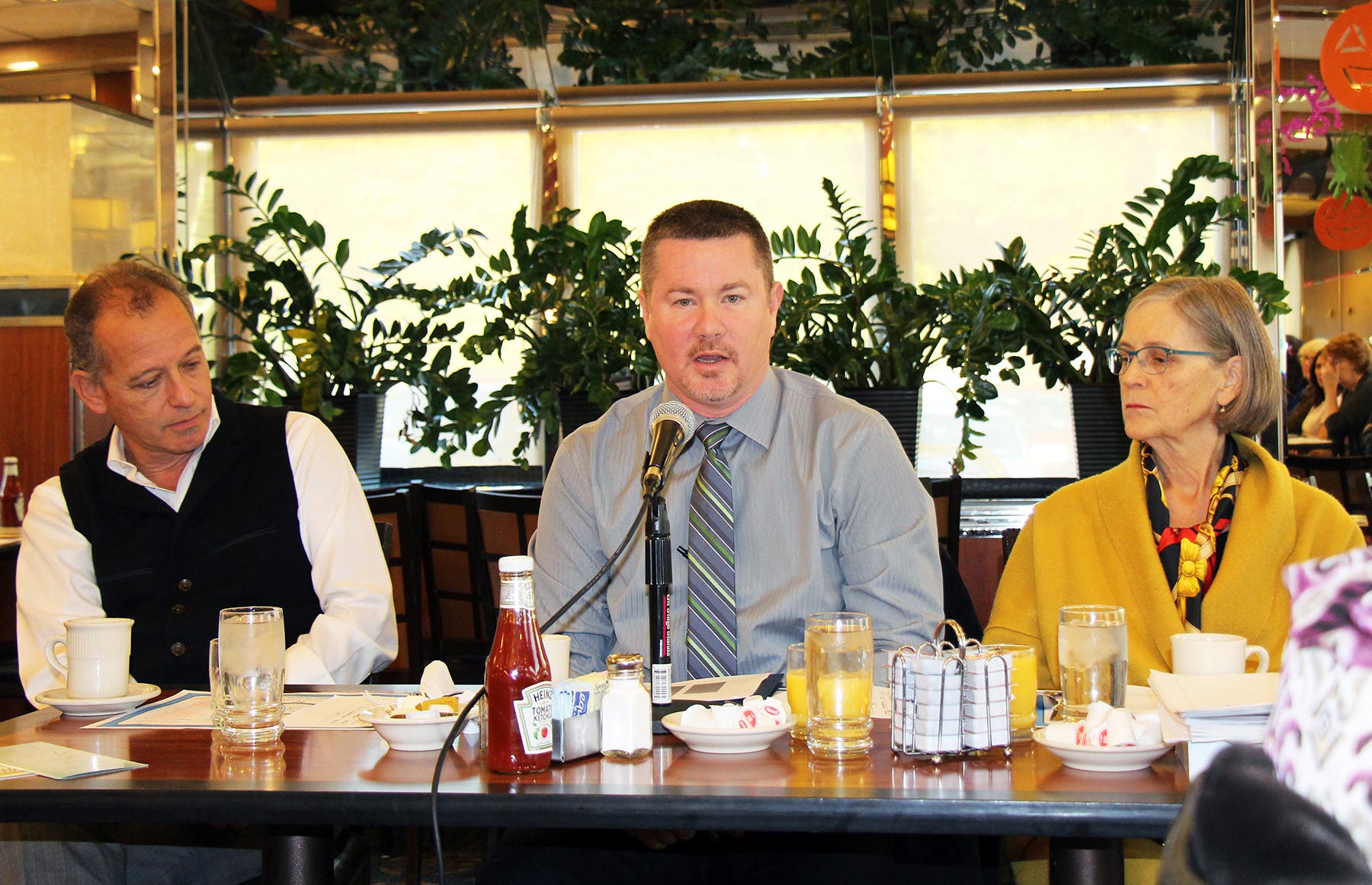
With the goal of shedding light on these concerns, the Local Summit invited three professionals from the area, with extensive but different backgrounds on this issue, to address the community at its October 20 breakfast discussion at the Nautilus Diner. The panel was comprised of William Hayes, Executive Director of the Westchester Intelligence Center of the District Attorney’s Office; Janet Buchbinder, President of RADAR; and Dr. Alan Dienstag, Clinical Director of the Community Counseling Center in Mamaroneck. The result was a presentation that provided both some good news, but also words of caution.
Find out what's happening in Larchmont-Mamaroneckfor free with the latest updates from Patch.
Addressing the use of drugs in our local schools, panelist Janet Buchbinder, the president of RADAR, a 501(c)(3) non-profit organization, explained how RADAR collects data about student drug use and behavior by conducting student surveys every two years at Mamaroneck High School (MHS) and Hommocks Middle School. RADAR has been conducting surveys since 2006. According to Buchbinder, who shared highlights from the most recent survey, the overall trend in the Mamaroneck school district is an improving one.
RADAR’s surveys, Buchbinder explained, are a respected tool for data gathering and utilize the risk and protective factor model approach. The CTC (Communities that Care) teen surveys that RADAR uses were generated by the Center for Substance Abuse Prevention in the federal government’s Office of Substance Abuse and Mental Health Services. Buchbinder stated that the next survey would be conducted in 2016.
Find out what's happening in Larchmont-Mamaroneckfor free with the latest updates from Patch.
Risk factors are those that increase the likelihood a student might engage in the use of drugs or alcohol. An example of such a risk factor is poor parental supervision. Conversely, protective factors are elements in a student’s life that would buffer and/or discourage him or her from becoming involved in drug or alcohol abuse. This would include, for instance, family attachment or school opportunities for pro-social involvement. In our school district, risk factors have been diminishing over time and protective factors have been increasing in the district. Buchbinder noted that the one protective factor that has gone down is religiosity, indicating less attendance by students at religious services.
However, there was also mixed news in the most recent survey concerning alcohol use in the schools. Buchbinder explained to the audience that alcohol remains “the top drug of choice for local teens.” She reported, however, that the good news is that there has been a steady decline in alcohol use rate in 8th grade, showing a delay in the onset of use of alcohol. This, she said, is a positive development because the later the initial use of alcohol by a student, the less the likelihood of developing an abuse problem.
On the other hand, Buchbinder warned “use rates tend to go up by grade level from 6th grade up to 12th.” In fact, the survey showed that the alcohol use rates doubled from 8th to 9th grade and also doubled from 9th to 10th grade. Buchbinder says we need to investigate what are the high-risk transitions and changes in play for those grades and to identify problematic situations.
Another area of concern, reported Buchbinder, is the comparative use rates of alcohol among Mamaroneck High students. The use rate is measured by how many times alcohol was consumed in the last 30 days. The survey results show that the MHS rate of alcohol use in the 10th and 12th grades is above both the County and national averages. For example, Buchbinder told the audience that in 2014, the 12th grade national average use rate was 37.4% and the County rate was 49.4%. MHS had a rate of 74.5%. However, binge drinking (defined as 5+ drinks in a row in one sitting) reduced in MHS from 44.9% in 2006 to 27.9% in 2014.
If a family is facing an alcohol or drug abuse problem, the community is fortunate to be able to turn to the Larchmont-Mamaroneck Community Counseling Center for help. The Center, which was established about 35 years ago, is a public not-for-profit organization that provides services to the local community without regard to a person’s ability to pay and is subsidized by state and local governments as well as the school district. According to the Center’s Director, Alan Dienstag, the Center “focuses on the needs of adolescents, young people and their families” and is set up to “provide a resource for the prevention of drug and alcohol problems in this community”. In Dienstag’s words, it is “very rare to find an organization that provides this particular service solely for its community.”
Dienstag explained that the Center’s focus is on prevention. In this regard, there are three areas of concern: primary care, which is designed to keep a problem from developing; secondary care, which is relapse prevention, and; tertiary care, which addresses the ancillary problems in a family that accompany an alcohol or drug problem.
The Center works with students in the 6th through 8th grades, providing a prevention curriculum in the school including “life skills training” and “advocacy training,” all aimed at increasing the “protective factors” and reducing the “risk factors,” as described by Buchbinder in her presentation. In addition, individual and family counseling is provided at the Center.
The Center also works with parents because, in Dienstag’s words, “parents are at the foundation of efforts to prevent drug and alcohol use among adolescents.” Dienstag said parents need help in initiating conversations with their children about drug and alcohol use. “Prevention works,” insisted Deinstag, and so does drug treatment. The agenda, he explained, should be to encourage and teach parents how to have these important conversations.
Deinstag recognized that certain children are at greater risk of developing drug or alcohol problems, citing psychological factors, rates of anxiety, and impulsivity as factors that can affect a child’s proclivity to use alcohol or drugs. Family history can also be a factor. If family history or genetic factors are present, a conversation with a child should include this. He also warned parents to be united in their point of view as to what is acceptable behavior in the family in order to have a successful dialogue with their child.
Words of caution came from William Hayes, a former police chief with a 30-year history in law enforcement who was appointed Executive Director of the Westchester Intelligence Center by the County’s District Attorney. The Center is an information-sharing network for the police that partners with the DEA and other law enforcement agencies to follow drug trends and to support narcotics investigations.
Hayes explained that an important part of his job is to predict drug trends occurring in the County. But, as Hayes said, “It’s like hitting a moving target.” People do not “self-report” their drug abuse, he explained, and therefore the Center determines much about drug trends by making reasonable inferences. One primary basis for the Center’s inferences and predictions of drug use is the number of fatal drug overdoses in the County.
Interestingly, the age group most affected by fatal overdoses (though not necessarily heroin) is the group of citizens who are 51 years and older. Hayes attributes part of this problem to accidental overdoses of prescription meds by older people and also to the fact that an older body may be less resilient and therefore less able to recover from an overdose. Following the 51 and older crowd, the next largest number of fatal overdoses occurs in individuals aged 21– 30 years.
In the County, heroin is responsible for the most fatal overdoses, followed by cocaine and then alcohol. Although heroin is a bigger problem “up-County” than in our community, it remains a concern for local law enforcement. Also showing up on the radar, according to Hayes, is fentanyl, a powerful drug originally intended for medical use as an anesthesia. Hayes explained that drug dealers are mixing fentanyl with heroin, which is what leads to many of the fatalities. According to Hayes, fentanyl is coming in from overseas, particularly China, and arriving in the United States by very “low-tech means”, such as UPS, FedEx and the US mail.
In examining the numbers of fatal overdoses within the County in order to determine if there is a trend, Hayes noted that in 2013 there were 72 fatal overdoses in the County and 52 in 2014. However, as of May 2015, there already were 26 fatal overdoses so what appeared to be a downward trend may not materialize.
Hayes discussed other developing trends that are presenting problems for law enforcement and dangers for users. He noted the growing prevalence of crystal meth. The good news, reported Hayes, is that at this time this particular drug is not commonly found in our immediate neighborhood, although it is prevalent upstate and in the southwest US. Another growing problem is the creation of synthetic drugs such as K-2, a toxic synthetic substance that mimics the effects of marijuana, and Flakka, another synthetic substance that emerged in South Florida. Flakka, which can be smoked, injected or snorted, allows the user to get high, but small manipulations in its molecular structure also allow the manufacturer and user to skirt controlled substance restrictions, presenting serious law enforcement challenges.
All panelists reminded the audience that everyone could help by properly disposing of unused drugs in their medicine cabinets. Hayes encouraged community members to make the disposal of unwanted and unneeded medications a part of their regular routine, advising that many police stations have a medical return box. The County also has specific days and locations for drug and medicine disposal. Town Supervisor Nancy Seligson reminded residents not to flush away unused drugs as they can end up in Long Island Sound waters.
RADAR maintains a comprehensive website at www.lmradar.org. Information on the proper disposal of drugs can be found on the County website at www.environment.westchestergov.com/medications.
This breakfast forum was hosted by The Larchmont-Mamaroneck Local Summit, an informal community council that seeks to make life better for all in the tri-municipal area. Its monthly public meetings are held at the Nautilus Diner in Mamaroneck at 7:45 a.m., usually on the third Tuesday of the month.
Photo: From left, Dr. Alan Dienstag, William Hayes and Janet Buchbinder. Photo credit: John Gitlitz
Get more local news delivered straight to your inbox. Sign up for free Patch newsletters and alerts.