Neighbor News
Local Summit Welcomes New Head of Community Resource Center in Celebration of Martin Luther King Day
Executive Director Milan Bhatt describes priorities and challenges for the CRC
by Nina Recio Cuddy
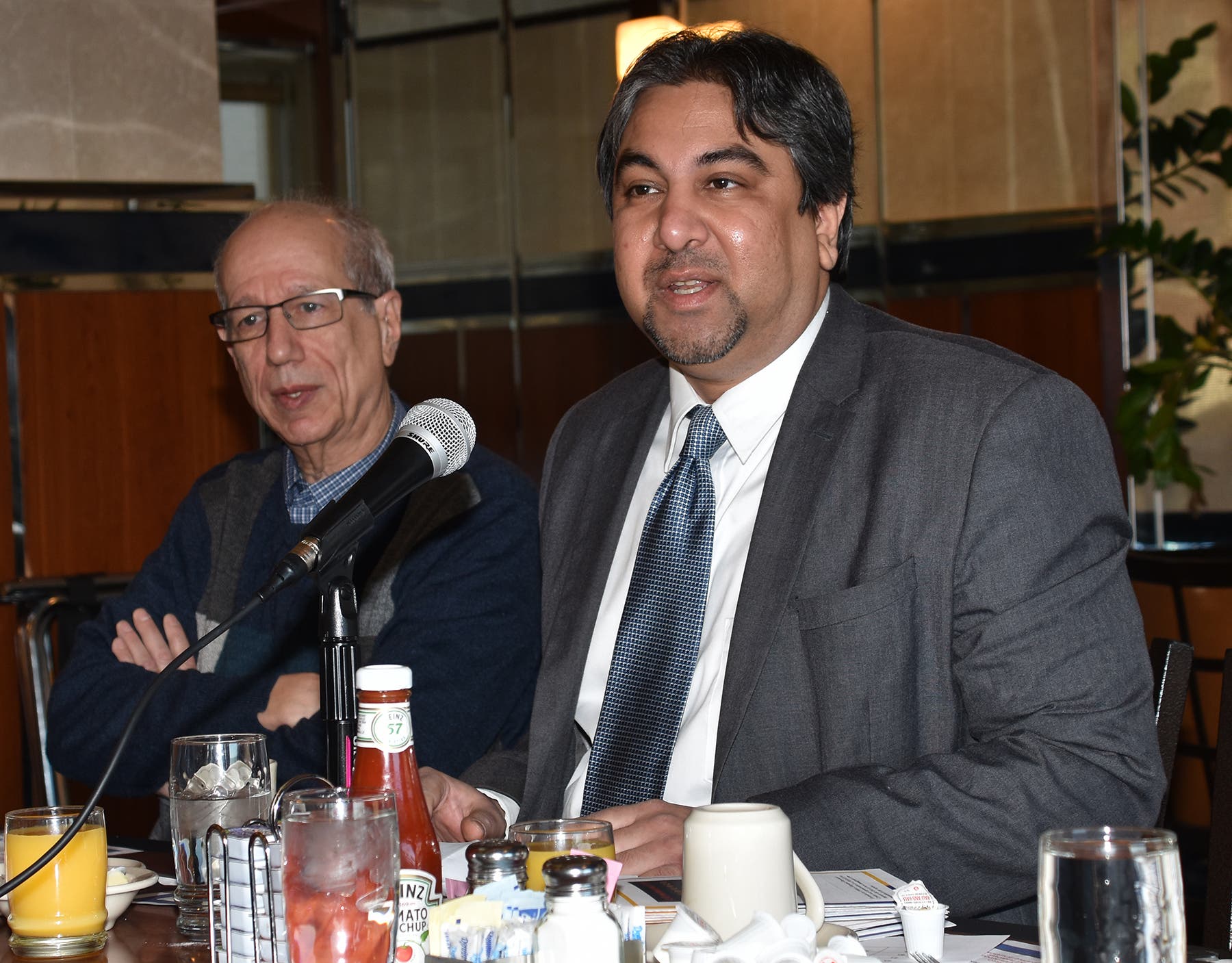
As its contribution to the community’s celebration of Martin Luther King Day, the Local Summit welcomed, as the sole speaker at its monthly breakfast program on January 19, Milan Bhatt, the new Executive Director of the Community Resource Center (the “CRC”), formerly the Hispanic Resource Center.
Find out what's happening in Larchmont-Mamaroneckfor free with the latest updates from Patch.
Mr. Bhatt joined the CRC in August 2015 after spending a decade working on workers’ rights issues, including holding positions with the Workers’ Rights Law Center, the Workers’ Justice Center of New York, and the New York Immigration Coalition in New York City, where he still serves on the board. Bhatt also held fellowships with Amnesty International and the Executive Office of the U.N. Secretary General. He received his Bachelors degree from Columbia University and a Juris Doctor from the University of Iowa. Although his background is as a human rights attorney, more than anything else Bhatt views himself as “an activist”.
Now leading the CRC, Bhatt described his philosophy for the Center’s work as a “partnership approach” achieved by working with other local non-profits and community organizations. He cited as examples of the partnership the CRC’s work with the Hunger Task Force, the Youth Center, Westchester Legal Services and both the Mamaroneck and Rye Neck School Districts. He also complimented community members on their willingness to come together to address complex issues, noting how many people within the community are willing to not only acknowledge community problems, but also to “roll up their sleeves” and work to solve them.
Find out what's happening in Larchmont-Mamaroneckfor free with the latest updates from Patch.
Although the CRC will continue its focus on helping new immigrants, Bhatt explained that his goal for the CRC goes beyond that historic focus, which is derived from its roots as the Hispanic Resource Center. “The problems facing the new immigrant community are the same as those that were faced by prior immigrants generations ago,” he stated, but are also “the same or similar to those confronting the African-American and other non-immigrant groups”.
Bhatt explained to the crowd of attendees that he wants to open the organization to the broader community, and described how he is seeing more diversity in the people who come through the door seeking assistance. He also pointed out that the services offered by the CRC are not limited to the Larchmont/Mamaroneck community, but are available to residents of New Rochelle and other communities within Westchester County.
Bhatt went on to describe what he considers to be the “ten challenges” that confront the new immigrant community, using the words “dire” and “serious” to describe these challenges. First on his list is language access. According to Bhatt, there is a great yearning to learn English, but there simply are not enough resources to adequately serve the need. There are often long waiting lists at places that offer English as a Second Language, such as BOCES. In some instances, the CRC is able to help by simply translating a document, such as a food stamps application. But not all language problems have such quick fixes.
Hand-in-hand with the language problem is the isolation problem caused by the new immigrant’s socio-economic circumstances and the simple fact that people, especially new arrivals, “gravitate towards what they know.”
Economic security may well be the greatest challenge, according to Bhatt, and combating poverty is a major part of the CRC’s mission. The Worker Center at the CRC is its principal vehicle to help improve economic security within the new immigrant community.
Among the other major challenges cited by Bhatt are the lack of affordable housing and the difficulty in accessing public transportation. Bhatt lamented the limits to what the CRC can do to change the affordable housing problem.
The inaccessibility to public transportation is particularly vexing as it makes it hard for an immigrant to find housing, secure and keep a job, buy groceries, seek medical attention, secure legal assistance and attend school and community activities, to name just a few of the many obstacles. Bhatt noted, however, the CRC’s work with the two local school districts regarding the transportation issue, describing in detail the Comprehensive Transportation Needs Assessment Study undertaken with the Rye Neck School District. The goal is to improve the routes and reach of the public system.
Bhatt also included in his top ten challenges the exploitation of workers, wage theft or wage disputes, and the lack of employee benefits. These problems generally result from the fact that the immigrant client may not have acquired lawful status. Also contributing to this situation is another challenge confronting new immigrants – - the general lack of acceptance and prejudice that new immigrants often encounter.
Health problems and access to health care is another fundamental challenge. Bhatt discussed how statistics show that certain portions of the population, including the Latino and African-American communities, are disproportionately more apt to develop health problems, such as diabetes and heart issues, which, in his view, result from quality of life issues and the stress that often accompanies the immigrant’s personal, economic and legal status. In addition, alcohol and drug abuse problems may appear more frequently than in other populations.
Rounding out his top ten immigrant challenge list is lack of access to financial institutions. This affects new immigrant populations more than others. Bhatt explained that the Patriot Act has imposed a number of requirements on banks with respect to basic transactions and personal verifications. One solution can be for the immigrant to acquire an “ITIN”, Individual Tax Identification Number, in lieu of a social security number, thereby allowing the immigrant to pay taxes. The paper trail created by the ITIN may help immigrants by providing documentation of their presence, if there are future changes in the law.
Bhatt described how the CRC tries to tackle these challenges in a “holistic” manner through three programs which he calls “pillars”: 1) Case Management Department, which provides direct services to clients; 2) the Worker Center, and; 3) Educational Programs. Bhatt was particularly proud that the federal government recently approved the CRC’s application to become accredited to provide immigration legal services. This work will be performed in partnership with Legal Services of Hudson Valley, Pace Law School and local attorneys in private practice. This may also be a revenue source, he advised.
The direct services that the CRC provides to its clients can range from document translation to assistance in preparing food stamp or public benefits applications. It may include simple interventions and assistance with unscrupulous individuals who pretend to be notaries and seek fees for services. The CRC also runs a domestic violence intervention program.
The CRC’s educational program is designed to supplement traditional school programs and reduce learning gaps. It includes a student civic leadership program, an adult literacy program, ESL classes, and GED and SAT preparation.
One of the primary goals of the CRC’s Worker Center is workforce development. Often the CRC is asked to help workers dealing with problems of wage theft and business non-compliance with employment requirements. Bhatt reported that in the fifteen under-regulated industries, wage theft is rampant. He added that the CRC has credible reports from workers of some form of wage theft at a number of establishments on Mamaroneck Avenue. Often, however, the CRC is able to resolve these disputes through a phone call to the employer explaining the legal requirements.
The CRC also tries to match candidates to jobs and will provide worker training by bringing in outside consultants. For example, the CRC had great success with the 100-hour restaurant certification-training program and is planning to repeat the program later in the year at St. Thomas Church. Several attendees at the program pursued successful careers as chefs. Bhatt invited the community to call the Center if anyone has the need for a worker. The Worker Center also helps individuals fill out unemployment forms and other required documents.
The CRC has a staff of ten employees and approximately twenty volunteers. Its new offices, which opened in September 2015, are located at 134 Center Avenue in Mamaroneck.
This breakfast forum was hosted by The Larchmont-Mamaroneck Local Summit, an informal community council that seeks to make life better for all in the tri-municipal area. Its monthly public meetings are held at the Nautilus Diner in Mamaroneck at 7:45 a.m., usually on the third Tuesday of the month. The next breakfast meeting will take place on February 9.