Neighbor News
School Superintendents Think Ahead to Meeting the Future Needs of Our Students . . . Express Frustration with Albany
Mamaroneck Public Schools Superintendent Dr. Robert Shaps and Rye Neck School District Superintendent Dr. Peter Mustich Address Local Summit
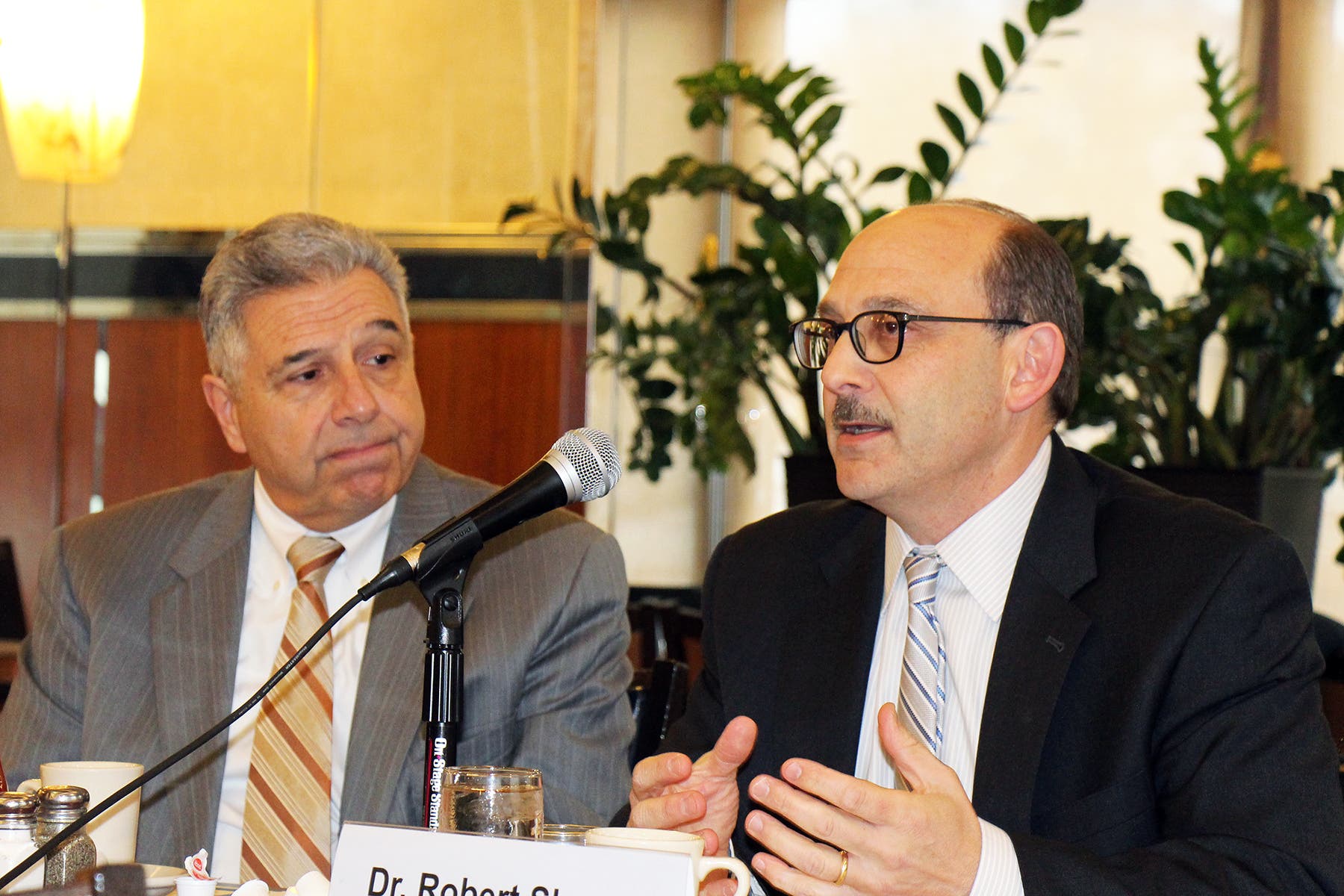
At the Larchmont-Mamaroneck Local Summit’s March 15 breakfast program, Dr. Peter Mustich, Superintendent of the Rye Neck School District for twenty-five years, led off by attributing the success of schools like Rye Neck and Mamaroneck to “local control.” In doing so, Dr. Mustich introduced a theme that was to be heard throughout the program – frustration with Albany, and the need for greater local control – as he and Dr. Robert Shaps, Superintendent of the Mamaroneck Public Schools, discussed their Districts’ challenges and initiatives aimed at addressing the changing needs of our students.
Teaching and Learning . . . Meeting the Future Needs of Students
Turning their attention to the future, the superintendents discussed the challenge of anticipating and preparing their students for a future that is not clear at present and for “careers that don’t even exist now.”
Find out what's happening in Larchmont-Mamaroneckfor free with the latest updates from Patch.
According to Dr. Shaps, who has been Superintendent in Mamaroneck for six years, the question is, “How do we think about changing the nature of teaching and learning from an industrial model of schools that’s been around for 150 years and make it relevant for our students?” Dr. Mustich emphasized the need to “offer different types of programs that catch a student’s interest.”
Under Dr. Shaps’ leadership, Mamaroneck has been focusing on providing students with authentic learning opportunities and providing pathways for students to learn in different, entrepreneurial ways. Dr. Shaps believes that “‘learning by doing’ really changes the perspective of students and gives them a level of expertise and confidence that we think should be inherent in their day-to-day experiences.”
Find out what's happening in Larchmont-Mamaroneckfor free with the latest updates from Patch.
One such example is Mamaroneck High School’s AP Government classes’ recent experience campaigning side-by-side with Republican and Democrat presidential candidates in New Hampshire. Another example is elementary students’ hands-on science experiences at the Sheldrake Environmental Center. This experience not only allows students to “take advantage of our local eco-system, but also affords them the opportunity to become stronger advocates for their environment.”
Dr. Mustich pointedly noted that such experiences “can’t be measured by state tests,” although they are enormously enriching for students.
Addressing the growing need for STEM/STEAM (Science, Technology, Engineering, Arts, Math) initiatives, Rye Neck has re-introduced an engineering course that is in high demand at the high school, and Mamaroneck is expanding its computer science and engineering program, with plans to expose students to coding beginning in 2nd grade. Already 10% of MHS students are enrolled in the computer science program.
Other initiatives in the Mamaroneck schools that will provide students with different, entrepreneurial pathways include a technology-based Design sequence at the high school; the expansion of the Culinary Arts program at the high school to a multi-year program with ties to local restaurants; and an electronic music composition course at the Hommocks Middle School, made possible by a Mamaroneck School Foundation grant.
Dr. Mustich stated that changes in how instruction is being delivered to meet the future needs of students will necessitate major changes to Rye Neck’s facilities. He alluded to the need for a sizeable facilities bond in the near future.
Meeting the Needs of a Changing Population
Another large challenge faced by both school districts is meeting the needs of a changing population. Dr. Shaps cited “a significant change in the rate of poverty” in the past six years. In an attempt to address the needs of a changing population, Mamaroneck has recently considered a few initiatives, including the possible use of a school-based health center model to improve attendance “by addressing the medical needs of students who don’t have access to health care.” It has also been looking into alternatives to Co-Op Camp that would provide an experience that “really extends learning and prevents the ‘summer slide’ – the loss of reading levels – experienced by students from lower social-economic families.”
Rye Neck has recently piloted two new programs to address the needs of its changing population. One program pairs seniors from its World Language program with elementary school children and their families in a Big Brother-Big Sister-like program, with the students meeting weekly. The second program provides incoming Kindergartners who haven’t attended pre-school with a week-long pre-school experience to acclimate children to a formal school environment.
Impact of the Tax Levy Cap
How to fund needed changes? Both Dr. Shaps and Dr. Mustich asserted that the tax levy cap, enacted by the NYS legislature in 2011, isn’t helping. Dr. Mustich called it “ridiculous . . . onerous . . . unreasonable,” Dr. Mustich insisting that people don’t understand the “2% is not 2%.” He explained that this year, with inflation at a low, the cap, prior to exclusions, is close to zero and well below the modest salary increases included in staff contracts and the continuously rising cost of benefits.
Always wrestling with whether to exceed the cap, both Superintendents have managed to keep their budgets within the tax cap limits each year, but other neighboring districts have not been so fortunate. “After years and years of staying within the cap, a number of school districts are now facing a wall, running into significant shortfalls between their budgets and the tax levy cap,” explained Dr. Mustich. If a district exceeds the tax cap, its budget must be approved by a supermajority – 60% – of voters; if it fails, its budget will be held flat to the prior year’s budget. Despite past support for their budgets, neither Superintendent feels he can gamble on an override. An audience member accurately likened it to playing Russian Roulette, a risk that few districts are willing to take.
Asked if the tax cap has changed either district’s approach to budgeting, or resulted in a greater focus on efficiency, Dr. Mustich maintained that districts have always had to look for efficiencies since school budgets are voted on by the community each year. Dr. Shaps went on to describe how he has “uncovered every rock in programs, staffing and operations,” from looking at how the district uses copiers to examining hiring/assignment practices.
Five years into the tax levy cap, NYS districts are exhausting cost savings initiatives and their limited reserves. As expenditures, driven by staffing-related costs, continue to outpace the tax levy cap limits, districts will face even greater budget challenges, especially those whose enrollment is growing, like Mamaroneck. (Mamaroneck’s elementary school enrollment increased 3.5% last year and overall enrollment has climbed over the last five years.)
Strong community support will continue to be key to the success of our schools and both superintendents expressed appreciation for having supportive boards and communities. According to the superintendents, ongoing involvement of the community, a transparent budget process, a track record of being fiscally responsible, and clear communications are all critical to gaining and maintaining community trust.
On Albany . . .
Both Dr. Mustich and Dr. Shaps expressed dismay at Albany’s lack of responsiveness to the concerns school leaders have raised. While local legislators George Latimer, Steve Otis and Amy Paulin “get it,” Dr. Mustich expressed his belief that most legislators do not understand the issues nor do they appreciate the urgency in addressing them. Dr. Shaps agreed, calling the situation a “real and direct failure of leadership.” A meeting with newly appointed New York State Education Commissioner MaryEllen Elia the day prior to the breakfast program left both superintendents disheartened by their perception of her reluctance to assume a leadership role in support of public school educators.
Praising Dr. Mustich for taking a leadership role in advocating for public education in Albany, Dr. Shaps explained that Dr. Mustich’s efforts to unify the region to speak in one voice has “made a huge difference.” Dr. Mustich spear-headed the formation of the Tri-Region Coalition, which includes Suffolk County and the Lower Hudson schools, representing 700,000 students and 199 schools, a “power base from which to have a conversation with legislators.”
Referring to vehement disagreements with Albany in regards to a new APPR (teacher evaluation) plan based on state test results, and its linkage to receipt of state aid, Dr. Shaps argued that “Albany has taken away our ability to develop a supervision/evaluation model for teachers and administrators that works and reflects our values.” He expressed great frustration, saying “that it has been allowed to be politicized is a shame and will have a direct impact on the quality of public education in this state for a long time to come.”
Dr. Mustich urged the audience to make their voices heard. Citing the impact parents had on NYS implementation of the Common Core Standards (CCS) last year when they had their children boycott state tests in large numbers, Dr. Mustich noted that “parent voices have the potential to make a huge difference.”
Proposed 2016-17 Budget
Both the Mamaroneck and Rye Neck School Districts proposed 2016-17 budgets are within the tax levy cap. Rye Neck’s $40.4MM proposed budget represents a tax levy increase is 0.33%, with expenses increasing 1.84%; its estimated tax rate change per $1,000 of assessed value is expected to decrease (9.63)% for Rye City and decrease (0.4)% for Rye Town due to rising assessed values.
Mamaroneck’s $133.2MM proposed budget represents a tax levy increase of 0.74%, although total expenses will actually decrease by (0.55)%. The tax rate per $1,000 of assessed value is anticipated to decrease (4.57)%.
Budget discussions will continue until the respective school boards adopt their final budgets in mid-April. The statewide date for school budget votes is Tuesday, May 17.