Schools
STEM Opportunities Grow for K-12 Mamaroneck Students
Cutting-Edge STEM Initiatives Discussed at Local Summit Meeting on Feb 10
By Janet K. O’Connell
On Tuesday, February 10, 2015, the Larchmont-Mamaroneck Local Summit hosted an exciting program on STEM Initiatives in the Mamaroneck School District. The headlines report that American students are falling behind their counterparts in other countries in terms of science and technology, but the Local Summit’s program was encouraging and optimistic. Because of STEM initiatives, there is hope for our students and in turn our economy. STEM stands for Science Technology Engineering and Math.
Margaret Käufer, President and founding member of the STEM Alliance of Larchmont-Mamaroneck, began the program by explaining STEM. Ms. Käufer is an educator, community organizer and fundraiser and brings her training and certifications in education to her promotion of STEM initiatives.
Find out what's happening in Larchmont-Mamaroneckfor free with the latest updates from Patch.
Joining Ms. Käufer was Mamaroneck Schools Superintendent, Dr. Robert Shaps. Dr. Shaps is in his fifth year as Superintendent and is particularly proud of the STEM work taking place throughout the district. He believes passionately in the importance of STEM in equipping students with 21st century skills and teaching them to be confident, critical thinkers.
Ms. Käufer said that at its simplest STEM is the interface of learning across the disciplines of science, technology, engineering and math. STEM is an approach to learning that looks for questions, answers, and problem solving: out of the box thinking that can be applied to real world problems. An “A” for Art is often added to STEM, so that it becomes STEAM.
Find out what's happening in Larchmont-Mamaroneckfor free with the latest updates from Patch.
“Making” and “maker spaces” are important so that our youth return to skills as hand workers and makers of things, to enable them to move away from simply being consumers toward being creators of things that we need for our world. “Creative design” refers to the interface of art and design with engineering. The idea that when you take creative elements and put them towards design you end up with innovation.
Manufacturing is critical, but we also need ways to respond rapidly, and that is most often done in fabrication spaces, which are spaces that allow you to think “Why isn’t this device working? What should we do to create a better screw or valve?” thereby creating an immediate solution through rapid prototyping. Lastly there are computer science terms such as, robotics, coding, gaming, and app development.
STEM initiatives seek to increase curiosity, employability, job growth and social equality. Children are insatiably curious, but curiosity declines rapidly as children age. STEM education nurtures creativity. It validates the cultural context of youth, because they are using science and technology in their daily lives, and it makes learning relevant.
Over the past ten years, growth in STEM jobs was three times that in non-STEM jobs. 80% of the fastest growing jobs in the United States are in STEM fields. Unfortunately, our children are not necessarily well prepared for those job opportunities. Right now there are jobs available but no one to fill them. There is a real imperative to have training for the jobs that are there. If we can attract industry, then we will have a stronger economy.
Social equality: you are less likely to experience joblessness, if you have STEM skills, and you will command 26% higher wages than people working in non-STEM fields. This will be the difference between the haves and the have-nots. The question we must ask is, “Are we really giving people the access that they need for social equality?” 75% of all college students are women and students of color and under-represented minorities, but they represent only 45% of STEM degrees, a massive disparity.
The STEM Alliance is working as a network to connect our community to STEM inquiry as a means to solving problems and to foster innovation. The STEM Alliance seeks funding and partners for more programs. More information about the STEM Alliance in Larchmont and Mamaroneck can be found on their website: www.lmstemalliance.com.
Dr. Shaps said that the collaboration between the Mamaroneck School District and the STEM Alliance is wonderful. The District’s policy now is to prepare students for a world that is changing and to give them tools for critical thinking and collaboration. Students must graduate prepared for an unknown future with the ability to think quickly. Since we do not know the jobs of the future, we must prepare students to be critical thinkers and to be adaptable.
Three years ago, the high school had no computer courses. Now over 125 students are taking some form of computer class, and there is an Advanced Placement computer science course, as well as, an advanced robotics course. Some of the projects that students at the high school have been involved with are:
- Three students patented a program to help football quarterbacks determine which receiver is open. Football teams are buying this program.
- Last year, sixty students participated in a Carnegie Mellon cybersecurity competition to solve a real life problem. MHS students finished in the top ten percent, competing against thousands of students from across the country and out-performing many science magnet schools.
- This year, seventy students are participating in another competition against peers from all over the world. Right now they are in the second round and still in the top ten percent, and they may travel to Florida in May for the finals.
- This year, the High School launched its first robotics team. The team has taken part in two regional competitions, involving many students.
Things are also happening at Hommocks Middle School and in the elementary schools to capture the imagination and curiosity that Ms. Käufer described as so essential in the changing world. At Hommocks, students are building and programming 3D printers and becoming adept at using Rhino software. The entire district recently participated in an Hour of Code. Each week 75 middle schoolers take part in after-school activities that involve STEM initiatives, and going forward, they will work with drones and vinyl cutters. The District is considering a 4-year design program to work across disciplines. “We are just getting started. Hands-on STEM learning at all levels K-12 lays the foundation for more advanced work in college and beyond. A lot is happening, and a lot more is going to happen. It is hard to keep up!” concludes Dr. Shaps.
During the question and answer session, the Superintendent was asked if the district is considering making STEM-related courses a requirement for graduation. He said that the district is working on insuring that all students have access to this area. Soon they will introduce coding as a 4th language in addition to French, Spanish and Chinese. He added that engineering is critical to our students, and the high school now has an engineering course and is considering adding another one.
When asked how to excite girls into STEM. Ms. Käufer said it is about PR, and we need to put in the “A” for Art into STEM: STEAM. If girls step forward together, do it as a group, it will be more successful. Do it yourself does not mean do it alone. Girls are more likely to participate if their friends are doing it too.
Similarly it is important to include the lower socio economic groups. A kindergarten curriculum is being developed. We have one of two maker space programs in the country. The STEM Alliance is working with the Hispanic Resource Center to become better known in the Hispanic community. MasterCard is offering a code program for girls. 1:1 is putting IPads in the hands of all middle-schoolers, so all our students have access to the same technology. One can argue the merits of everyone having an IPad, but the playing field is being leveled.
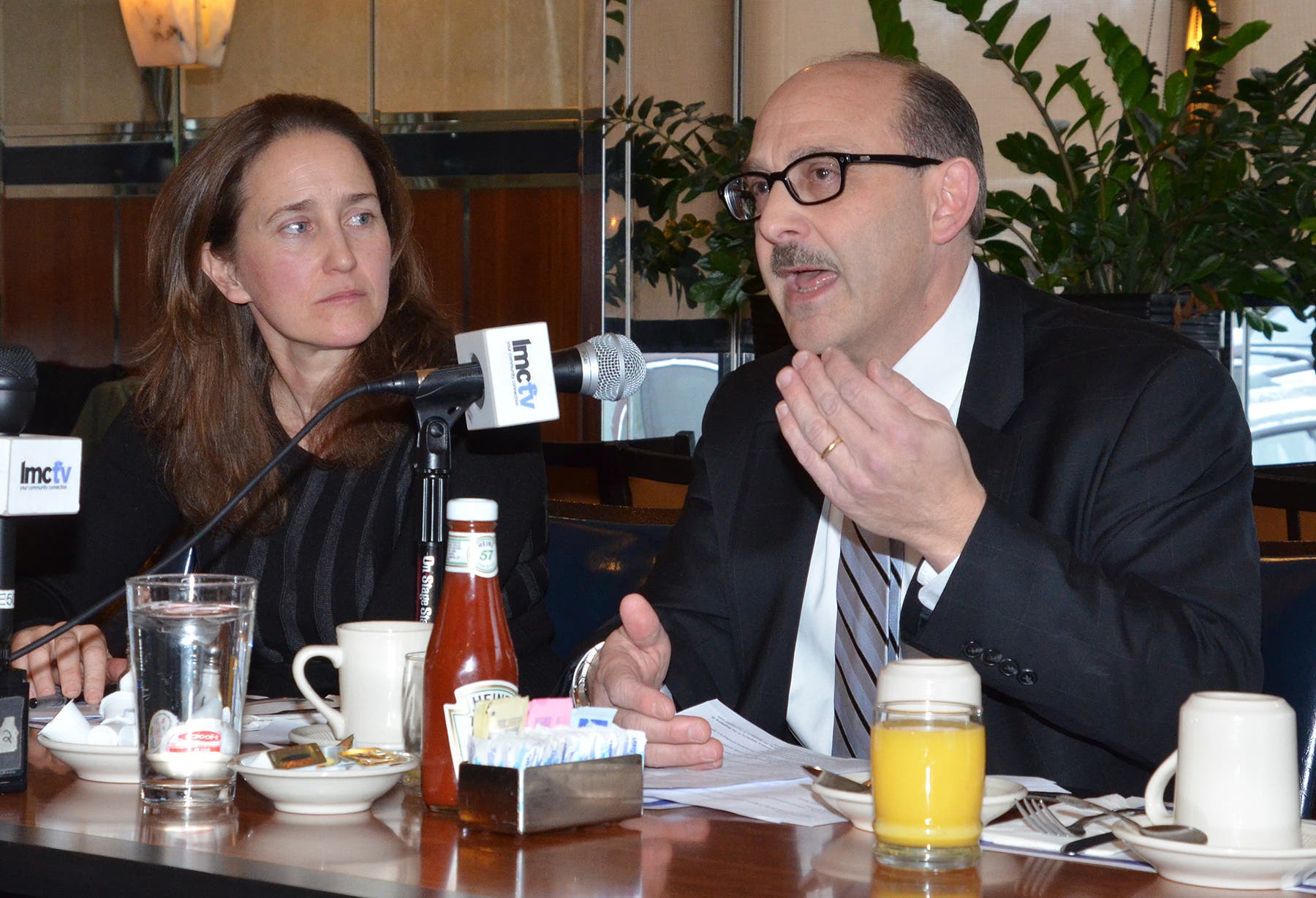
This breakfast forum was hosted by The Larchmont-Mamaroneck Local Summit, an informal community council that seeks to make life better for all in the tri-municipal area. Its monthly public meetings are held at the Nautilus Diner in Mamaroneck at 7:45 a.m. usually on the third Tuesday of the month. The next breakfast meeting will take place on Tuesday, March 17th, and the topic will be about the quality of our drinking water.
Subscribe to a free email newsletter and news alerts:
BEDFORD-KATONAH • BRONXVILLE-EASTCHESTER-TUCKAHOE • CHAPPAQUA-MOUNT KISCO • HARRISON • LARCHMONT-MAMARONECK • NANUET • NEW CITY • NEW ROCHELLE • NYACK-PIERMONT • OSSINING-CROTON • PEARL RIVER • PEEKSKILL-CORTLANDT • PELHAM • PORT CHESTER • PLEASANTVILLE-BRIARCLIFF • RIVERTOWNS • RYE • SCARSDALE • SOUTHEST-BREWSTER • TARRYTOWN-SLEEPY HOLLOW • WHITE PLAINS • YORKTOWN-SOMERS