Politics & Government
Greenport Businesses Team Up To Reduce Plastic Use, Save Environment
BREAKING: Plastic utensils and takeout containers littering beaches could soon be a thing of the past if a new pilot program is successful.


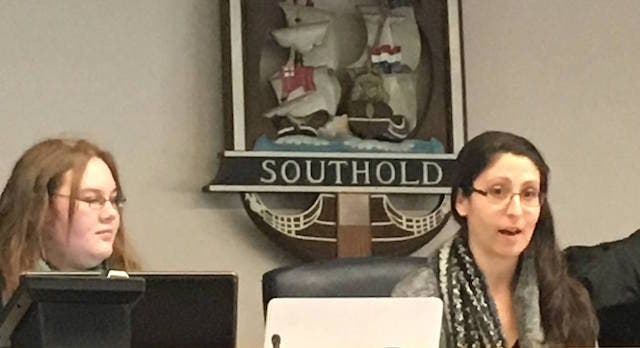
SOUTHOLD, NY — Four businesses in Greenport have been selected to participate in a pilot program aimed at cutting down on use of disposable plastic products that end up in local bays and on beaches.
Vivian Fuhrman and Megan Byers of the Product Stewardship Institute gave a presentation at last week's Southold town board work session on the project.
The Product Stewardship Institute, according to its website, is a "national, membership-based nonprofit committed to reducing the health, safety, and environmental impacts of consumer products across their lifecycle with a strong focus on sustainable end-of-life management."
Find out what's happening in North Forkfor free with the latest updates from Patch.
Items that become obsolete must be disposed of, but they are often hazardous and end up in the waste stream, Fuhrman said.
The group, through the North England Interstate Water Pollution Control Commission, she said, won a grant from the United States Environmental Protection Agency, aimed at a trash-free waters project that's focused on the New England and eastern Long Island area.
Find out what's happening in North Forkfor free with the latest updates from Patch.
The goal, Fuhrman added, is to consult with restaurant owners and businesses to keep plastics out of the bays and Sound — and off the beaches and waterfront areas.
The pair met last week with Greenport and Southold Schools Superintendent David Gamberg, as well as four local business owners, Marc LaMaina of Lucharitos, Mary Bess Phillips of Alice's Fish Market, Scott and Cassata Bollman of Bruce & Son, and Carlos Gonzalez of Tikal 1.
The grant will help to provide some funding to the business owners if there's a cost to changing procedures, Fuhrman said.
Both thanked Jim Bunchuck, Southold Town's solid waste coordinator, for his help.
"Our goal is not only to help with the environment but also, with public health," Fuhrman said. "They are intertwined."
After working with the businesses involved in the pilot program, the goal is to work with Southold Town and Greenport Village to create model policies to help reduce plastic waste in communities outside of New York.
Byers said PSI has worked with California universities to reduce plastic waste generated by campus eateries.
University of California, Santa Barbara, reduced their use of plastic bottles and bags by 98 percent, Byers said. And, at a local Subway shop in that area, the elimination of the plastic sandwich sleeve saved the business $14,000, she added.
Another facet of the project on campus was retrofitting old drinking fountains and installing new ones, she said.
In addition to reducing plastic use in local eateries, a public education campaign about the risks of marine debris will also ensue, Byers said.
Public health and the environment are connected and impacted by plastics strewn on local beaches and in the waterways, Byers said.
Long Island, she said, is home to endangered species such as piping plover, osprey, and turtles, and wildlife can be put in danger by plastics in the waterways.
Water quality is also a concern, she said.
Public health concerns include microplastics and compounds such as styrene, which can leach into tissue, Byers added.
Another reason for the pilot program, Byers said, includes the elimination of costly cleanups.
"Our approach is mostly to eliminate these plastics and move to reusable alternatives," she said.
Discussing the metrics for success, Byers said the hope is to reduce plastic use by 40 percent; the final number will be determined by taking plastic footprints of the participating businesses at the beginning and end of the project. A short visual survey of the area for marine debris will also be conducted, she said.
Model municipal policies should be completed by December, with a source reduction toolkit created by February, 2018 and promotion to follow in March, 2018.
Meetings will follow with local officials and tourism boards to discuss results, challenges, and potential community programs to enhance and support plastics reduction efforts, Byers said.
Both agreed the hope is to convey the message to local businesses in a simple and practical way.
"You hit on the key words, 'simple,' and 'practical,'" Southold Town Councilwoman Jill Doherty said. "People are so busy. If they can implement simple and practical suggestions and save money, they will do it."
Doherty also suggested an emblem or sticker that participating restaurants can affix to their windows to show their support for saving the environment.
The public, Fuhrman said, "needs to make a connection between what they are buying for breakfast and what we see wrapped around a seagull's leg."
Councilman Jim Dinizio asked how Southold Town and Greenport were chosen.
The process included searching for an engaged community, as well as one with restaurants concentrated in close proximity to the coast, Fuhrman said.
Southold Town and Greenport are the only municipalities currently being studied for plastic reduction; Fuhrman said her work so far has been focused mainly on getting pharmaceuticals out of the wrong hands and ensuring they are not disposed improperly into waterways.
The board and Bunchuck also discussed K-Cups and how they are recycled, as well as mattresses.
Bunchuck was designated the contact person moving forward; the board suggested PSI also reach out to the Greenport village board and choose a contact person in the village.
Doherty also said mylar balloons are an issue in the water and on the beach; the women said they could look into the balloons.
Business owners weigh in
The two PSI representatives met with the four Greenport business owners later that day.
After that meeting, LaMaina, of Lucharitos, explained why he decided to participate. "We do a lot of take out. And we are on the water. I grew up a Orient Yacht Club kid," he said. "The bay is important to me. Our restaurant is on the water. It's my job to do everything I can to protect it. And working with Megan and Vivian to find the best products for us specifically is a great way to set the bar for ourself and neighboring businesses."
Phillips agreed. "The commercial fishing industry observes many of the issues caused by the use of plastic bags and disposable eating containers on marine life. Participating in this pilot brings an opportunity to network with commercial and retail industries to understand how important our bays and oceans are to our Village of Greenport."
Kassata Bollman said Bruce & Son stopped using plastic bags and styrofoam containers for takeout orders last year.
"We were already thinking of ways to further reduce our plastic usage when we were approached to participate in this study. The timing was perfect. For the next year, we'll have these amazing partners to turn to for guidance," she said.
And, she added, "When we open for the season this Friday customers will notice that we also eliminated plastic containers for condiments used in our dining room. We now use metal serving containers, instead."
In addition, Bollman said, for all takeout orders, "We'll be asking customers if they need plastic utensils rather than automatically putting them in their bag. Hopefully, a year from now, we'll be using an affordable alternative to plastic utensils."
After the work session, Southold Town Supervisor Scott Russell spoke out in support of the pilot program
"The plastics presentation was very important," he said. "The organization is one that would make a good partner in future initiatives to bring solutions to these critical issues."
Get more local news delivered straight to your inbox. Sign up for free Patch newsletters and alerts.