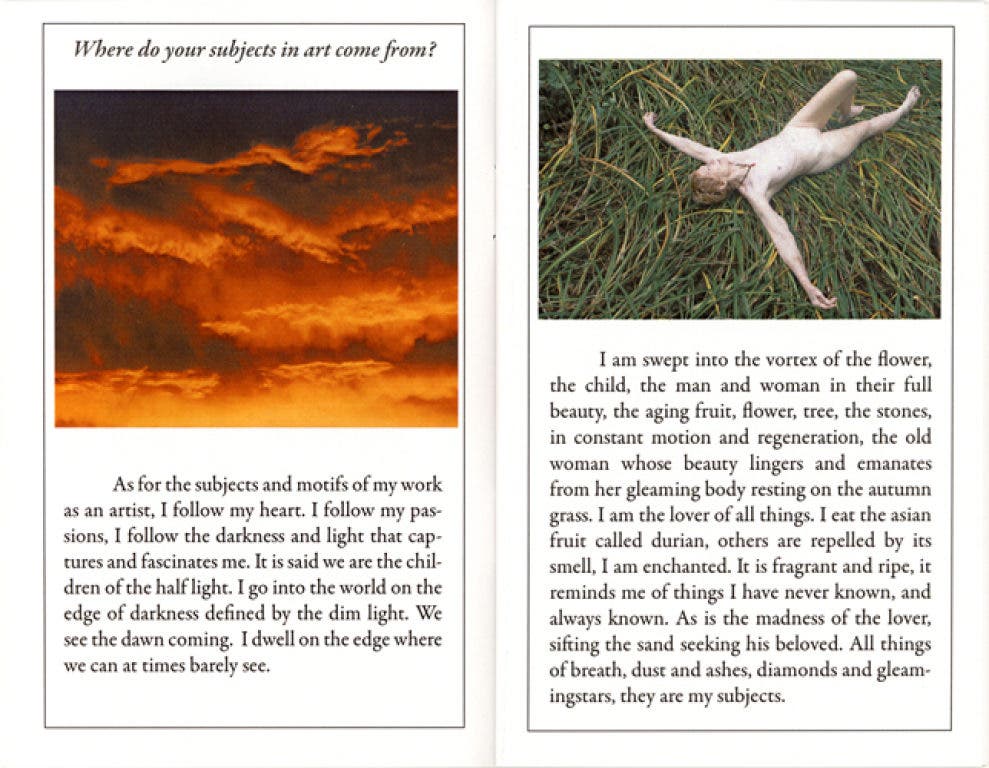


Life handed Mark Sadan the bitterest of lemons early on, but with the help of an observant therapist who spotted the richness of Sadan’s imagination, he pulled it together to make films and eventually still photos with insight and beauty.
Photos from his book, The Unbearable Beauty of Existence, will be exhibited at in Tarrytown from August 1 to September 4, and Sadan will host a reception and book-signing there on Monday, August 1, from 5-7 p.m.
The petite but powerful book, small enough to carry around in purse or pocket, came out of an interview done by Maia Sylba for her internet Arts Magazine Musetouch.net in December, 2010. Along with the photos, the book reprints twelve questions and answers from that interview.
Find out what's happening in Tarrytown-Sleepy Hollowfor free with the latest updates from Patch.
"Art was the only way, I felt. My family wanted me to be a businessman and do art on the side, but I needed total commitment," he said.
Sadan studied at the American Academy of Dramatic Arts, with interests in acting, filmmaking, and painting.
Find out what's happening in Tarrytown-Sleepy Hollowfor free with the latest updates from Patch.
“Some of my heroes,” he said, “are Walt Whitman, who made me feel that I was no longer alone in the world, and Van Gogh, who never compromised. I discovered there’s craft to art, and to film—like dreams that were a kind of reality.”
Acting had too much wasted time, he said, waiting for the director. He preferred to become a director himself, and won enough recognition and cash prizes to enable him to go to school for it. His short experimental films were shown at the Museum of Modern Art and led to his receiving a full two-year scholarship to graduate school at New York University Institute of Film and Television. He landed a job doing live-action short films for Sesame Street, working with Jim Hensen and the Muppets, with music by Peter Schickle (PDQ Bach), followed by a series of music videos for NBC with Seals and Crofts. He traveled, hitchhiking all over Europe, Turkey and Iran in what he described as “a wonderfully scary journey.”
“I read philosophy,” he said, “and I realized that all work is honorable if it helps others, whether manual labor or anything else, and that success and failure are transitory. What matters is to be able to give to others.”
Other successes followed, with films and short plays that got good reviews from the Village Voice. He produced and directed a two-hour documentary film, The Green Light Expedition, for which he traveled by boat through the Amazon and its tributaries, and in the jungles and mountains of Peru and Bolivia, visiting 36 indigenous tribes.
Sadan's award winning films led to his being invited twice to Hollywood to discuss his ideas for feature films, but found no common language with the people there.
"At NYU, photography was part of the training,” Sadan said, “but business was not. I came to hate the film business.”
Sadan felt that the true expression of his art could only be done via photography. He studied with master photographer Paul Caponigro and John Szarkowski, director of the Photography Department at the Museum of Modern Art. With the latter, he said, “I was awed by handling the original master prints and being able to discuss them with Szarkowski.”
A successful film he made depicting the sculpture of Gustav Vigeland called Cycle of Life played every day in a museum in Oslo, Norway for years. He went back to Norway five times, and eventually met Leif Preus, who had a museum later called the Photo Museum of Norway, and who invited him to have his first museum exhibit. The show was favorably reviewed by art critics, which led to Sadan being invited to do an exhibit on Norway, Norwegian Reflections, which opened at the World Trade Center in the early 1980s and toured the world.
Sadan, who has lived in Ossining for twenty-five years, has a large number of photos in the Ossining Post Office, and once transformed an auto mechanic’s shop into a temporary museum for local people. He set up a reception, had white cloth-covered tables, and projected movies onto the walls.
“I liked the idea of starting in my own community,” he said, “giving to its people.”
People should stop, look and see, he said, rather than just thinking about what mundane tasks they need to do.
“I’m bored with just copying reality,” Sadan said. “I manipulate images to express layers,” for example in his close-up photo of young lovers with the color and pattern of a flowered sari superimposed. Another photo layers knight's armor and a "maiden's dress" over an image of a standing nude couple. Other of his photos may be unmanipulated yet still hold symbolic or psychological meaning, such as his blue stairway, which is a real blue stairway in someone’s home, but may to some people suggest moving towards the light at the top.
His Black Swan, a very painterly image, is, he said, a straight capture of reality. It is a very special moment, seen with a true artist's eye.
“I go to a photo session like a child playing, not knowing what will be there,” he said. “It makes life difficult sometimes, …but I’ve learned to ride my passions.”
All visual art forms are sources for him, including painters Gustav Klimt and the Pre-Raphaelites in addition to Van Gogh. He shares Degas’ passion for dancers, whom he sees as “almost possessed by gods, poetic. People work so hard to reach the point where they transcend, are in the zone.” See many of his dance images on www.dancerzine.com.
His mother and child images, he said, relate to losing his mother when he was four, and being left with a father who horsewhipped him, carrying into the next generation the abusive discipline he himself had suffered as a child. Sadan said that the experience makes him abhor any form of violence.
“I know that each day is an opportunity to find beauty, to make things right,” he said. He quoted Irish poet and philosopher John O’Donahue, “That which you fear is actually a gift, if you understand and work with it.” Sadan continued, “We live alone, we die alone, but light can be found in others—‘anam cara’—Celtic for ‘beloved friend’—to find that is why we’re here.”
For those who can’t make it to the reception, the book is available by contacting Sadan at marksadan13@hotmail.com. Look for his website at www.marksadan.com. For exhibition hours see www.coffeelabs.com or call 914-332-1479. For the complete interview by Maia Sylba from Musetouch, look for Issue 4, page 54 after clicking here.