Arts & Entertainment
Memoirist and Novelist to Read in Sleepy Hollow on Sunday
Two acclaimed writers, Elena Gorokhova and Jennifer Natalya Fink, will read at Hudson Valley Writers' Center


Two acclaimed writers, one a memoirist and the other a novelist and professor, will read from their works this Sunday at 4:30 p.m. at the Hudson Valley Writers’ Center in Sleepy Hollow.
Elena Gorokhova has written a memoir called A Mountain of Crumbs, about growing up in Leningrad in the 1960's, but starting out with gripping family background going back before World War I. Particularly riveting in this section are her mother’s experiences as a dedicated physician in an environment of dictatorship and war.
There are universals in her book as well as differences. An early recollection is about going with a little friend to explore “a door under a dark archway” so spooky that someone with “a…horrible defect” must live there,” or maybe the garbageman, in “this damp tunnel, in the eye of darkness, where we are no longer protected by sunlight or Zinaida Vasilievna or even screaming Aunt Polya.”
Find out what's happening in Tarrytown-Sleepy Hollowfor free with the latest updates from Patch.
Another recollection that would feel familiar to many people is when Elena and her older sister Marina hide in the hallway of their home, under the “folds of wool and crinkly raincoats,” trying to eavesdrop. Their mother is in the kitchen, talking to a man who says he may be able to help Marina become an actress. The mother, completely practical, courageous, and dedicated to her profession, has the same concerns as any mother, at any time. “And what will you do?” her mother had asked her.
Spend your life in some provincial theater so you can come out at the end of the second act to say, Dinner is served?...They’ll send you to Kamchatka, and you’ll be stuck there, with society’s rejects, with sailors and ex-convicts, with those who could barely make it through a plumbing course, wishing you’d listened to what we told you.
Find out what's happening in Tarrytown-Sleepy Hollowfor free with the latest updates from Patch.
Yet she lets Marina go to drama school, the best drama school possible, even though that meant leaving for Moscow. Despite Marina’s many successes, her mother, like all mothers, continues to worry.
There are also things that are less familiar, such as the forced spying her mother had to do before she married Elena’s father and “escaped” to Leningrad. The chairman of the anatomy department where her mother worked was a Jew, and she had been required to report on him, which she did with the most innocuous possible information. She still worried that it would be “twisted and “mauled,” as had happened years before when a mild joke in public had gotten her uncle jailed and eventually shot. This time, though, nothing happened, and she was able to move on with peace of mind.
Elena’s youth was a time when American newspapers and magazines were “decreed subversive and dangerous… confiscated at the border.” An early experience of American culture was seeing the play We Bombed in New Haven. “An American play in a Leningrad theater, a phenomenon as next to impossible as dinner without soup.”
Eventually marriage at the age of twenty-four, to an American she has met at the university, brings her to this country. The title, “A Mountain of Crumbs” came from her grandmother’s attempts long ago to convince her three-year-old son, the author’s uncle, that there was plenty of food, despite the growlings of his stomach. She would tear the one piece of bread and one cube of sugar they had for him into little pieces and form them into a “semblance of abundance…enough crumbs to pick at for a whole hour…plentiful and sweet.” It worked. They made do.
The book was published by Simon and Schuster. Click here to find out more at the author’s website.
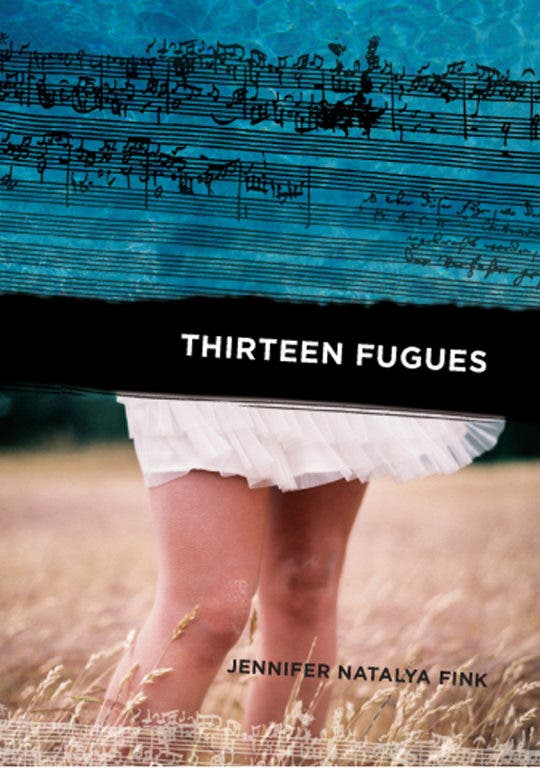
Jennifer Natalya Fink is a Pulitzer Prize nominee who has won the National Jewish Book, National Book, and Dana Awards, among others. The latter was for The Mikvah Queen, part of which she expects to read on Sunday, along with excerpts from her about-to-be-published Thirteen Fugues. Fink is also a professor of English at Georgetown University and a founder of The Gorilla Press, which, she says, gives kids from kindergarteners through teens “ownership over their own learning” through bookmaking.
The Mikvah Queen takes place in the 1980’s in Ithaca, New York, where Jane Schwartz is trying to make sense of life, especially puberty and Jewish law. Her neighbor Charlene Walkeson, current custodian of her granddaughter, whose mother has “ditched her husband and left Susie here with me,” is battling cancer. Charlene tells us that she has no intention of starting over with the birthday parties with other peoples’ children, “…worst of all, the pouty pre-teen girls in lipstick and long-john, sulking at some imagined insult…” But she finds herself taking an interest in Jane.
Jane is learning about the Talmud in tutorials with “some grad student who decided Jewish law was cooler than Kant.” She’s reading the rules as laid down by a renowned Orthodox rabbi, “the mikvah king, expert in all things relating to ‘family purity’….It’s about water. Water from within the body contaminates.” Orthodox Jewish women have to go through a ritual bath every month to be cleansed with water from outside the body, which purifies. The failure to obey the rules is said to lead to horrible diseases in the children of the offending women. Jane is eleven years old, and her body is not yet that of a woman, and she speculates about what it will be like.
We go back and forth in the book from Jane’s young voice, discovering and exploring and imagining, to Charlene’s voice of experience and her long view. Charlene envisions Jane’s future as “one of those women with big glasses and expensive suits who rattles off long chains of figures without blinking. Or a lawyer, a smart Jewish lawyer, maybe, talking fast and funny, with bright red lipstick.”
Eventually Jane builds a mikvah in Charlene’s porta-sauna, hoping that it will cure the older woman of cancer. The power of ritual, alternative culture, feminism, and postmodern Jewish identity are all examined in Fink’s book. Click here to read a generous sample online.
Thirteen Fugues, Fink’s new book, uses, she says, “the harmonic and melodic structure of the musical (and psychological) fugue…Each ‘fugue’ centers on a moment of transformation.” They are “interlocking short-short stories” narrated by “sardonic yet sweet” Tanya Irene Schwartz, and refer to 1970’s pop culture, 9/11, Viagra, and Jewish law, among other things.
One section, part of “Fabrications,” starts:
The hot water is coming out green and frothy. I lean into the tub to investigate. This is it, I tell myself as if I’m the heroine of my very own post-Cold War thriller: they’ve poisoned the water. I put a glove on, an old red mitten missing its mate. The water even smells green, herbal. Herbal? Unless the terrorists are using Herbal Essence shampoo as their weapon of choice, it’s just a backed-up drain.
And another:
I’d like to be dead, she says, but just for, oh, let’s say a month. To test-drive death, take her for a spin around the block.
That sounds very…American, you say. You are not alarmed. You and she have lots of conversations like this. You notice her jacket, a tight black wool number, boat-necked. It accentuates those thin bones on her neck. You smile at her neck.
The book will be published by Dark Coast Press in early May. Click here to read a larger sample on Facebook.
The reading, followed by a brief question-and-answer session and reception, is this Sunday, April 17, starting at 4:30 p.m. It takes place at the Hudson Valley Writers’ Center, 300 Riverside Drive, in the cozy, renovated former Philipse Manor Metro North Train Station. For more information see www.writerscenter.org, or call (914) 332-5953.