Arts & Entertainment
Painter's Eye, Camera's Lens Competition Winner
It wasn't easy, but I've chosen the photo that will add an exciting new painting.
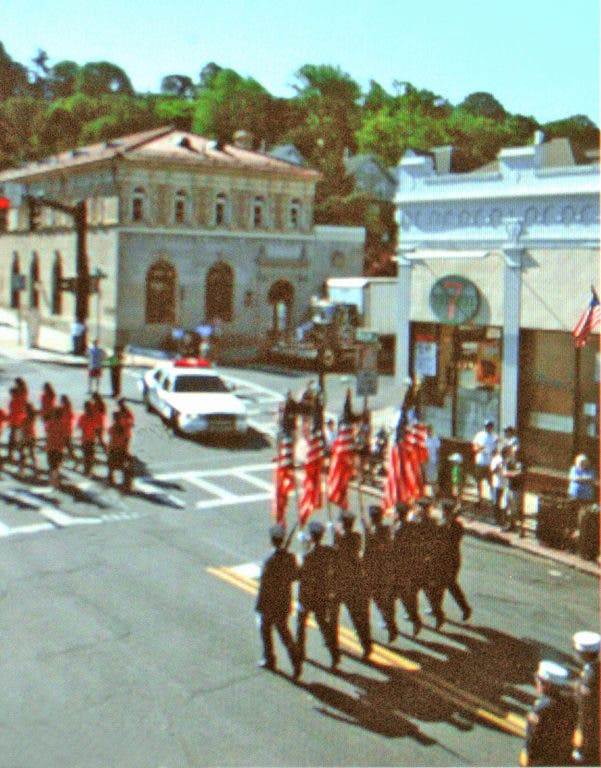

It was tough to choose. So many good photos were submitted to thCompetition! Ultimately, I decided on Anthony Pellegrino’s parade scene that gives me buildings, people, trees, and an unusual perspective.
Why is the parade scene painterly as well as good photography? It reminds me of some Impressionist street scenes, with the overhead view and the Degas-style cropping of the figures at the bottom. It has the excitement of motion, light and shadow, and a landmark building I’ve been intending to paint for a long time. To use Anthony’s photo for my next painting, I’ve cropped some of the sky, putting the focus on the action, and I’ve eliminated the heavy diagonal shadow that interfered with the main action of the marchers and also seemed oddly displaced from its source, presumably the traffic light. Make sure you click on the second image if you want to see the full frame.
What a painting needs is a little drama. Photos with all the action in the center are often less compelling than ones with a focal point that is around one-third in from left or right, and one-third from top or bottom. Take many photos of the same subject and look for the one that pops, which is from just the right angle, involves just the right light and shadow effects, or, if it involves living beings in motion, is at just the right moment.
Find out what's happening in Tarrytown-Sleepy Hollowfor free with the latest updates from Patch.
I love Anthony Pellegrino’s old mill seen beyond snowy branches, Camille Thompson’s water lilies, and Ruthmarie Hicks’ A Walk in the Park with its dynamic sky and vivid colors.
Rose Cardillo’s view of the distant city framed by the bridge and the marina is wonderful, I wanted to see a little more of the boats at the bottom of the image too.
Find out what's happening in Tarrytown-Sleepy Hollowfor free with the latest updates from Patch.
Other wonderful but more photojournalistic images include Debbie Allan’s Stone Barns, Robert Uricchio’s lighthouse and his blue-background river scene, Cathy’s After a Rainstorm, Kykuit, Jerry Vallo’s entries such as TT Lakes and Babies at the TT Lakes. Also more photojournalistic are Camille Thompson’s pigeons and Ruthmarie Hicks’ The Sacred Meets Santa, which is very clever, and The Holidays on Main Street, with its Music Hall section that I might like to see a little more of at top and bottom. Also very photojournalistic are Anthony Moreno’s horse and section of a statue. I love Mary Westerfield’s water scene with reflected clouds and fall foliage; Vincent Fracaroli’s A Mallard and His Lady with the swirls in the water could be done in a very Monet way.
I think many other artists would love the unusual colors in Shiran Pasternak’s Tappan Zee Gulls and Anthony Moreno’s green and purple bridge scene. Moreno’s Tappan Zee night scene is one of my favorites, and Mary Westerfield’s version of the same subject with the glow in the sky is lovely, too. Debbie Allan’s Hudson and Tappan Zee From Pierson Park is near and dear to my sensibility and was a finalist. The other-worldly glow of Nancy Zallo’s Sunrise, Tarrytown, January 2011 was fascinating. I’ll have to take her word for it that the world can look like that so early in the morning, because you won’t find me out and alert at that hour.
Tricia Taxter, Susan Cember and Jeff White all submitted beautiful possibilities. Judith Giordano’s spring street scene is very successful in creating a poetic mood, and as a work that relates to many of mine, was definitely a finalist. It’s got a cool sophistication that I enjoy. Cathy’s Sunset, Pierson Park is a beautiful graphic, almost symbolic rather than realistic.
My first reaction to Camille Thompson’s water lilies was that Monet “owns” that subject. When I paint in the Monet tradition, I do scenes he never saw, much less painted. These water lilies are very close to what he actually saw and so it felt like I would be imitating him if I chose one of them. Yet the closeup with the rich colors was just so beautiful I didn’t eliminate it until the end.
Camille Thompson’s still life is charming, and it would be a little different for me because I don’t usually do that kind of scene. This is another case where I felt it would have benefited from being cropped a little less closely. I’d like to see more of the richly textured surface on which the objects sit, and possibly a little more space above the pitcher.
Of course I love Ruthmarie Hicks’ Main Street and Looking Up. I’ve loved those buildings since the first day I came to explore Tarrytown. I’ve painted there many times. It’s tempting to stick with the familiar, but since you’re stretching yourselves to envision your photos as paintings, I fell that I should stretch myself to do something different and challenging too.
Thanks again to everyone who participated. Every entry was a valuable contribution. And we'll be doing this again once this photo is converted into a painting.
Next time: the drawing stage.