Arts & Entertainment
Stages of a Painting: Parade Scene, Part 3
Juicy colors and selective detail for a lively feeling.
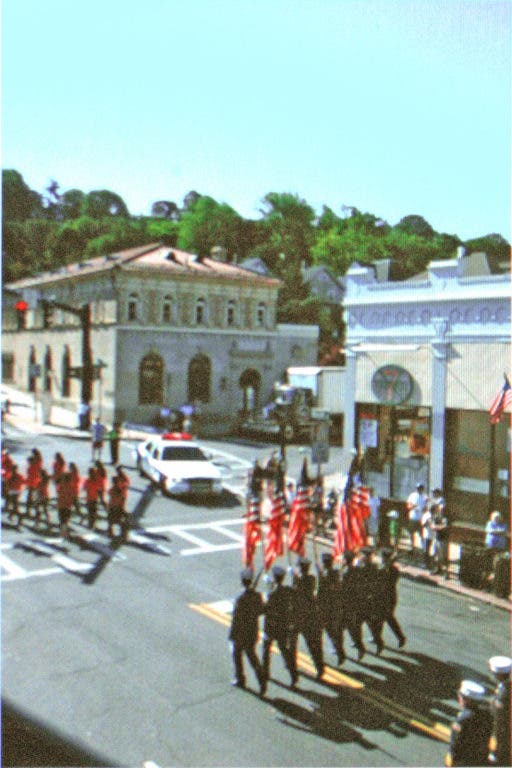


My painting, based on the wonderful photo by Anthony Pellegrino that won the , is just about finished. I’ve painted the all-important marchers, both the officers in the foreground and the group in the background that looks like it might be students. I’ve worked on the important, distinct shadows cast by the marchers. I’ve put in the spectators. I’ve done my best to maintain in my version the precision with which the officers are marching in a straight line worthy of the Rockettes. I’ve darkened the windows of the 7-Eleven, since in daytime windows look dark unless there are super-bright lights inside, which is pretty rare. I’ve also put some non-specific signs in the store windows.
I’ve added the two windows in the southernmost part of the bank building, which had been obscured by a truck in the photo. I’ve painted the street with alizarin crimson, ultramarine blue, and a touch of cadmium yellow, and of course white. Since I don’t want big areas of flat color where nothing is happening, I’ve painted color-over-color variations, using more yellow ochre on the bottom left, which makes a warmer color that looks closer to us, and a little pthalo blue and white in the bottom right, which makes it feel farther away. I’ve made the sidewalks lighter, with yellow ochre in white, toned down with a little of the purple mixture, to emphasize that they’re made of different material than the street.
Important things to consider as you work to make a painting are the simple geometric shapes that compose everything we see, and the negative space where the background shows between or next to the main subjects. For example, when I look for the slant of the shoulders in the line of marchers, or the angle formed by their legs, I look first at their bodies and second at the street left visible between their limbs.
Find out what's happening in Tarrytown-Sleepy Hollowfor free with the latest updates from Patch.
I’ve changed the direction of some of the officers’ heads, to let the light shine on their faces. I’ve interrupted the shape of the visually overlapping legs of the third and fourth marchers from the left, introducing a little street between them, because the one solid shape looks like the third marcher is about to be lifted into the air, apparently by his flag. In a photo it might get a double-take, but it would be accepted; in a painting it would probably be thought to be a mistake.
So why does it never get old for me? What makes it worth spending hours and hours making the same scene a camera can make so quickly?
Find out what's happening in Tarrytown-Sleepy Hollowfor free with the latest updates from Patch.
With all due respect to photography and to modern art critics who dismiss most realism as superfluous, for me there’s a sensuality to paint that is different and irreplaceable. The strokes and slight abstraction of the way I work says to me that this is a new world on the canvas, based on the familiar world of everyday life, but enhanced. I learned this technique by studying photos of places where the French Impressionists painted, and how the real thing, to the extent we can see it in modern photos, differed from the paintings.
I look at my version of the parade scene, based on a fine photo, and in the photo I see an interesting moment in the real world. I look at my painting and I see a little world I’ve just made, changed to be as I want it. I’ve used juicier colors than I see in the photo, colors which can be seen in the real world in the right light and weather, if you’re trained to see them. Pavement isn’t gray, it’s purple with varying degrees of yellow and white depending on the season and light. White buildings can have a touch of yellow. The sky is as blue as I want it to be.
In some ways movie-making is closer to painting than outdoor still photography is, partly because usually the movie director has the ability to light his/her scene with equipment that is out of financial reach for most still photographers, and so could add or eliminate shadows as needed to enhance the finished work. As we’ve experienced a few times in Tarrytown, a movie crew might come days ahead to repaint and redesign parts of the street. A still photographer at the scene we see in this photo might have approached the police to turn their car a few degrees counterclockwise, to make it parallel to the march rather than looking like it might be about to run over the marchers, and they might have done it. Or they might have said “Don’t bother us.” Who would blame them? And how many photographers would even notice the angle of the police car while they're shooting the march? But a movie director for a big-budget film would have the time and budget to see it and get it done, no doubt. A painter can just turn it around him/herself, no fuss, no foresight, no bulging muscles needed.
My painting is almost done, with less detail than the photo, but with vivid colors and feeling. I’ll put a few finishing touches on it, and then it will be displayed in Greenburgh Town Hall around the end of May. It’s a scene you can live and breathe in, if only in your imagination. I hope you do.