Jobs
Oregon Employment Department: Economy Growing, Where Are The Applicants?
Healthcare, social work, and construction were at the top of the list of difficult-to-fill positions in the state, according to the report.



While Oregon's economy is growing and at the same time experiencing historically low unemployment numbers, a report released Thursday by the state's Employment Department indicates the state's labor market could remain tight due to difficulty filling what job vacancies there are.
According to Gail Kiles Krumenauer, senior economic analyst with the State of Oregon Employment Department, Oregon businesses reported more than 50,000 job vacancies at any given time in 2016 — the majority of which were healthcare industry positions. As an already-large industry that continues to grow, Krumanauer said, healthcare showed the largest number of both difficult-to-fill vacancies and total vacancies overall compared to any other industry. Healthcare is followed by social assistance and construction work as the other top difficult-to-fill jobs.
Of the top four reasons explaining why vacancies are not being filled, a lack of applicants — regardless of qualifications — is number one, Krumenauer said, followed by a lack of qualified applicants, unfavorable working conditions, and low wages.
Find out what's happening in Portlandfor free with the latest updates from Patch.
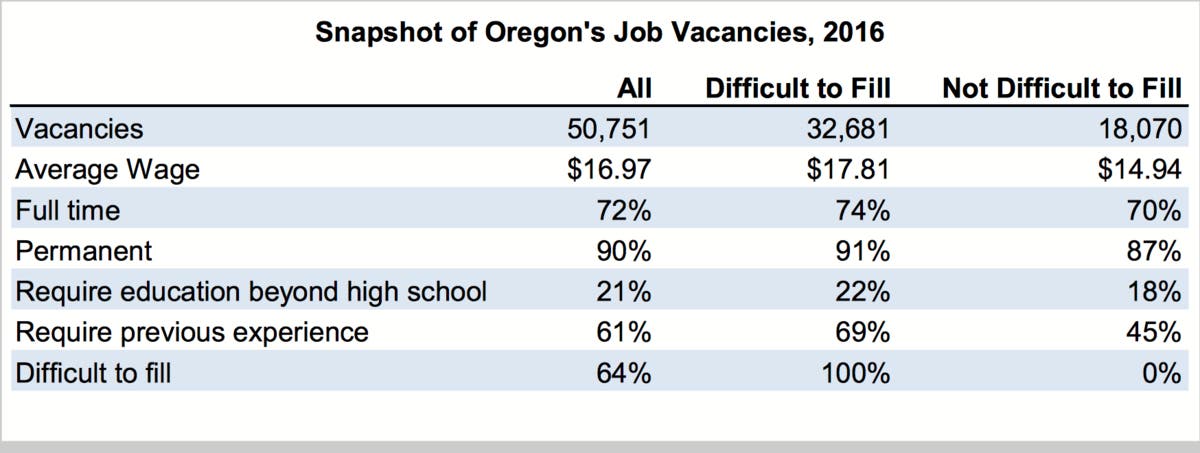
According to the report, the Portland metro area had the highest number of vacancies, though Eastern and Southern Oregon had the highest percentage of difficult-to-fill jobs, respectively.
The report further revealed little consistency in each county's reasons for unfilled vacancies with some areas reporting a lack of qualified applicants and others showing simply a shortage of applicants altogether.
Find out what's happening in Portlandfor free with the latest updates from Patch.
Click here to see the Employment Department's full report.
Krumenauer's report made some correlations, however, such as "vacancies with higher education requirements are more likely to be difficult to fill due to a lack of applicants or qualified candidates. Those with lower education requirements are more likely to report unfavorable working conditions or low wages."
How employers in Oregon overcome these challenges may require some creativity because not all vacancies can be addressed in the same way. For example, according to the report:
Six out of 10 difficult-to-fill vacancies generally cannot be addressed through education or workforce training programs. These include vacancies with a lack of applicants, unfavorable working conditions, and low wages.
They also include vacancies that pose challenges due to the job location or an employer’s need to find a candidate whose personality is just the "right fit" for the job.
Workforce training programs and education could help to fill some vacancies, the report said, but it's all relative to the type of employment being offered. Essentially, employers will need to find ways to make their jobs work for the applicants, while at the same time workers will need to become more flexible in what they're willing to do to earn a job.
Image: geralt via Pixabay.com
Get more local news delivered straight to your inbox. Sign up for free Patch newsletters and alerts.