Business & Tech
Kahn Unveils Plans for Downtown Buildings
Plans Unveiled for Former County Offices along High, Gay and Church Streets in Downtown West Chester Include Luxury Condo and New Retail Space.



In the next few weeks, as people stroll the streets, to shop and to enjoy the holiday festivities in downtown West Chester, the massive former Courthouse structure on High Street, known as the North Wing, will be quietly “gutted down to its studs,” according to Eli Kahn, the Downingtown-based developer whose name should be familiar to anyone who follows development projects in West Chester and Malvern.
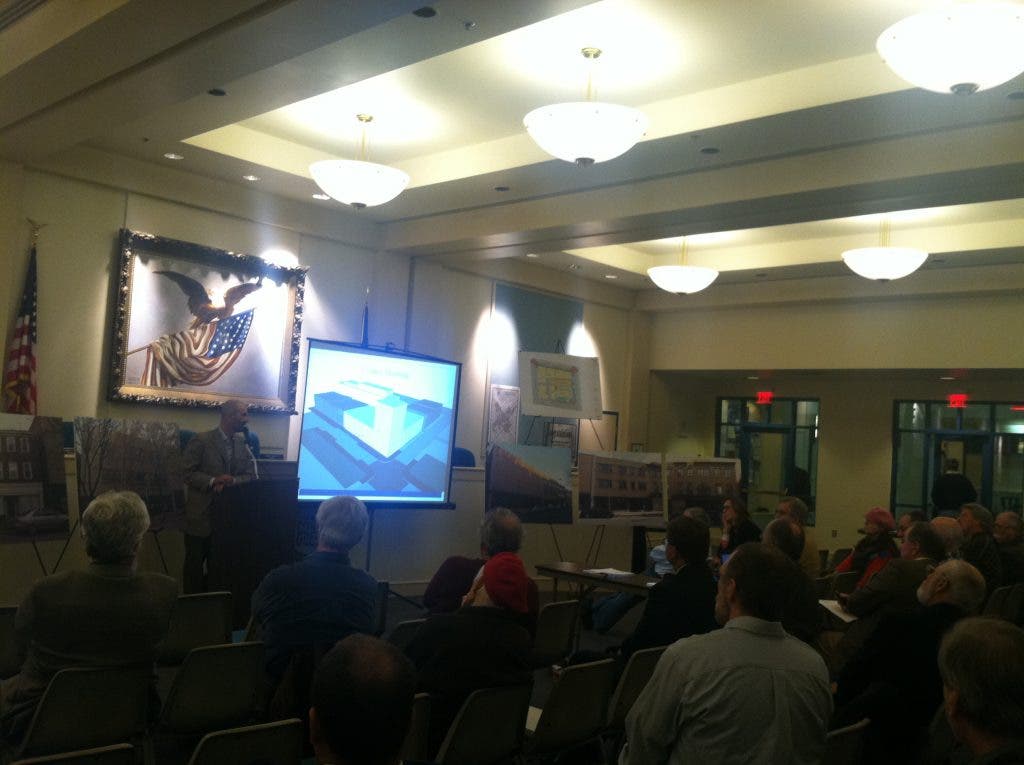
Kahn spoke Monday at a special meeting sponsored by the West Chester Business Improvement District (BID). The meeting was the first planned to give the public a glimpse of Kahn’s plans for the former county properties on more than an acre in downtown West Chester – all obtained this past fall when the Chester County Commissioners accepted his $4.5 million bid. Many in attendance said that they were familiar with Kahn’s proverbial “build it and they will come” philosophy in breathing new life into area towns.
At Monday’s meeting at the borough hall, Kahn only gave a broad view of his plans to bring office space, new housing, and retail development to the borough. The most significant news, in fact, was probably the announcement that the site will eventually boast a 20-unit luxury housing complex, complete with an underground parking garage.
Find out what's happening in West Chesterfor free with the latest updates from Patch.
Kahn briefly discussed the “gutting” of the former North Wing, renamed 10 North High Street, and then devoted the evening to his plans for his newly purchased property bordering N. Church and Gay Street. The former county land has long been described as the northwest quadrant of the First Block – a section that is located in the heart of the business district as well as the borough’s historic district.
Accompanied by his business associate Jack Lowe, who oversaw the PowerPoint presentation, Kahn opened the meeting by stating that he welcomed a discussion on the “aesthetics of the project.” However, the PowerPoint slide of the proposed housing site did not give much detail: a white block-like structure was labeled “Corner Massing” and arrows indicated that it would be 90 feet in height.
Find out what's happening in West Chesterfor free with the latest updates from Patch.
Standing before a crowd comprised mostly of businesspeople, Kahn described the site as “a dead corner for 30 years” – a reference to the fact that had been used for county offices and had therefore been a “dead” zone in the borough’s retail streetscape. Kahn said his immediate plans were to “mothball” the First Block quadrant, leaving the buildings with no heat or electricity until he could move forward with his plans. He gave no indication when this would happen.
Kahn presented a mini history of the ebb and flow of West Chester’s economic good times, including the construction of the c. 1908 Farmers & Mechanics Building, at High and Market, famous for being the borough’s first “skyscraper.” Noting that he was no fan of “contemporary” architecture, Kahn expressed admiration for the F & M Building’s seamless incorporation into the streetscape, despite its height.
Before leading a Q & A discussion about the quadrant, Kahn said that the quadrant’s “town center zoning” gave him plenty of leeway for developing the property as outlined IN the borough ordinance that might include everything from small shops and restaurants to hotels and student housing.
Kahn said he hopes to draw “upscale major retailers” such as “Trader’s Joe's,” but that he had no interest in pursuing student housing largely because his market research has shown that it would hinder his attempt to “attain high-end retail” regardless if they were major chains or small businesses. The central focus of the 90-foot “tower” complex, he said, would be tenants who would choose what is commonly called “livable” West Chester over places such as Philadelphia or the Main Line.
By building a “premier retail and residential area” on the former county property, Kahn said, the demographics would eventually change. He alluded to the 20-something population that keeps West Chester afloat economically but has made it a bar-centric town. “We could have student housing, but we don't want that… That would only acerbate our ability to attain high-end retail,” he said.
The E. Kahn Development Corp, he said, relies heavily on extensive marketing research before any construction is done. One marketing focus is a tenant who “wants a walkable downtown.”
Fielding questions that included a discussion of whether the corner complex would compete with Kahn’s proposed 120-unit complex on the nearby old Agway lot – it would not, Kahn replied – the conversation turned to the logistics of a underground garage containing 39 to 40 parking spots.
“Walkable” West Chester aside, Kahn said that he envisioned a tenant as one who “wants to drive home, park and then take the elevator up to his apartment.” Kahn repeated, “They are not going to live here unless they have parking.” Kahn’s insistence that “without parking, we can’t build” prompted some negative reaction.
Kahn also said that economic factors would make it nearly impossible to preserve three historic buildings in the quadrant. “We might be able to preserve the façade of the buildings,” he said.
In an informal discussion after the meeting, several local residents agreed that the current corner building – a 1940/60s-era structure that was once part of the Mosteller’s department store complex – has "negative" aesthetic value. Kahn called it “among the ugliest buildings in the borough.” That structure is bookended, however, by three buildings that are listed on the National Register as contributing. Two are adjoining Federal-style 19th-century structures, one of which was, for 25 years during the end of the 19th century and beginning of the 20th, the home of the popular “Charles Burns Oyster House.” Early newspaper accounts describe Burns as one of the borough’s most successful entrepreneurs – a man who was born to slaves in the south and who immigrated north on his own.
The third historic building is the original Mosteller department store, built in the 1920s as a dry goods store. Its handsome Palladian windows, tin-covered cornice, and stylized brickwork can still be seen.
Perhaps because more meetings are promised, Monday’s meeting was fairly subdued – and in marked contrast to a meeting called by the County Commissioners last August. In that meeting, residents expressed alarm that the county had placed a large chunk of the borough’s historic district up for sale with little to no public input.
A few residents and attendees including former borough council president, Bill Scott, noted that the two bidders – Kahn and Stan Zukin of Zukin Realty - differed widely on the scope of their plans. Zukin planned to revitalize all of the buildings, thereby retaining the existing streetscape and avoiding the fate of what some describe as the “Supersizing” of small towns across America.