Schools
Funnel-Like Depressions On Mars Surface Could Yield Portals For Life On The Red Planet, Texas Researcher Says
Likely formed by a volcano beneath a glacier, depressions could house warm, chemical-rich environments well suited for microbial life.


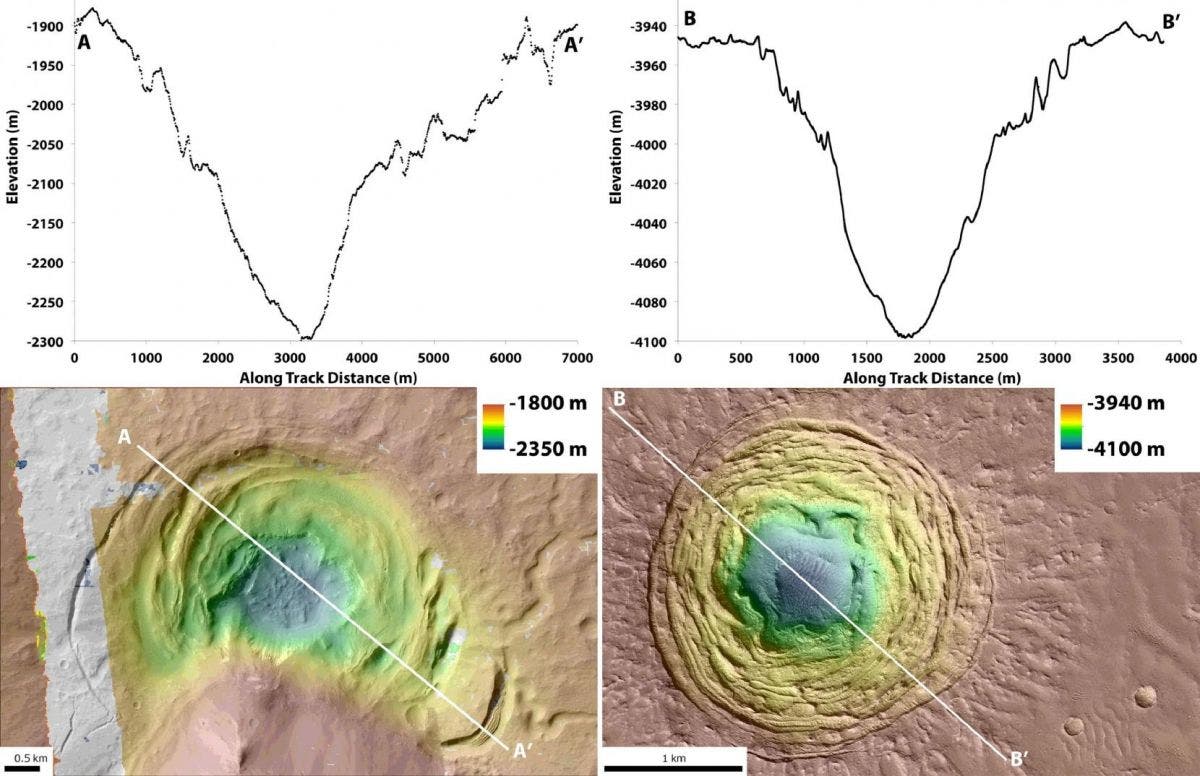
AUSTIN, TX — An oddly formed depression on the planet Mars, shaped roughly like a funnel, could yield a spot from from which to search for signs of life on the red planet, according to research led by University of Texas at Austin officials.
The weird-looking depression on the planet's surface was probably formed by a volcano beneath a glacier, and could have housed a warm, chemical-rich environment well suited for microbial life. The findings were published this month in Icarus, the International Journal of Solar System Studies.
“We were drawn to this site because it looked like it could host some of the key ingredients for habitability — water, heat and nutrients,” said lead author Joseph Levy, a research associate at the University of Texas Institute for Geophysics, a research unit of the Jackson School of Geosciences.
Find out what's happening in Austinfor free with the latest updates from Patch.
The depression is located inside a crater perched on the rim of the Hellas basin on Mars and surrounded by ancient glacial deposits, officials said. It first caught Levy’s attention in 2009, when he noticed crack-like features on pictures of depressions taken by the Mars Reconnaissance Orbiter that looked similar to “ice cauldrons” on Earth, university officials said. Such Earth-based, formations found in Iceland and Greenland are made by volcanoes erupting under an ice sheet, he added. Another depression in the Galaxias Fossae region of Mars had a similar appearance, university officials said.
“These landforms caught our eye because they’re weird looking," Levy said. "They’re concentrically fractured so they look like a bulls-eye. That can be a very diagnostic pattern you see in Earth materials,” said Levy, who was a postdoctoral researcher at Portland State University when he first saw the photos of the depressions.
Find out what's happening in Austinfor free with the latest updates from Patch.
But it wasn’t until this year that he and his research team were able to more thoroughly analyze the depressions using stereoscopic images to investigate whether the depressions were made by underground volcanic activity that melted away surface ice or by an impact from an asteroid, officials said.
Study collaborator Timothy Goudge, a postdoctoral fellow at the institute, used pairs of high-resolution images to create digital elevation models of the depressions that enabled in-depth analysis of their shape and structure in 3-D. Researchers from Brown University and Mount Holyoke College also participated in the study.
“The big contribution of the study was that we were able to measure not just their shape and appearance, but also how much material was lost to form the depressions. That 3-D view lets us test this idea of volcanic or impact,” Levy said.
The analysis revealed that both depressions shared an unusual funnel shape, with a broad perimeter that gradually narrowed with depth, the scientist added.
“That surprised us and led to a lot of thinking about whether it meant there was melting concentrated in the center that removed ice and allowed stuff to pour in from the sides," he said. "Or if you had an impact crater, did you start with a much smaller crater in the past, and by sublimating away ice, you’ve expanded the apparent size of the crater."
Researchers found the funnel-like formations probably formed in different ways, a hunch achieved after testing formation scenarios for the two depressions, Levy said. The debris spread around the Galaxias Fossae depression suggests that it was the result of an impact, but the known volcanic history of the area still doesn’t rule out volcanic origins, Levy said.
In contrast, the Hellas depression has many signs of volcanic origins, he added.. It lacks the surrounding debris of an impact and has a fracture pattern associated with concentrated removal of ice by melting or sublimation, Levy said.
Levy said the interaction of lava and ice to form a depression would be an exciting find because it could create an environment with liquid water and chemical nutrients, both ingredients required for life on Earth. The Hellas depression and, to a lesser extent, the Galaxias Fossae depression, should be kept in the mix in the realm of context when looking for habitats on Mars, Levy said.
Others agree with Levy's assertions. Gro Pedersen, a volcanologist at the University of Iceland who was not involved with the study, agrees that the depressions are promising sites for future research.
“These features do really resemble ice cauldrons known from Earth, and just from that perspective they should be of great interest,” Pedersen said. “Both because their existence may provide information on the properties of subsurface material — the potential existence of ice — and because of the potential for revealing ice-volcano interactions.”
The research was supported by a NASA Mars Data Analysis Program award.
>>> Images courtesy of University of Texas Institute for Geophysics.
Get more local news delivered straight to your inbox. Sign up for free Patch newsletters and alerts.