Community Corner
Edith Rogers: Breaking the Glass Ceiling
Remembering Herndon's History. Fairfax County's First Female Supervisor by Barbara Glakas




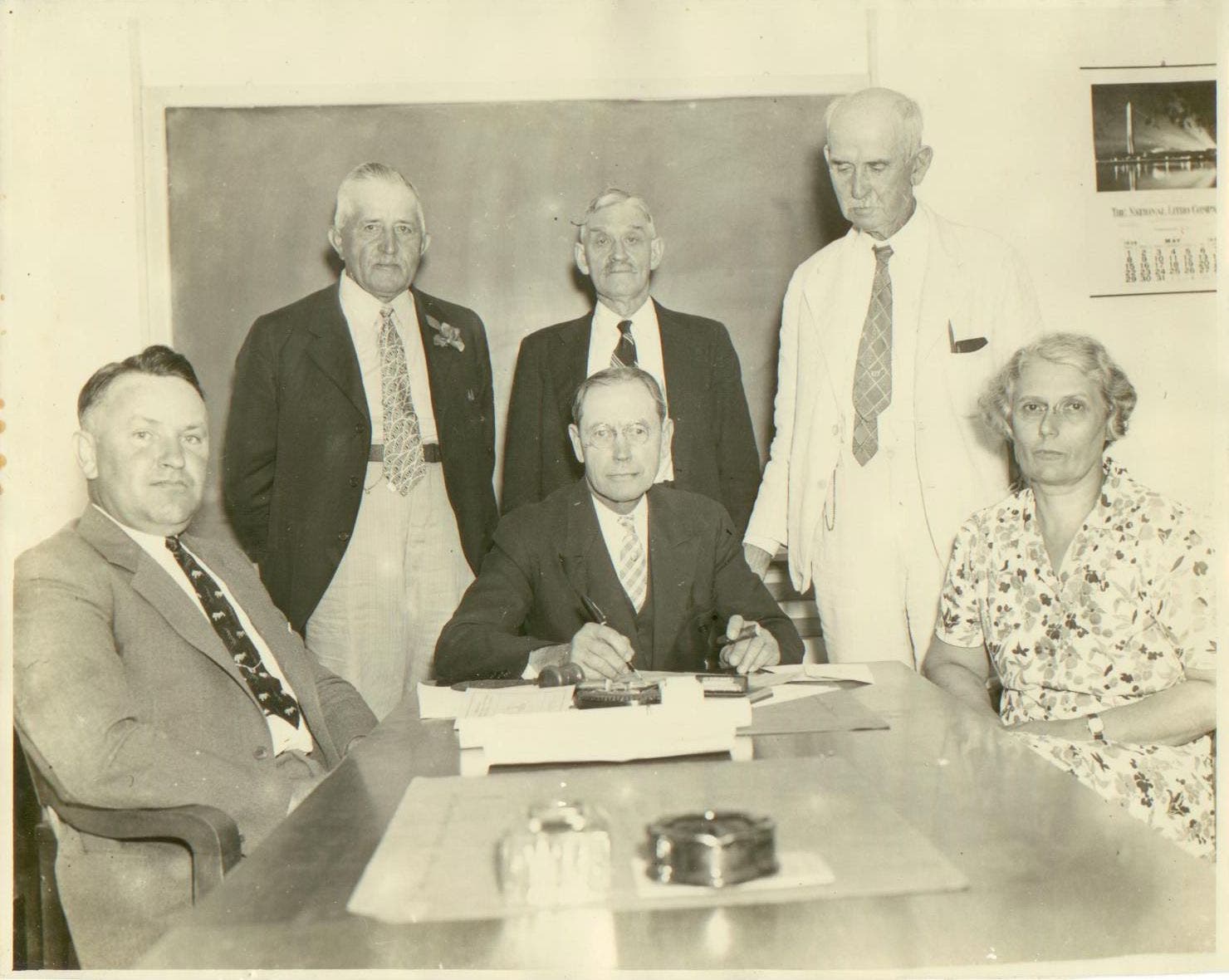
1. Edith Rogers as a Grange officer, c. 1940. Photo from Library of Congress.
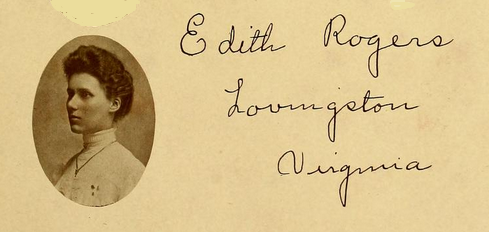
2. Edith Rogers, Senior class picture from State Female Normal School in Farmville, VA, c. 1908. Photo courtesy Longwood College.
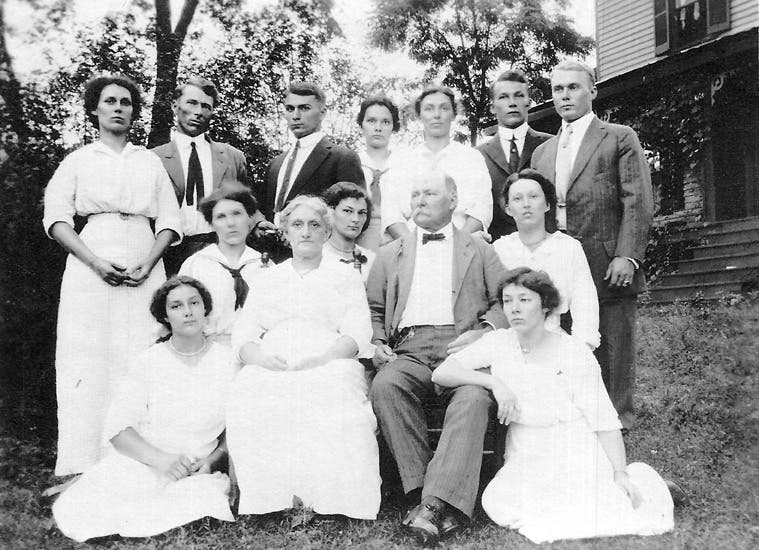
3. The Rogers Family. Edith stands at far left. Photo courtesy Susan Rogers MacAuley.
Find out what's happening in Herndonfor free with the latest updates from Patch.
4. Edith Rogers and brothers Edward & Holcomb during WWI. Photo courtesy Susan Rogers MacAuley.
5. The Blossom Hill farm house. Photo courtesy Susan Rogers MacAuley.
Find out what's happening in Herndonfor free with the latest updates from Patch.
6. Edith Rogers on the Fairfax Co. Board of Supervisors, c. 1938. Photo courtesy of Friends of Beacon Field Airport.
By Barbara Glakas
From farmer to educator to the first female County Supervisor, Edith Roger’s made an indelible mark on Fairfax County and the greater Herndon community.
EARLY LIFE
Prior to coming to Herndon in 1914, the Rogers family lived in Nelson County, Virginia, an area located between Charlottesville and Lynchburg. Edith’s parents, James and Mary Rogers, were born in Delaware and Pennsylvania, respectively, in the 1850s. They married in 1878 and went on to have 12 children. James was a farmer and owned a farm in Lovingston, Virginia.
Edith, the sixth child born in 1887, attended school in Nelson County. She graduated from the State Teacher’s College in Farmville, Virginia, (now Longwood University) in 1908, where she studied secondary education. In the college class prophesies, where predictions were made about what the seniors would be doing in 10 years, it was predicted that Edith would found an industrial school. Edith also served as Treasurer of the Virginia Normal League. Its mission was:
“To found and maintain, by means of annual dues, gifts from outside sources, and otherwise, and aid fund designed to help young women of fine mind and character who are eager for an education, but are unable to attend school. To conduct an educational bureau which seeks to place, free of charge, members of the League and graduates of the school in communication with county superintendents and school officials wishing trustworthy, well trained teachers for their schools.”
TEACHER AND FARMER
From 1912-1916 Edith taught in the public schools of Portland, Oregon. While living out west she travelled extensively, including travel to Alaska, Canada and Mexico.
In 1914 James and Mary Rogers and their grown children moved to a Herndon area farm in Floris. The Rogers family called their new farm Blossom Hill, due to its surrounding flowering shrubs, trees and gardens. Blossom Hill had a large farm house, as well as many other buildings scattered throughout the property, including a garage, smoke house, barns, hen houses, turkey coops, silos, wood and equipment sheds, a corn crib and several out houses. The farm had a host of animals, including dairy and beef cattle, pigs, poultry, cats, dogs and mules for plowing.
This 100 acre farm was located on the west side of Centerville Road, a few hundred yards across from the present day Frying Pan Park, in a neighborhood which is now the Copper Crossing.
Edith was already 27 years old when her family moved to Floris. She became active as an educator in the local schools. The younger Rogers children, and subsequently some of their grandchildren, attended Floris Elementary School, Floris Vocational School, and later Herndon High School on Locust Street.
Some members of the family were involved in the farm life, while others were in school or obtained other jobs. The family had hundreds of chickens. Dressed chickens and eggs were sold to members of the surrounding Herndon community. Days on the farm were filled with planting fields and gardens, baling and storing hay, threshing wheat, feeding the animals, gathering eggs and shelling corn. Harvest times were particularly busy, and the women spent long hours preparing home cooked meals for all the farm hands who would eat on the back porch of the house.
SERVING OVERSEAS IN THE RED CROSS
Not too long after the Rogers family had moved to Floris, the events leading up to World War I started escalating. In 1914 Archduke Ferdinand was assassinated. Austria, France, Germany and Britain declared war. The Lusitania was sunk in 1915 and by 1917 the United States declared War on Germany.
Two of Edith’s younger brothers, Holcomb and Edward, served in WWI. Holcomb served in the 119th Infantry of the American Expeditionary Forces. Edward served in the Navy. Edith was a member of the local War Aid group that collected goods for overseas service members, but she opted to do more. Edith resigned from her position as Principal of Herndon High School to go overseas to serve with the Red Cross.
In October of 1918 Edith applied for a passport to go to France and Great Britain. At 31 years old, Edith’s passport indicated that she was five foot six, with brown curly hair and a dark complexion, and with brown eyes that were surrounded by round wire-rimmed spectacles. She left the United States through New York, sent for duty as a civilian with the American Expeditionary Force, in connection with the Red Cross. She served as a canteen worker in Bourges and Brest, France. Unlike the British women who were on loan to American Expeditionary Force in France, the American women, other than some nurses, were considered civilian, not military. Therefore, they received no benefits, including no housing, no food, no insurance, no medical care, no legal protection, no pensions, and no compensation for their families in the case of death. On a 1930 census document, for the question that asked if the person was a veteran, the word “yes” was marked in the box by Holcomb’s name. The box by Edith’s name was left blank.
NEVER IDLE AFTER THE GREAT WAR
In 1922, Edith became the principal at the Fairfax School, while also teaching first through third grades. Teaching, however, was not her only endeavor. Edith was a very active member of the community. All the through the 1920s local newspapers noted her involvement in a variety of community events, often times acting as the organizer. With children she was a Scouting Mistress with a Girl Scout Troop organized at the Episcopal Church in Chantilly. She was a Sunday School Association Officer, attended a Sunday School Convention in Roanoke and became a driving force in the Ladies Auxiliary of the church. She organized Halloween and Valentine’s parties. She organized plays and pageants and was involved with the Floris PTA.
Socially, she and her sisters were avid bridge players and hosted Wednesday afternoon bridge club meetings at Blossom Hill. She won 4-H and local fair contests for best devil’s food cake and grape preserves. She was a member of a Farmer Club no. 1, the Daughters of the American Revolution, the Business Woman’s Professional Club, and The Home and Interest Garden Club. In the early days she was a member of St. Timothy’s Episcopal Church in Herndon but later changed her membership to an Episcopal Church in Chantilly.
Edith was also involved with the local Home Demonstration Club. Such clubs became popular in the 1920s and were a part of the U.S. Department of Agriculture Cooperative Extension Service. They offered adult education for rural citizens in the areas of agriculture and other at-home practices for farming families. Farm women, for example, would be taught improved methods for accomplishing labor-saving methods to help improve conditions at home. Many of the demonstration projects related to commodities, such as selling canned goods, which would earn additional money for the farm families. Edith began organizing home demonstrations.
Edith increasingly took on leadership roles. She became an officer in the Woman’s Home Demonstration Advisory Council, in the Herndon Mason’s Order of Eastern Star and in the Floris Grange. The Grange, another important part of rural America, was an association that sought to advance methods of agriculture, as well as to promote the social and economic needs of farmers. In the 1920s there were four Grange chapters in Fairfax County, with one being in Floris. Grange group meetings included discussions and lectures on a variety of topics, such as diseases effecting dairy cows, road conditions, methods to keep milk at the right temperature, and cooperative efforts between farmers to buy seed together in large quantities. Edith was a founding member of three local granges (Floris, Ponoma and State) that were organized in 1927-1928. She became a lecturer for the Floris Grange. For years the Floris Grange met once per month, sometimes in the farm house at Blossom Hill.
Edith was known to grow wheat on the farm. The wheat was used for two purposes: some was used for chicken feed and some she had milled at the Herndon Milling Company (near Elden and Station Streets) for home use. Edith’s occupation was never listed as “Farmer” on census documents, although farming was a big aspect of her life, as well as teaching.
Edith and her brother Holcomb eventually bought the farm from their parents, making the farm their permanent home. Holcomb ran the operations of the farm while Edith managed the financial aspects and tended to the chicken house. In the 1930 census Holcomb was listed as “Head” of the household, while Edith’s name is marked “Sister-H.” (It is only speculation that the “H” may have been an additional symbol for head of household). The parents still lived at the farm house along with sister, Dorothy, who returned home after retiring as a librarian from a New Jersey school system.
PERSERVERING THROUGH LIFE’S CHALLENGES
In 1931, Edith was named as principal of Forestville School in Great Falls. However, she was not re-appointed as Principal in 1932. Local newspaper reports showed that community members had submitted many petitions to the Fairfax County School Board, asking for Edith to be retained. Newspaper articles also indicated that school funds were cut that year, eliminating music and language classes. It is not clear if that was related to Edith not being re-hired.
Concurrently, Edith also attended American University in Washington, D.C., which she began in 1930. To get to school she would ride a horse part of the way to get to a car and then motor the rest of the way into Washington. She graduated in 1933, earning a Bachelor of Science in Education. Edith’s mother passed away that same year.
THE FIRST FEMALE COUNTY SUPERVIOR
After graduation, Edith was appointed to fill a vacancy on the Fairfax County Board of Supervisors as a result of the death of Supervisor W.H. Ellmore. When that term expired Edith ran to continue serving in that post. She won her election and the Fairfax Herald newspaper editorial staff gave their “hats off” to Edith for maintaining such “a fine majority.” She represented the Dranesville District on the Board of Supervisors from 1935 to 1940. Edith broke a glass ceiling as she was the first woman to serve on Fairfax County’s Board of Supervisors – the governing body of Fairfax County -- since its inception in the 1890s.
While serving on the Board of Supervisors, Edith worked to balance the urbanization of Fairfax County with the needs of the farming community. When the Fairfax County Grange appeared before the Board to recommend Joseph Beard, a Floris native, to succeed Harry Derr as Fairfax County’s new Agricultural Extension Agent, Edith made the motion to hire him.
Edith cast votes to keep taxes rates in check whenever she thought they would overburden the farmers. One year she took out a special ad on the front page of the Herndon Observer newspaper, asking people to come to a special meeting at the high school to talk with her about a proposed tax hike, warning that there was a “very serious situation,” saying that the people may be facing an unprecedented tax increase. She cautioned, “Farm land is now bearing more than its share of the taxes.”
She served on a road beautification committee and served as the Chairman of the County Board of Public Welfare, established in accordance with Virginia’s new Public Assistance Act. She conducted speaking engagements for many local groups, such as the Shriners, the 4-H Club, the Agricultural Board and at County Fairs. She continued to engage with the groups in which she had always been associated, such as the Home Demonstration Club and the Home Interest and Garden Club. During this time period she also travelled for both business and pleasure, going to New York, New Jersey, Charlottesville and Richmond.
In 1936 the Dranesville District Democratic Club elected her as their representative to the Democratic Convention in Norfolk. That same year she was elected as an officer to the Order of Eastern Star, a Freemasonry-related organization open to women.
Edith ran for another term on the Fairfax County Board of Supervisors. In 1939 she wrote an open letter to the local newspapers, explaining the propaganda that was being spread about one of her votes, anticipating that it may lead to her defeat. The letter had to do with a vote she cast about apportioning road money. She explained how the Dranesville District had the largest amount of secondary roads but the apportionment policy had been “hit and miss.” She voted for a plan by the county engineer to apportion money to the districts by road mileage. The vote on the Board was a tie. She then accepted a compromise plan that she said – as it ended up – would have benefited the district. She also explained how she had helped stop a motion for a referendum to increase school levies. Nevertheless, in the next election, Edith lost her seat on the Board of Supervisors by 30 votes.
Shortly after her election loss, she became a census enumerator, became the Superintendent of the Floris Fair, became the chairperson of the Red Cross Roll Call (a fundraising drive), became a Democratic Primary official, and served on the Civil Defense Council.
Edith was also soon appointed to serve on a committee to study the proposed changes to the County’s form of government. She, along with several others, wrote an open letter in a local newspaper, urging voters to approve the adoption of a County Executive form of government, explaining that it would simplify government, save money, and would give more local control to the people by giving the Board of Supervisors more appointment powers. (At that point in time some County officials were appointed by a Circuit Judge). Fairfax County’s current form of government is in part due to Edith’s efforts.
FROM COMMUNITY LEADER TO CARETAKER
Life at Blossom Hill carried on. The 1940 census listed Holcomb as the “Operator-Owner” of the farm. Edith’s father died the following year. Holcomb, with his wife and their three young children, lived in a bungalow house on the property. Holcomb and his wife later separated in the mid-1950s, and the children moved back into the big Blossom Hill house. Edith became the children’s legal guardian after Holcomb’s divorce and raised them as her own.
After Holcomb’s death in 1962, Blossom Hill was sold to an investment group. However, John Middleton – a farmer from the nearby Horse Pen Farm – rented the property and continued to farm it. Edith continued to live there for a few more years.
In her later years, Edith took in an intellectually challenged woman that she became associated with through the Public Welfare Board. Edith became her ward. In the late 1960s Edith, at the age of about 80, bought and moved – with her ward -- into a smaller brick house on Fox Mill Road, less than a mile from where Blossom Hill had stood. After the ward left one of Edith’s nieces moved in with her.
The 1960s brought another large change to area -- the construction of the nearby Dulles airport. From riding horses, to using horse drawn carriages, to using automobiles and to ultimately watching airplanes fly over Floris, Edith lived through many changes in her lifetime while at Blossom Hill.
LEGACY
Edith Rogers was a well-respected and highly accomplished woman of her times, who had a significant impact on the Herndon area. She died in 1978 at the age of 91 and is buried in Herndon’s Chestnut Grove Cemetery. Today one of her grandnieces says that she grew up knowing that Edith Rogers was amazing, adding that her great aunts were “some very strong women.” She is proud to say that she now stands on their shoulders.
----------
About this column: “Remembering Herndon’s History” is a regular Herndon Patch feature offering stories and anecdotes about Herndon’s past. The articles are written by members of the Herndon Historical Society. Barbara Glakas is a member. A complete list of “Remembering Herndon’s History” columns is available on the Historical Society website at herndonhistoricalsociety.org.
The Herndon Historical Society operates a small museum that focuses on local history. It is housed in the Herndon Depot in downtown Herndon on Lynn Street and is open every Sunday from noon until 3:00. Visit the Society’s website at herndonhistoricalsociety.org, and the Historical Society’s Facebook page at facebook.com/HerndonHistory for more information.
Note: The Historical Society is seeking volunteers to help keep the museum open each Sunday. If you have an interest in local history and would like to help, contact HerndonHistoricalSociety@gmail.com.
Get more local news delivered straight to your inbox. Sign up for free Patch newsletters and alerts.