Community Corner
Boards I Have Known
The Board of Supervisors pendulum tends to swing every four years.
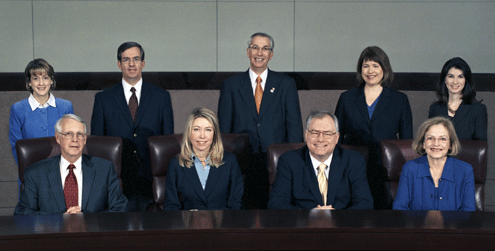
When I came to Loudoun County in 1989, it seemed odd to me that people referred to this , or the last Board, or the next Board, as if the Board of Supervisors ceases to exist every four years, only to be born anew. Almost 23 years later, it still seems odd.
In my experience, the elected bodies of most other local governments have staggered terms, with members who come and go every two years. The county, city or town council is considered to be one continuous entity, stretching back to the time the city or county was founded. If someone has a beef with the council going back five or six years, it’s still the same council, even if the members are different.
That’s not the case in Loudoun County and many other counties in Virginia. Since all the seats on the Board of Supervisors run concurrently, all are up for election at the same time. Since I have lived here, there has been significant turnover on the Board every four years. Often the returning incumbents find themselves in the minority on the new Board.
Find out what's happening in Leesburgfor free with the latest updates from Patch.
As result, the Board of Supervisors develops a new identity every four years, with new faces, new leaders, new interrelationships (or lack thereof) and new philosophies about local government. Thus, we tend to think of each group of supervisors as a different entity from the one that precedes or succeeds it. We also tend to brand each Board with the name of its chairman.
In this high-growth environment, the Board’s approach to handling land development issues has arguably been the defining characteristic of each Board. The four-year swings from “pro-growth” to “slow growth” to managed growth” have been just as important as the swings from Republican majority to Democratic majority and back.
Find out what's happening in Leesburgfor free with the latest updates from Patch.
Here’s a quick overview of the Boards I have observed:
The Tatum Board (1988-1991): This was the last Board to have only eight members, with the chairman elected by the other Board members. Chaired by Democrat Betty Tatum, the Board had five Democrats, two Republicans, and an eighth seat that shifted from Republican to Democrat and back again because of a resignation. Despite the Democratic majority that favored a managed growth approach, the Board was divided in many areas, and often deadlocked 4 to 4 on key issues. Consequently, the 9th seat was added – the at-large chairman, elected directly by the voters.
The Barton Board (1992-1995): Chaired by George Barton, this Board started with eight Republicans (including Independent Charlie Scaggs, who ran with Republican support) and one Democrat, Thomas Dodson. Dodson resigned midway through the term and was replaced by Republican Ready Snodgrass. This group was considered to be pro-growth. Since this was the last all-Republican Board to serve Loudoun County, it may give us some clues as to what to expect from the new Board next year.
The Myers Board (1996-1999): Although this Board had a seven-Republican majority, including Chairman Dale Polen Myers, it was badly divided. A bipartisan “Gang of Five” composed of Democrat Eleanore Towe, Independent Jim Burton, and Republicans Scott York, Joan Rokus and Dave McWatters formed a working majority that favored a slower approach to growth than Myers and her allies. This Board’s term was marked by obvious bad feelings between the two factions.
York I (2000-2003): Democrats returned to power on this Board, with the help of Independents who often sided with the Democrats on key issues. This Board, which was generally considered a “slow growth” Board, functioned quite smoothly compared to the Boards that came before and after it.
York II (2004-2007): This was a mirror image of the Myers Board. A pro-growth, Republican “Gang of Five” – including some who were allies of Myers herself – seized control from York (by then an Independent), who occasionally ruefully referred to himself as the assistant to Vice Chairman Bruce Tulloch. It was another Board marred by bad feelings that were on display for the entire four years.
York III (2008-2011): The Democrats regained power on this Board, which was also noteworthy as the first to have a majority of female Board members. Over time, York again found himself in a political minority as well, frequently voting with Republicans Lori Waters and Eugene Delgaudio. By the end of his term, York had returned to the Republican Party. Of four incumbents seeking re-election, only York and Delgaudio will return in 2012.
As the end of this Board’s term approaches, we’ll take a look at recent history for some early indicators that might provide hints as to what we can expect from York IV.