Community Corner
Roaring 20's Come Alive At Villa Madera On Gravelly Lake
Flappers, classic luxury cars and Lakewood's high society converged in the gated Madera community Sunday to benefit the Lakewood Historical Society.
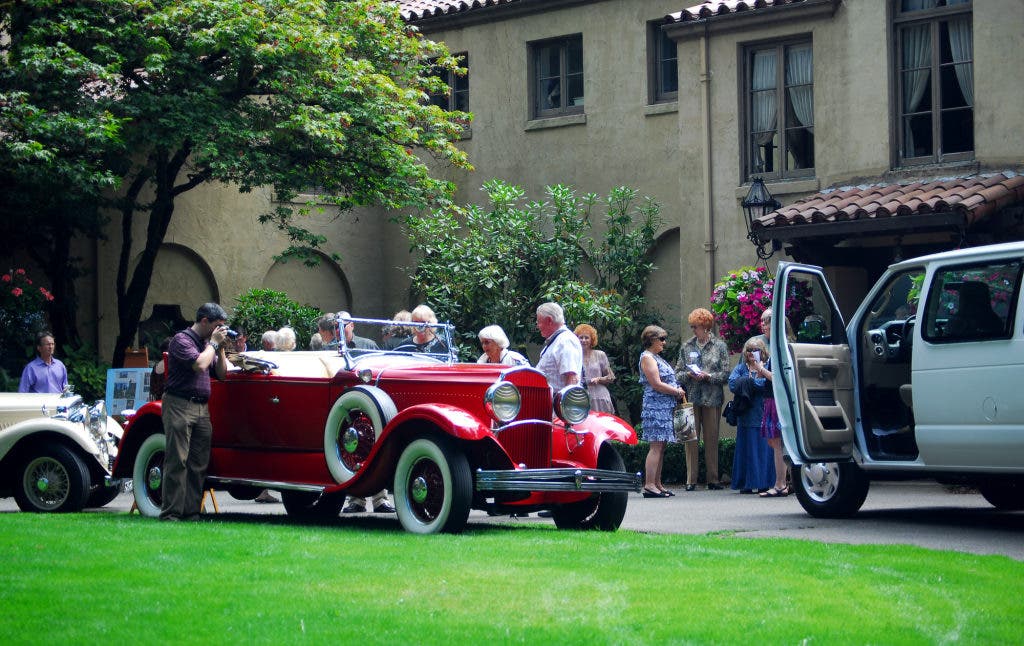


They called it the Jazz Age, the Roaring 20’s, the age of “Anything Goes.”
And a slice of it came to life again Sunday when Kyle Smith and Gayle Hampton-Smith threw open the doors of their 1920s-era Villa Madera estate overlooking Gravelly Lake to raise operating funds for the Lakewood Historical Society.
One could easily imagine F. Scott Fitzgerald, Ernest Hemingway and Gertrude Stein smiling down nostalgically upon these lush, gated grounds and on the pristine Bentley parked in the driveway.
Find out what's happening in Lakewood-JBLMfor free with the latest updates from Patch.
The place was buzzing with nearly 170 visitors and 50 volunteers. The guests comprised a veritable “Who’s Who” list of Lakewood’s upper crust, who paid $50 to tour the house and grounds, enjoy live music and hors d'oeuvres and become—if only for a while—denizens of the Lost Generation.
Latter-day flappers in brightly colored fringed dresses with dyed ostrich plumes in their hair and long strands of faux pearls looped around their necks glided across perfectly manicured lawns, leisurely sipping wine, stopping to chat here and there with men dressed in period attire.
Find out what's happening in Lakewood-JBLMfor free with the latest updates from Patch.
Sunday’s "Walk Into History at Villa Madera also brought together descendants of the estate’s former owners.
Anita Murray Barbey, of Portland, Ore., is the granddaughter of the second owner, Lowell Murray.
“We were the only Murray grandchildren who didn’t live in Tacoma,” she said. “We lived in Astoria, Ore., and came up every year for Christmas. I remember when it was 40 acres, all trees and over 5,000 rhododendrons. I don’t remember it ever being gated.”
Smith, the current owner, explained how he and his wife came to be the home’s sixth owners.
“Because my job involves a lot of travel, I told my wife many years ago that the next time we move she would have 60 percent of the vote,” he said. “She found the home of her dreams and that was the end of the story.
“We absolutely love living here. We love sharing it, because we know a lot of people enjoy being here.”
A Puget Sound native, Smith moved to Villa Madera from University Place. He and his wife are raising two grandchildren.
Becky Huber, president of the Lakewood Historical Society, said the non-profit group was looking for a signature fundraising event that could generate some serious income—hopefully on an annual basis.
“Obviously, we get a lot of wonderful donations, but we needed a really, really special event,” she said. “This is the first of this particular kind of thing and it’s been a huge success.”
Huber said that between ticket sales, contributions and grants, she expects the event to generate close to $10,000.
“The most we’ve done before is something like $2,500 for a command performance at the Lakewood Playhouse,” she said.
For those interested in the mansion’s history, here’s more:
Villa Madera’s story begins at the end of World War I, when speculators and entrepreneurs were amassing fortunes in real estate, banking, shipping and lumber.
Born in 1861 in Iowa, Joseph Carman had come to Tacoma in 1890 at age 29, founded the Carman Manufacturing Co. and prospered producing mattresses.
In 1906, he and 24 other investors bought land on American Lake for the Tacoma Country and Golf Club, then exchanged his lot and located his summer home on Gravelly Lake.
In 1919, he purchased 18 acres from land-speculator William Pearce of Massachusetts, who had never seen the virgin evergreens that stretched from Gravelly Lake Drive to the shoreline.
Carman and his wife, Margaret, chose Kirkland Cutter from Spokane to design their villa. As the Pacific Northwest’s premier architect, Cutter also had farshioned the Stimson mansion in Seattle, remodeled the Tacoma Hotel and created Thornewood mansion in the Lakes District.
For the Carmans, he blended the nobility of an Italian villa with the comfort and charm required by a Northwest family that entertained regularly in lavish style.
Prior to construction, the Carmans traveled to Europe and bought art pieces to suit the interior and exterior decor of their new home. Margaret Carman also worked with Seattle landscape architect Fred Cole to create formal gardens with walks, native plantings, contoured lawns and a terraced brick path leading to the lake.
But the stock market crash of 1929 and subsequent Great Depression curtailed the couple’s lavish lifestyle. Margaret Carman died in 1937, followed by her husband the next year.
Their only child, Joseph Carman II, and his second wife, Mary Lee, moved into the villa. However, she neither wanted nor needed a house that required a staff of six people to maintain it, including three gardeners.
In 1939, the Carmans sold their 27-acre estate to Lowell Murray, owner of West Fork Timber Co. Murray’s wife, Helen, changed the name to Villa Madera after learning that “madera” means wood in Spanish. The couple also bought another 13 acres, bringing the total to 40.
Following her husband’s death in 1971, Helen Murray stayed in the mansion another six years. Then in 1977, she sold the home and five adjacent acres to Michael Dick. The rest of the property was subdivided into large residential lots, with much of the original lawn, forest and gardens preserved for the use of other residents.
Real estate broker Dena Hollowwa bought the mansion in 1984, then sold it to TV actress Linda Evans three years later. In turn, Evans sold it to Smith and his wife in 2002.
The couple owns Smith-Western Co., a Tacoma-based firm that produces promotional items and souvenirs for the tourist industry, basically airport gift-shop fare like pens, key rings, coffee mugs, miniature replicas of the Statue of Liberty and the Space Needle.