Community Corner
Last-Known Slave Ship Clotilda May Have Been Found
The wreckage of what is thought to be America's last known slave ship, the Clotilda, was exposed by the low tides of the "bomb cyclone."


MOBILE, AL — The wreckage of the slave ship Clotilda, the last known ship to bring African slaves to America, may have been exposed by low tides accompanying the “bomb cyclone” weather system that battered the Eastern Seaboard earlier this month. Ben Raines, a reporter for Al.com, used historical accounts and stories from old-times to pinpoint where the schoonr should have rested after it sunk more than 150 years ago.
What Raines and others believe is the wreckage of the notorious ship almost completely buried in mud near an island in the lower Mobile-Tensaw Delta. It is typically under water, but tides that were about two and one-half feet lower than normal gave Raines a better view of it. Archaeologists from the University of West Florida helped him in the documentation.
John Sledge, a senior historian with the Mobile Historical Commission and author of “The Mobile River,” said the vicinity where the wreckage was found corresponds with historical accounts.
Find out what's happening in Mobilefor free with the latest updates from Patch.
“I’m quaking with excitement,” Sledge told Raines. “This would be a story of world historical significance, if this is the Clotilda.”
The Clotilda was built in 1855 and was never intended to be used as a slave ship, according to historical accounts.
Find out what's happening in Mobilefor free with the latest updates from Patch.
Though slavery was still legal at the time, the international slave trade was outlawed in 1807, years before the Clotilda made its final journey in 1859 under the command of Capt. William Foster, writes historian Sylviane Anna Diouf, the author of “Dreams of Africa in Alabama.” The ship came ashore in Mobile in the summer of 1860, carrying a cargo of at least 110 children, teenagers and young adults from modern-day Benin, Africa.
Other accounts say the ship carried 160 Africans and that it arrived back in Alabama the same year it sailed. What most historians agree on is that Mobile shipyard owner Timothy Meaher sent the ship to Western Africa on a bet he could bring a shipful of slaves “right into Mobile Bay under the officers’ noses,” Diouf writes.
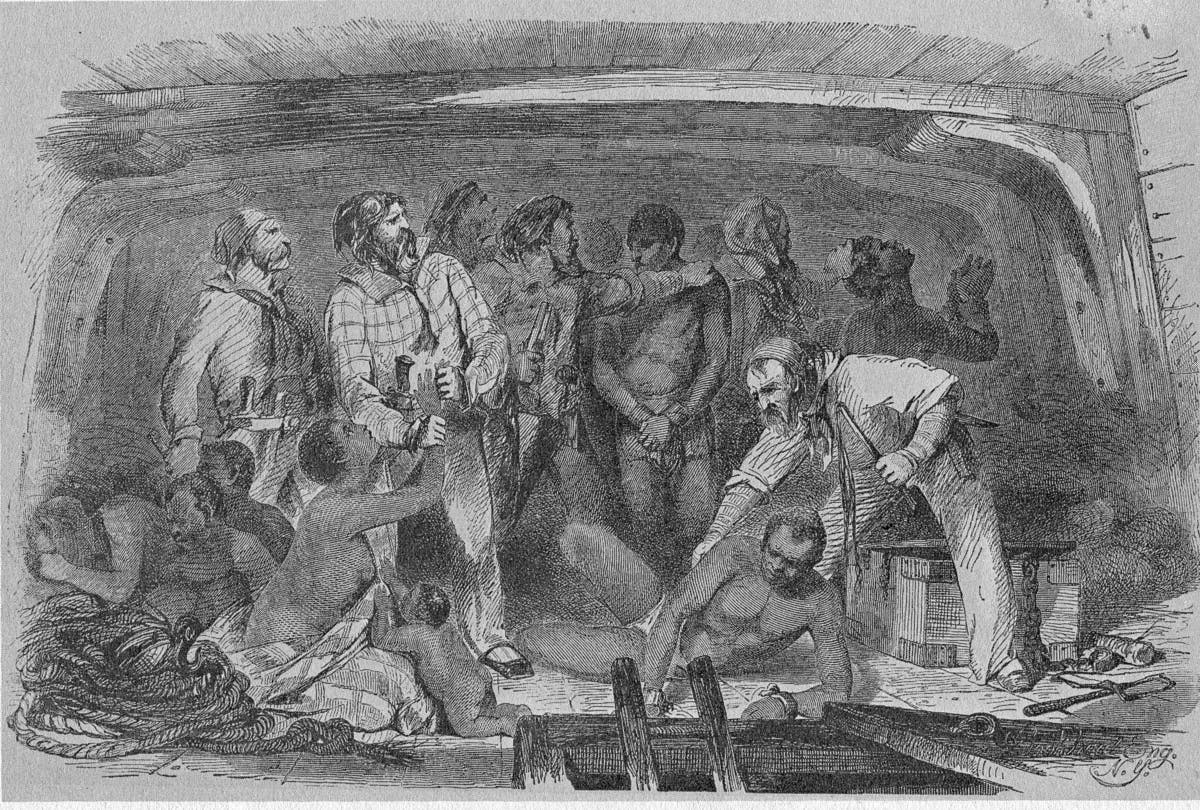
It worked. The ship came into port under the cover of darkness. After transferring the Africans to a riverboat, Foster burned and sunk the Clotilda to cover up what at the time was illegal activity, Al.com and others say.
At least 30 of the slaves were dispatched to work at Meaher’s plantation, Al.com writes. Many remained in the area after emancipation, settling in what is now known as the Africatown neighborhood of Mobile.
“Even though it's a terrible story, it's uplifting," Diouf said in a 2007 Press-Register interview about her book. "It's not about what was done to them. It's about what they did. They came as children, maintained their traditions, their language. If they could do that, we can do anything."
» Read the full account of the possible discovery of The Clotilda on Al.com.
Image: This is an undated photo of an illustration of slavers subduing their African captives in the cargo hold of their slave ship. (AP Photo)
Get more local news delivered straight to your inbox. Sign up for free Patch newsletters and alerts.