Schools
Arizona State University: Late Professor's Legacy Remembered With Memorial, Exhibit
The School of International Letters and Cultures recently held a memorial in honor of David William Foster, a Regents Professor of Spani ...

September 27, 2021
The School of International Letters and Cultures recently held a memorial in honor of David William Foster, a Regents Professor of Spanish and women and gender studies who died last year at the age of 79.
Find out what's happening in Phoenixfor free with the latest updates from Patch.
Foster joined Arizona State University 55 years ago and helped build the Spanish and Portuguese programs that are now housed in the School of International Letters and Cultures. Over the course of his career, he published more than 50 book-length, single-authored critical studies, bibliographies and anthologies, and over 35 edited and co-edited anthologies.
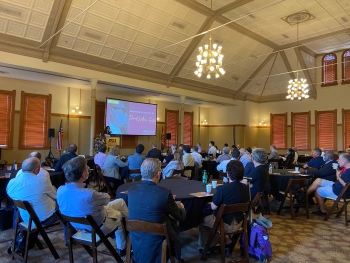
The School of International Letters and Cultures recently held a memorial in honor of David William Foster, a Regents Professor of Spanish and women and gender studies who passed away last year at the age of 79.
Download Full Image
The memorial in Old Main on the Tempe campus, held the day before what would have been Foster’s 81st birthday, had in-person attendees and was also livestreamed on the school's YouTube channel. Remembrances from Foster’s former colleagues and students continued after the event concluded as members of the school community shared stories of the beloved professor.
Find out what's happening in Phoenixfor free with the latest updates from Patch.
“The memorial for David was a great success,” Spanish Professor Carmen Urioste-Azcorra said. “It served as a homecoming for many doctoral students who worked with David since the early '70s, and we had presentations and messages from three different Latin American countries that David knew very well: Mexico, Brazil and Argentina.”
Edurne Beltrán de Heredia Carmona, an assistant professor at Coastal Carolina University in South Carolina, worked closely with Foster during her Spanish PhD studies at ASU. Beltrán graduated from ASU in summer 2021.
“Working with Dr. Foster meant always having a second opportunity for everything (and a third one, too),” Beltrán said. “I will always remember what he told me the last time we met in person: ‘Always stay by the side of your students and support them, even when you know they aren’t always right.’”
An exhibit celebrating Foster’s life and career is now open in the lobby of Hayden Library. The exhibit includes a short biography of Foster, shelves of books he wrote and other texts relevant to his studies and photographs from his life. It features furniture like a desk and several chairs along with potted plants to make students feel at home and replicate “the unique experience of working with him in his office,” said Seonaid Valiant, curator for Latin American studies at the ASU Library.
The walls of Foster’s office were covered in posters, and he had numerous bookcases placed back to back and packed full of books, Valiant said. The exhibit is designed to mimic the atmosphere of his office, a place of deep thinking that reflected the personality of the man who occupied it.
The exhibit “helps all visitors visualize David at work: His desk — like the one in the library — was always perfectly organized, and the office walls were covered with pictures and film posters,” Urioste-Azcorra said. “By virtue of his immense critical production, he was a strong magnet for prospective students. He always had an open-door office policy that made him easily accessible for everybody.”
Two Arizona State University School of Public Affairs professors began work this fall in national leadership positions in prestigious research and education organizations.
Mary Feeney, a full professor and Lincoln Professor of Ethics in Public Affairs, is the new program director of the Science of Science: Discovery, Communication and Impact Program at the National Science Foundation (NSF).

Derrick Anderson (left) and Mary Feeney of the ASU School of Public Affairs faculty have been named to national leadership positions in prestigious research and education organizations. ASU photos
Download Full Image
Derrick Anderson, an associate professor of science and technology policy, is the new senior vice president for learning and engagement at the American Council on Education (ACE).
Feeney said the Science of Science program will offer her an excellent opportunity to explore new ways to communicate about science and scientific discovery.
“It’s an opportunity to run a great program that focuses on the social science of science – how science policy is implemented, how scientists do their work and what makes scientific teams and work successful,” she said.
Feeney said she is filling a big role but welcomes the challenge. She said she is excited to work with the NSF to expand research opportunities for individuals from historically excluded groups including women, people of color, Indigenous researchers and those working in new or underfunded social science disciplines.
Feeney is editor of the Journal of Public Administration Research and Theory and associate director of the Center for Science, Technology and Environmental Policy Studies, based in the Watts College of Public Service and Community Solutions. She is working on a center team project, SciOPS, that investigates scientists’ opinions about current issues such as working with the media and the effects of COVID-19 on their work.
A fellow in the National Academy of Public Administration, Feeney’s research “focuses on public and nonprofit management and science and technology policy,” according to her biography.
“I’m really excited to have the opportunity to put my science policy research into practice, as well as to help the NSF direct funding toward projects that advance its mission and expand NSF funding to scholars working on innovative projects across disciplines,” Feeney said.
The NSF is an independent federal agency created by Congress in 1950 “to promote the progress of science; to advance the national health, prosperity and welfare; to secure the national defense," according to a description on its website. NSF supports “basic research and people to create knowledge that transforms the future.”
Anderson is the university’s managing director of university design and is a senior adviser to ASU President Michael Crow. Anderson also conducts research at the Watts College-based Center for Organization Research and Design.
Anderson “has directed or co-directed multiple national-scale research initiatives including the National Administrative Studies Project and the NSF-funded National Study of Research Collaboration (a joint project between the University of Georgia and Georgia Tech),” according to his biography.
Anderson said ACE, a 103-year-old organization that promotes American higher education in the United States and throughout the world, provides professional development, university transformation services and industry insights to more than 1,700 member institutions.
“My assignment involves the coordination of research activities, professional learning and development and engagement activities in the programmatic arm of the ACE,” he said.
Anderson said he is honored to have been selected for the post and is hopeful that he can continue advancing work he has been involved in at ASU on a national level.
Anderson has been working with Crow on university design and university initiatives, creating operational logics and cultures intended to displace existing bureaucratic structures in higher education.
“The dominant bureaucratic models in higher education invite universities to limit their operations based on available resources,” Anderson said, “whereas the new enterprise logics we are developing at ASU empower universities to start with a vision for impact and then work forward entrepreneurially to find whatever resources are available to fulfill their visions for impact.”
ACE, the major coordinating body for U.S. universities and colleges, “mobilizes the higher education community to shape public policy and foster innovative, high-quality practice,” according to its website.
Watts College interim Dean and President’s Professor Cynthia Lietz said Anderson and Feeney are excellent examples the School of Public Affairs’ highly accomplished faculty.
“Our School of Public Affairs includes an impressive set of scholars recognized for the quality and impact of their research. These two prestigious appointments of Dr. Mary Feeney and Dr. Derrick Anderson provide further evidence that our faculty are nationally recognized leaders in their respective fields,” Lietz said. “I am pleased to extend my congratulations to Derrick and Mary on these accomplishments.”
School of Public Affairs Director and Foundation Professor Donald Siegel said both Feeney’s and Anderson’s appointments are notable examples of why the school enjoys an excellent national standing.
“Professor Feeney’s outstanding scholarly and editorial accomplishments and long-standing commitment to rigorous research on science policy make her an ideal choice for this important leadership role at the National Science Foundation,” Siegel said. “This prestigious appointment also adds significant luster to the School of Public Affairs’ reputation as the nation’s leading center for research on innovation policy and technology transfer.”
Siegel called Anderson one of the nation’s leading experts on higher education policy, a key research area at the Center for Organization Research and Design.
“Professor Anderson has also played a vital role in launching a variety of initiatives here at ASU that have made us the most innovative university in the world. Thus, it is entirely appropriate that the American Council on Education, the major coordinating body for America’s colleges and universities, has chosen him for this prestigious position,” Siegel said. “This is a quintessential example of ‘engaged scholarship,’ which will simultaneously enhance the School of Public Affairs’ reputation as a world leader in higher education policy.”
This press release was produced by Arizona State University. The views expressed here are the author’s own.