Community Corner
‘I Sit Here Crying’: Phoenix Woman’s Mom Fights Coronavirus Alone
Diane Alcantar says she wishes she had known about the coronavirus in a California nursing home in time to bring her mom home to Phoenix.


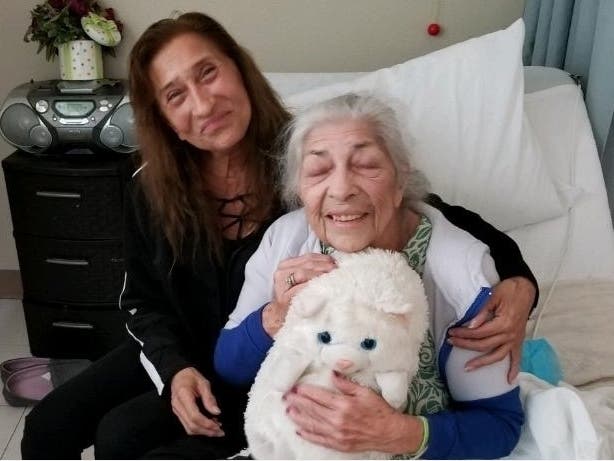
PHOENIX, AZ — Diane Alcantar sits alone in her grandmother’s house in Phoenix, the same place her mother grew up, and frets.
Will her 86-year-old mom make it through the night, or will she become the latest to die from the coronavirus? If she does die, will she know that, 400 miles away from a Burbank, California, hospital, her daughter’s heart is full of memories of the pure joy in being raised by her?
“She was always there for me,” Alcantar says. “We used to laugh a lot. Mom loves to sing. She’s a happy person. We did a lot of good things together, and when I was down, she always brought me out of it. She loves life.”
Find out what's happening in Phoenixfor free with the latest updates from Patch.
For the latest coronavirus news, sign up for real-time news alerts and newsletters from Phoenix Patch.
Alcantar wishes she had known sooner the new coronavirus was running through the Burbank nursing home where her mother, Helen Alcantar, lived until late last month, when she was hospitalized.
Find out what's happening in Phoenixfor free with the latest updates from Patch.
It’s a six- or seven-hour drive there from Phoenix, “but I would’ve taken her out of there right away,” Alcantar says. “I would’ve brought her home had I known.”
Elizabeth Tyler, a spokeswoman for Artesia Healthcare Inc., which owns the Alameda Care Center where the octogenarian became ill, says families of residents were notified once the first coronavirus case was confirmed. Only four of seven residents who tested positive for the coronavirus remain at the care center, and they all have mild symptoms, Tyler says.
Two were hospitalized, including Alcantar’s mother on March 27.
Helen Alcantar is breathing with the help of a ventilator, leaving her daughter with the same terrible decision untold numbers of Americans are having to make as the United States leads the world in new coronavirus cases: Should she tell doctors to unplug the ventilator and allow her mother to die?
The thought of her mother fighting for her life alone is almost more than the 61-year-old Alcantar can bear.
“I’m devastated,” she says. “I’m frustrated. I can’t go see my mother. It’s tearing me apart. I think about it and I pace back and forth.”
Alcantar’s daughter, 34-year-old Elizabeth Hileman, lives within driving distance of Burbank in Rialto, California. But with California’s 40 million residents under a mandatory lockdown to slow the spread of the virus, she can’t go see her grandmother. Alcantar and Hileman have used the Face Time app to talk to the family matriarch and hope to do so again if the doctors and nurses can arrange it.
“Maybe she’ll hear,” Alcantar says. “Maybe she’ll hear she’s not alone and we are with her in our hearts.”
Helen Alcantar’s doctors are taking “baby steps” and putting her on what’s known as a “step-down ventilator” to see if she can breathe on her own.
“We’re taking baby steps to get her off the ventilator and taking her off sedation,” Alcantar says. “She’ll be on a different ventilator to see if she can do it.”
If her mother pulls through, she’ll go to a skilled nursing facility, but not the Alameda Care Center in Burbank, where at least 17 people — 10 staff members and seven residents — have tested positive for the coronavirus, according to a Los Angeles Times-Burbank Reader report. Two people have died.
One of them was Vernon Robinson, whose wife, Willa, last saw her husband of 55 years healthy on March 13, the day before the nursing home prohibited visitors, The Associated Press reports.
“I love you,” Willa Robinson told her husband as she prepared to leave after taking him his favorite dinner — baked chicken, garlic mashed potatoes and carrots.
“I love you more,” he replied.
Robinson watched her husband die alone from behind a glass window, unable to hold his hand and whisper reassuringly to him as he struggled for his final breath.
Alcantar can’t even do that.
The 61-year-old has COPD, and says her doctor sternly warned her “if you catch this, you will die.”
All she can do now is pray — pray, as Bible says, without ceasing.
“A lot of prayer, a lot of prayer,” Alcantar says. “Praying out loud. Praying silently. Trying to send my prayers over the airwaves to my mom.”
Alcantar spoke with a hospital chaplain, a Roman Catholic priest, who gave her mother last rites and prayed for her soul — “which was awesome,” Alcantar says, “because right after that, her oxygen levels went up.”
Her white blood cell count went up substantially, too.
“Prayer is very powerful,” Alcantar says.
But her mother is also 86 years old and in poor health. Her odds of survival are slim, Alcantar says.
Alcantar is planning a funeral “just in case,” although with social distancing recommendations, funerals in the time of coronavirus are scaled down events, if they’re held at all.
Related: Coronavirus Funeral Dilemma: Who Do You Tell They Can’t Go?
It won’t be the kind of funeral Alcantar envisioned for her mother, a devout Catholic, and “my best friend.”
But she also never imagined doctors and nurses, trained to save lives, would be put in the traumatizing position of deciding if patients should stay on the life-saving ventilators or if they should be relinquished to a patient with a better chance of survival.
“I know the doctors and nurses are doing what they can,” Alcantar says. “They are even putting their lives at stake working with these very, very sick people.”
Alcantar says she’s trying to “keep a straight head.”
“I have to guide the family — my daughter and her family. I’m having her help me make decisions on it; that’s what we are doing,” she says.
“It’s really hard. At night, I sit here crying.”
And although she’s alone in the house where three generations of her family have lived, Alcantar is not really alone.
“It’s happening to thousands of people,” she says. “It’s scary. We’re humans, and we’re all in this together."
Get more local news delivered straight to your inbox. Sign up for free Patch newsletters and alerts.