Schools
Arizona State University: 4th Class Of Sun Devil Alumni Chosen For ASU Leadership Institute
The Arizona State University Alumni Association is proud to welcome 27 Sun Devil alumni to the ASU Leadership Institute. Class 4 of the ...

Morgan Harrison
September 9, 2021
Find out what's happening in Tempefor free with the latest updates from Patch.
The Arizona State University Alumni Association is proud to welcome 27 Sun Devil alumni to the ASU Leadership Institute. Class 4 of the leadership development program is composed of up-and-coming and current leaders representing a variety of industries including education, nonprofit, marketing, construction and health care.
This nine-month program immerses participants in the university’s culture with behind-the-scenes tours, presentations from renowned ASU professors and leaders, and experiences to broaden the perspectives on critical issues facing our region. The program continues to grow with participants from out of state willing to travel on a monthly basis to experience the leadership program and connect back to their alma mater. This year, four of the participants will travel from California, Texas and Maine for the monthly Innovation Days.
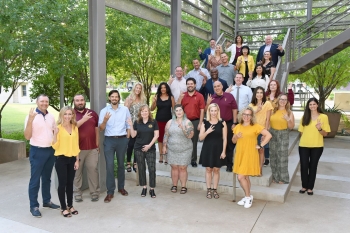
ASU Leadership Institute Class 4. Photo by Tim Trumble
Download Full Image
Find out what's happening in Tempefor free with the latest updates from Patch.
“During Class 4’s orientation day, we had each participant introduce themselves and explain why they applied for the Leadership Institute,” said Christine K. Wilkinson, ASU Alumni Association president and CEO. “There were three responses that were repeated among the group – to grow as a leader; to reconnect with the university and learn how ASU continues to innovate; and to make a difference in their community. I am looking forward to working with this devoted group of Sun Devil alumni develop their skill set and become champions for ASU.”
The members of ASU Leadership Institute Class 4 are:
Each year, the ASU Leadership Institute, sponsored by ASU Alumni, accepts a new cohort of alumni for a professional and personal leadership development program. This structured program takes an in-depth look at the university and its institutional objectives to demonstrate excellence, access and impact, and the importance of higher education. Learn more about the ASU Leadership Institute.
Wenwen Li, professor in Arizona State University's School of Geographical Sciences and Urban Planning and affiliate faculty member of ASU’s Spatial Analysis Research Center, was selected as a recipient of the National Science Foundation’s Mid-Career Advancement (MCA) award.
The MCA award is the only cross-disciplined, career-oriented award that aims to protect the time and resources of mid-career scholars, enabling applicants the opportunity to concentrate on research and training while building synergistic and mutually beneficial partnerships.

Wenwen Li, professor in the ASU School of Geographical Sciences and Urban Planning.
Download Full Image
“I am super excited and humbled to receive this Mid-Career Advancement award from NSF. In preparation of the proposal, I have received tremendous support from many of my ASU colleagues, and I cannot thank them enough,” said Li, who specializes in spatial analysis and using cyberinfrastructure and artificial intelligence to explore new questions about the geographic world. “I am viewing this award not only as an opportunity to advance my own career, but also a good timing to return my service back to the community to help junior and other mid-career scholars to boost their careers, increase visibility, develop leadership to achieve amazing success and happiness.”
The award will support Li’s research that explores new ways of integrating artificial intelligence, geospatial analysis and cyberinfrastructure into Arctic permafrost research.
In partnership with Anna Liljedahl, an Arctic permafrost hydrology expert from Woodwell Climate Research Center, Li aims to develop novel GeoAI (geospatial artificial intelligence) solutions to enable automated, high-resolution mapping and the quantification of permafrost thaw at a pan-Arctic scale.
“Polar regions play a vital role in Earth’s climate, ecosystems and economy. Unfortunately, climate change is driving dramatic changes in the Arctic ecosystem, endangering its natural environment, infrastructure and lives,” Li said. “Arctic permafrost, ground that remains below 0 degrees Celsius for at least two consecutive summers, is at the center of this change.”
By developing new GeoAI solutions, Li and Liljedahl hope to create a high-resolution dataset that quantifies permafrost thaw and helps scientists gain a better understanding and accurate prediction of the landscape changes in the Arctic.
Additionally, the research pair will co-create an initiative called “Women in Polar Cyberinfrastructure” to diversify the field of cyberinfrastructure, AI and Arctic science by offering training to more female scholars and underrepresented minorities.
“I have always had a great interest in applying data science methods to solve environmental problems, especially those endangering the polar regions,” Li said. “This award focuses exactly on career advancement in polar data science; it offers an exciting opportunity for me to build a large collaboration network with Arctic scientists to broaden and deepen the applications of various computational solutions that my team has developed for better problem solving in the Arctic.”
This press release was produced by Arizona State University. The views expressed here are the author’s own.