Schools
Arizona State University: ASU Celebrates Postdocs During National Postdoc Appreciation Week
Since 2009, the National Postdoctoral Association has sponsored National Postdoc Appreciation Week to recognize the significant contribu ...

October 1, 2021
Since 2009, the National Postdoctoral Association has sponsored National Postdoc Appreciation Week to recognize the significant contributions that postdoctoral scholars make to research and discovery at universities and organizations all over the country.
Find out what's happening in Tempefor free with the latest updates from Patch.
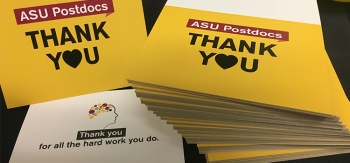
The event is celebrated during the week of Sept. 20. At Arizona State University, the Postdoctoral Affairs Office hosted postdocs for a series of events, both fun and focused on professional development. The week culminated with the Arizona Postdoctoral Research Conference, a statewide conference where ASU postdocs presented their research, networked and attended professional development activities.
Download Full Image
“National Postdoctoral Appreciation Week is a great opportunity to pause and thank our postdocs for the great work that they are doing at ASU,” said Wiley Larsen, manager for Postdoctoral Affairs Office, part of ASU’s Graduate College.”They are teaching, managing labs, writing papers and more, all while working on their own research. They play a huge role in what goes on at the university, and we are grateful for their contributions.”
Find out what's happening in Tempefor free with the latest updates from Patch.
Sally Morton, executive vice president of ASU’s Knowledge Enterprise, spoke at this year’s breakfast and offered encouragement to ASU’s postdocs. The annual breakfast enabled postdocs to network with faculty members.
“After nine months of navigating the challenges of learning to be a postdoc at ASU, the Postdoc Breakfast felt like a timely moment of support,” said Stephanie Arcusa, a postdoctoral research fellow at ASU's Center for Negative Carbon Emissions. “I appreciated the energy and vision of Dr. Morton's talk about the role of postdocs in ASU's Knowledge Enterprise concept, and l left the event feeling like I was part of something unique.”
Carmen Velasco, a postdoctoral scholar in the Westerhoff Lab in the Ira A. Fulton Schools of Engineering, was excited to attend the breakfast.
“I have been a postdoc at ASU since January 2020, and as much as I have enjoyed working on research and mentoring students, the appreciation breakfast hosted by the Postdoctoral Affairs Office felt very nurturing,” said Velasco.
During the Postdoc Lunch and Learn on Sept. 23, David Shiffman, a research associate and former postdoc based in Washington, D.C., shared his tips and tricks for having a successful social media following. Shiffman, a prolific Twitter user, goes by the handle @WhySharksMatter and has more than 60,000 followers.
“After the workshop, I have more ideas on what content I should share on my research-based Twitter account,” said Ting Liu, a postdoctoral research scholar at ASU’s Muenich Lab Group.
ASU closed out National Postdoc Appreciation Week with the Arizona Postdoctoral Research Conference on Sept. 24. Held in downtown Phoenix, this year’s theme was “Potential for all research to promote equity and inclusion,” and it featured a keynote from Michael Johnson, a professor of immunobiology at the University of Arizona.
The Graduate College’s Postdoctoral Affairs Office was created to support the personal growth and professional development of each postdoc through a number of community-building and professional development programs to enrich the postdoc experience at ASU. Visit the Postdoctoral Affairs Office website to view the full calendar of events.
Written by Jenna Nabors
Arizona State University contributed four new and two returning graduate alumni to the 2021–22 cohort of the Science and Technology Policy Fellowship program administered by the American Association for the Advancement of Science (AAAS).
Now in its 49th year, the Science and Technology Policy Fellowship program places highly trained scientists and researchers in posts throughout the federal government, where they advance projects that increase evidence-based decision making while exploring government careers. The 2021–22 cohort includes 284 fellows sponsored by AAAS, the Moore Foundation and other partners among professional and scientific societies.

U.S. Capitol in Washington, D.C. Photo by Charlie Leight/ASU News
Download Full Image
With their placements in this prestigious and impactful program, ASU colleges and schools continue to produce leaders who shape the next generation of federal science and technology policy.
Many of the new fellows used ASU's program for Distinguished Graduate Fellowships during the application process. The program hosts information sessions and speaking engagements from previous fellows, and assists applicants with getting constructive feedback on early drafts of applications. Former program director Joshua Brooks said that placements in the Science and Technology Policy Fellowship exemplified ASU’s charter.
“Part of ASU's charter is advancing research and discovery of public value,” Brooks said. “Those who are best situated to determine public value and mobilize effective research and discovery are often in government. ASU’s STPF fellows advance ASU’s charter in the most direct way.”
Two first-year fellows are recent graduates who worked in the Center for Biology and Society in the School of Life Sciences, where they earned PhDs in biology and society.
Center for Biology and Society Director Jane Maienschein said that the fellowship placements highlighted the center’s track record of successfully fostering inclusive and collaborative learning about diverse and interdisciplinary topics.
“The AAAS Science and Technology Fellows Program provides exceptional opportunities for our graduates,” Maienschein said, adding that she expects that they will “share those experiences with others as they move forward to impact the world.”
Theo Tiffney
Theo Tiffney completed a PhD in 2020. Tiffney's dissertation discussed the history of treatments for hepatitis C and the effects of federal policy on treatment access barriers. Tiffney moves to the National Institutes of Health's Office of AIDS Research and will work on a variety of topics and projects related to HIV/AIDS research.
Tiffney’s adviser, Robert Cook-Deegan, was a fellow in 1982–83 and said the experience is life-changing.
“(It) was the first time I felt like my skills were being fully used,” Cook-Deegan said. “I felt easy to replace as a molecular biology postdoc and physician, and it was exhilarating to find that translating what was going on in science, engineering and medicine for those making policy decisions might actually help them make those decisions better. I never went back. The rest of my career was inflected by the fellowship year."
Steve Elliott
Steve Elliott finished his work at CBS in 2017, and for the past four years he has been a postdoctoral researcher at ASU's Center for Gender Equity in Science and Technology, where he studied federal science funding programs. He'll spend the next year at the National Oceanographic and Atmospheric Administration working on topics of data governance for the Weather Program Office.
Kimberly A. Scott, director of the Center for Gender Equity in Science and Technology (CGEST), said that supporting male allies is an important component of the center's mission of improving social systems so that women of color become change agents in science and technology.
“I believe preparing CGEST researchers to synthesize the knowledge gathered during their tenure and apply it to policy is how we can encourage structural shifts,” Scott said. “Dr. Elliott's placement at (the Science and Technology Policy Fellowship) reflects this ambition — to motivate change well beyond our university to nurture more equitable outcomes for all.”
Two fellows received PhDs in civil, environmental and sustainable engineering from the School of Sustainable Engineering and the Built Environment in the Ira A. Fulton Schools of Engineering, while a third finished her PhD research there after her lab moved to ASU.
Evvan Morton
Evvan Morton received her PhD in 2020, for which she studied the effectiveness of U.S. policies that govern carbon dioxide emissions and explored political, technological and ethical considerations for carbon dioxide removal. Morton also received a graduate certificate in responsible innovation from the School for the Future of Innovation in Society, where Ira Bennett encouraged her to apply for the Science and Technology Policy Fellowship. She has begun work at the Department of Energy in the Office of Sustainable Transportation, where she'll work on decarbonization policies related to electric vehicles, biofuels and hydrogen fuel cells.
"I learned about the AAAS (Science and Technology Policy) Fellowship in my first year of graduate school, and I had been working towards it ever since,” Morton said. “I am so excited to finally be on the other side and have the opportunity to use my engineering knowledge to influence policy."
Emily Bondank
Emily Bondank is a second-year fellow at the U.S. Agency for International Development (USAID), where she is moving from the Water Office to the Center for Water, Security, Sanitation and Hygiene. She received her PhD in 2019 after studying climate change adaptation of water distribution systems. In her second fellowship year, she'll support water security, sanitation and hygiene programming and applying scientific knowledge to improve climate resilience.
Bondack noted that the Science and Technology Policy Fellowship has given her “the unique opportunity to move beyond theory to learn how to identify and influence the practical factors that underpin sustainable and resilient water and sanitation service delivery.”
Avni Solanki
When Avni Solanki came to ASU’s Biodesign Institute in 2016, her interests in science policy ignited.
Solanki arrived with her adviser, then newly recruited Treavor Boyer, and while at ASU, she finished her University of Florida PhD on filtering pharmaceutical pollutants and recovery of nutrients from source-separated urine using biochar.
Through her interactions with her ASU colleagues and attending numerous seminars, Solanki was inspired to focus on the role of science in policy. After several years of teaching and leading a research center at Washington University in St. Louis, she’ll soon be addressing water policy for the Department of State.
Carole Mars
Carole Mars is continuing a second year in the Department of Defense's Office of the Deputy Assistant Secretary of Defense for Environment and Energy Resilience. Mars trained originally as a PhD analytical chemist at Penn State University, and in 2021 she completed a Master of Science in science and technology policy from ASU's School for the Future of Innovation in Society. At the Department of Defense, Mars will continue work on improving sustainable acquisition policy, raising visibility on circular economy initiatives at the department, implementing supplier carbon emission reporting policy and supporting efforts to expand material disclosure reporting to better manage chemical supply chain risk.
“My master’s program introduced me to the world of policy and (the Science and Technology Policy Fellowship),” Mars said. “(The fellowship) has shown me there is a place for me in policy, where my experience can truly have an impact. I am now charting a career change to stay in the federal government, hopefully with the DOD, to realize that impact.”
Additionally, Christina Wong, who received her PhD from the School of Sustainability, completed the second year of her fellowship in September at the USAID Office of Energy and Infrastructure.
This press release was produced by Arizona State University. The views expressed here are the author’s own.