Schools
Arizona State University: ASU Honors Outstanding Alumni For Their Achievements, Impact
College of Global Futures alumni are actively making a difference in the world and working to meet the global challenges of today and to ...

Ashley Richards
2021-11-16
Find out what's happening in Tempefor free with the latest updates from Patch.
College of Global Futures alumni are actively making a difference in the world and working to meet the global challenges of today and tomorrow. The college recently celebrated some of these outstanding alumni for their accomplishments and impact in their professional careers.
Three alumni were chosen for the College of Global Futures Alumni Hall of Fame and received awards.

First picture, from left: Scott Williams and Jenny Strickland, student and alumni engagement coordinator. Second picture: Madeline Mercer and Abi Graves, assistant manager of student engagement.
Download Full Image
Find out what's happening in Tempefor free with the latest updates from Patch.
The Distinguished Achievement Award recognizes an alum's outstanding accomplishments and experience as a distinguished leader in their profession. The Emerging Leader Award is given to recent graduates who have made significant contributions to their community.
This is the first year the college has given these awards, which were presented during ASU's Homecoming weekend.
Distinguished Achievement Award: Manjyot Kaur Ahluwalia
Growing up in Bhopal, India, Ahluwalia saw the environmental damage left behind from a hazardous gas leak at the Union Carbide pesticide plant. Though the disaster happened before she was born, Ahluwalia was made aware of the longer-term environmental and health impacts on her small town. She wanted to learn more about the regulations and safeguards put into place to prevent future disasters, and the positive role corporations could play. She came to the School of Sustainability in the College of Global Futures to earn a Master of Science in sustainability with a concentration in corporate sustainability.
Manjyot Kaur Ahluwalia
"ASU is a leader in sustainability," Ahluwalia said. "I liked the multi- and interdisciplinary aspect of the School of Sustainability. You can't tackle the climate problem with just one discipline; the problem is too complex. The school helped me think about the systems and networks and how we need to work together as a society."
During her time at ASU, Ahluwalia was part of the executive team for the university's Net Impact chapter. After graduating, she served as the director-at-large on the School of Sustainability alumni board for two years and mentored the first cohort of students in the Frasier Global Mentorship Program. Currently, she is a senior program officer for U.S. and International Climate Corporation at the climate program at World Wildlife Fund and coordinates the global multi-stakeholder initiative Alliances for Climate Action, including the U.S. subnational coalition America Is All In. This initiative has mobilized over 6,000 diverse actors across the Americas, Africa, Asia and Oceania.
"We are bound by the theory of change that it will take a 'whole-of-society' to address climate change," Ahluwalia said. "With this initiative, members work collaboratively to advance Paris-aligned climate policies in their country for an inclusive and resilient transition. This means working together in this decisive decade of delivery to keep 1.5 C alive, the scientifically safe temperature limit. While we've seen some progress and bold commitments at the UN Climate Change Conference of the Parties, we still have an ambition and credibility gap.”
Ahluwalia is a member of an expert peer review group of the U.N.-backed Race to Zero Campaign, representing actors with a net-zero target across 35 regions, 800 cities, 4,475 companies, 731 educational institutions, 250 financial institutions and over 3,000 hospitals from 45 health care institutions. In this role, she assesses commitments to ensure that they are backed by transparent action plans and robust near-term targets.
Looking back at the Bhopal gas tragedy in her city, to other global environmental disasters where companies were part of the problem, to the recent sustainability practices, she notes that we must move to the next frontier of climate leadership.
"Corporations must proactively engage in advocating for 1.5 C-aligned climate policies, and as a global community, we must catalyze Paris-aligned climate finance, especially for vulnerable countries," Ahluwalia said. "The credibility of our commitments, policy integrity and climate finance could determine whether we succeed as the human race in averting the greatest challenge of our times, for the sake of our current and many generations to come, and for the sake of this beautiful planet that we call home."
Emerging Leader Award: Scott Williams
Scott Williams
As a U.S. Air Force veteran, Williams has a proven history of leadership. The field-based researcher has led initiatives involving security, compliance, bilateral affairs and foreign military sales. He is now utilizing those leadership skills as the CEO and founder of WiscLift, where he is working to integrate drone-based dynamic networks to close gaps in connectivity. Earning a Master of Science in global technology and development online from the School for the Future of Innovation in Society in the College of Global Futures has helped him develop new innovations that can make an impact.
"We are rolling out an entirely new and disruptive technology that's defining a multibillion-dollar industry, and we're the only ones in the world that can do it right now," Williams said. "We're scoping the next century of how technology applies to global development."
Williams has shared his expertise on cutting-edge technology as a speaker for the State of Wisconsin Investment Board on Broadband and Emerging Technology, and a panelist on Sen. Tammy Baldwin’s roundtable on broadband. He was also a finalist for a 2021 Wisconsin Innovation Award. Williams is now continuing his involvement with the College of Global Futures. He participates in the Job S.H.A.R.E. program providing internship opportunities for current students, and he is even considering returning to the college for his PhD. He is looking to give back to the college that helped him succeed.
"I've learned a lot in field research," Williams said. "I want to shape the way academic research is done in the future so that it's more applied and gives students more hands-on experience."
Emerging Leader Award: Madeline Mercer
Madeline Mercer
Mercer is a community-driven sustainability researcher working to improve food access and find solutions to complex social problems. Her interest in interdisciplinary, action-oriented research brought her to the School of Sustainability in the College of Global Futures, where she earned a Bachelor of Arts in sustainability and a Master of Sustainability Solutions.
"I chose to study at the School of Sustainability for its explicit emphasis on creating collaborative solutions to our society’s biggest sustainability challenges," Mercer said. "The Master of Sustainability Solutions program recognizes the potential of sustainability to inspire a better future, and it empowers sustainability professionals with the tools and attitudes needed to create transformative solutions to the most pressing problems of our time.”
Mercer's research focuses on food systems sustainability and social entrepreneurship. She has worked as a researcher and urban farmer at St. Vincent de Paul and as a research assistant for the Sustainable Local Food Economies and Enterprises Lab at ASU, and she has volunteered with several community groups to advance food systems initiatives. Currently, Mercer is a social innovation fellow in ASU’s Office of Applied Innovation, where she works on projects related to food entrepreneurship, sustainable economies and the intersection of food security and community well-being. Her time at the College of Global Futures has given her the tools to make sustainable changes.
"My time in the College of Global Futures was invigorating," Mercer said. "Rather than focusing solely on the challenges we face, the programs I was a part of inspired me to analyze the underlying causes of a problem, envision a sustainable future and develop concrete, actionable steps needed to make it a reality. The college's focus on what’s possible inspires me and instills optimism and hope for our collective future."
Employment is recovering from the severe contraction induced by the pandemic, but it is still way below levels at the start of 2020. Can it fully recover this year? What is the expected role of the stimulus legislation on growth, employment and inflation? What are the perspectives for the Arizona economy?
Top national and regional experts will present their economic forecasts and advice on these issues and more at the Economic Forecast Luncheon, hosted by the W. P. Carey School of Business at Arizona State University and sponsored by PNC Bank.
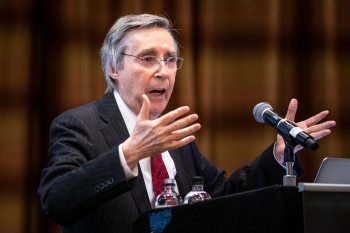
Economic Outlook Center Director Lee McPheters. Photo by Charlie Leight/ASU News
Download Full Image
The keynote address, presented via Zoom, will be given by Lawrence H. Summers, the Charles W. Eliot University Professor and president emeritus of Harvard University. The outlook for the U.S. economy will be presented by Gus Faucher, the chief economist of the PNC Financial Services Group. The outlook for the regional and metro economy will be shared by Lee McPheters, research professor of economics and director of the Economic Outlook Center at ASU.
The event will be held from 11:15 a.m. to 1:30 p.m. Wednesday, Dec. 8. Attendees can join virtually via Zoom and in person in the Grand Ballroom of the Renaissance Phoenix Downtown Hotel. To register, visit wpcarey.asu.edu/efl.
McPheters is available for media opportunities in person at the Renaissance Phoenix Downtown Hotel before the event from 10 to 11 a.m. Dec. 8. He’s also available from 10 a.m. to 2 pm. Dec. 6, via Zoom. Reporters can schedule interviews by emailing Shay Moser at shay.moser@asu.edu.
This press release was produced by Arizona State University. The views expressed here are the author’s own.