Schools
Arizona State University: ASU President's Professor Ariel Anbar Elected As An AGU Fellow
Arizona State University Professor Ariel Anbar has been elected as an American Geophysical Union (AGU) fellow. He joins 59 other individ ...

Karin Valentine
September 28, 2021
Find out what's happening in Tempefor free with the latest updates from Patch.
Arizona State University Professor Ariel Anbar has been elected as an American Geophysical Union (AGU) fellow. He joins 59 other individuals in the 2021 Class of Fellows.
Since 1962, the AGU Union Fellows Committee has selected less than 0.1% of members as new fellows. AGU, a nonprofit organization that supports 130,000 enthusiasts to experts worldwide in earth and space sciences, annually recognizes a select number of individuals as part of its honors and recognition program.

Ariel Anbar, ASU President’s Professor and recently elected American Geophysical Union fellow. Photo courtesy of Ariel Anbar/ASU
Download Full Image
Find out what's happening in Tempefor free with the latest updates from Patch.
"Throughout his career, Ariel Anbar has made significant contributions to scientific exploration of Earth’s past. We are proud that Professor Anbar is being recognized for his efforts by the American Geophysical Union, and we look forward to his future discoveries as he continues to push beyond the boundaries of astrobiology and biogeosciences,” said Kenro Kusumi, dean of natural sciences in The College of Liberal Arts and Sciences at ASU.
Anbar is a scientist and educator interested in Earth’s past and future as an inhabited world, and the prospects for life beyond. The AGU selected Anbar for this honor in recognition of his outstanding achievements and contributions in pushing forward the frontiers of science. Specifically, Anbar is recognized for developing novel biogeochemical methods that enabled studies of Earth’s earliest life and its relationships with the co-evolving environment.
“Professor Anbar is a world leader in isotope geochemistry, who has made important contributions towards understanding Earth’s past,” said School of Earth and Space Exploration Director Meenakshi Wadhwa. “What’s unique about him, though, is that not only does he care about excellence in his science, but he also cares just as deeply about advancing societal good through innovative technology-enhanced approaches, whether they be applied to education or to sustainability. I’m proud to have him as a colleague.”
“This is a humbling honor,” Anbar said. “Early in my career, I took some big professional risks and — like so many young scientists — hit some rocky patches that made me question my future in the field. It goes to show that risk-taking and perseverance can pay off. I hope that's a lesson that today's younger scientists will take away."
Anbar is an ASU President’s Professor, a Howard Hughes Medical Institute Professor and a Global Futures scientist in ASU’s Julie Ann Wrigley Global Futures Laboratory, and he is on the faculty of the School of Earth and Space Exploration and the School of Molecular Sciences. Anbar also directs ASU’s Center for Education Through Exploration, which is reinventing digital learning around curiosity, exploration and discovery.
“Ariel Anbar and his group have published over 175 refereed papers on topics ranging from the origins of Earth’s atmosphere to detecting life on other worlds,” said Tijana Rajh, director of the School of Molecular Sciences. “It is extremely fitting that Ariel has been selected to join this prestigious group of AGU fellows.”
AGU will formally recognize this year’s recipients during the AGU fall meeting Dec. 13–17 in New Orleans and online. This celebration is a chance for AGU’s community to recognize the outstanding work of colleagues and be inspired by their accomplishments and stories.
New developmental psychology work has upended decades of research suggesting that children as young as 4 years old possess theory of mind.
Having theory of mind means understanding how others think, including the ability of someone else to have a false belief.
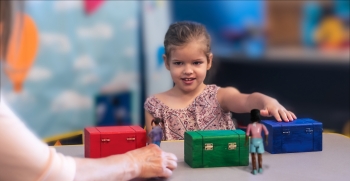
In a theory-of-mind experiment, a child decides whether a character named Maxi will look for the chocolate bar in the blue, red or green box after he has left the room and the chocolate was moved. When there are two possible locations of the chocolate bar, children can answer correctly without understanding how other people think. When there are more than two locations, children must understand how Maxi can have a false belief to answer correctly. Research shows that children do not reliably understand others’ false beliefs until they are 6 or 7 years old. Photo by Robert Ewing/ASU
Download Full Image
In a famous theory-of-mind experiment that includes false beliefs, children watch scenes involving a character named Maxi, his mother and a chocolate bar. Maxi places the chocolate bar into a blue box and then leaves. Unbeknownst to Maxi, his mother shows up and moves the chocolate from the blue box into a green box. After Maxi’s mother leaves, Maxi returns and then the child is asked where Maxi will look for the chocolate.
By 4 years old, children can answer correctly: Maxi will look in the blue box.
But do young children really understand that because Maxi did not see his mother move the chocolate, he falsely believes it is still in the blue box?
The answer is no, according to William Fabricius, associate professor of psychology at Arizona State University. For more than a decade, Fabricius and his collaborators have carried out new experiments and have also analyzed previous experiments that collectively show children do not actually understand false beliefs until they are 6 or 7 years old.
This work was published in Monographs of the Society for Research in Child Development on Sept. 28.
“When we overestimate what young children understand about the mind, and thus how others think, we can expect too much from them in terms of social behavior or performance in school,” said Fabricius, who is the lead author of the paper.
One of the first ways the research team tested what children actually understand about Maxi’s false belief was to add a third possible location of the chocolate bar.
In these experiments, there is a blue box, a green box and a red box. Maxi again places his chocolate bar in the blue box. His mother again moves the chocolate bar into the green box.
When young children are asked where Maxi will look for the chocolate, they answer the blue box 50% of the time and the red box 50% of the time.
“When there are only two locations, 4- and 5-year-old children can answer correctly without truly understanding that Maxi has a false belief about the location of the chocolate bar,” Fabricius said. “Adding a third location results in them guessing at chance between the two empty locations. Because young children can pass the two-option false-belief task without understanding Maxi’s thought processes, this experiment does not test theory of mind.”
The random choices children make when there are three possible locations of the chocolate bar suggest they rely on their rudimentary understanding of seeing and knowing. This research team has named this process “perceptual access reasoning.”
Children use perceptual access reasoning in the following way:
Based on these rules, 4- and 5-year-old children reason that when Maxi returns, he cannot see that the chocolate is in the green box, so he does not know that the chocolate is in the green box. Children reason that Maxi will make the wrong choice and will look in an empty location.
When there is only one empty location (the blue box), children answer correctly by default. When there are two empty locations (blue and red boxes), they guess.
Another way the research team tested what young children understand about others’ thoughts was to have the chocolate bar remain where Maxi put it. When Maxi returns, he has a true belief about where the chocolate is.
In this experiment, Maxi again puts the chocolate bar in the blue box and leaves. This time when Maxi’s mother comes in, she leaves the chocolate bar where it is.
Even with just two options – the blue and green boxes – young children fail the true-belief task. They incorrectly answer that Maxi will make the wrong choice and look in the green box.
“Perceptual access reasoning users have an immature concept of knowing as tied to the present situation, and do not yet understand that people have memories that persist across situations. They do not understand that Maxi might remember putting the chocolate bar into the blue box,” Fabricius said. “The evidence from this series of experiments is consistent that children do not understand mental representation until they are 6 or 7 years old.
The finding that young children do not understand true or false beliefs and instead rely on perceptual access reasoning is relevant for how they are taught.
“There are strong correlations between theory of mind and a child’s ability to share, be socially appropriate and be able to problem solve and plan,” said Anne Kupfer, director of ASU’s Child Study Lab and co-author of the Monograph paper.
The lab partners with developmental psychology faculty to put research findings into practice and has implemented the findings from the Monograph paper into its preschool curriculum.
“It is important for educators to know at what age a child can finally realize that how they feel, how they think or what they want are not necessarily what everyone else feels, thinks or wants,” Kupfer said.
Sharing a toy is a common situation that requires lab staff to leverage how young children use perceptual access reasoning. Kupfer described a scenario in which a child wants a toy, but another classmate is playing with it. The child takes the toy and because they are happy holding the toy, they think everyone is happy. But the child who just lost the toy starts to cry, and the child who took the toy is puzzled.
“That’s where we come in. In this situation we narrate what is happening and role model responses that are based on what the kids understand from perceptual access reasoning,” Kupfer said. “We say to the child who is crying, ‘I can see you are upset and saw that Johnny took the toy away from you. Is that why you are upset?’ We then role model and ask the crying child to tell Johnny why they are upset, because he took their toy. Then we direct Johnny to look at the sad child’s face and say, ‘She just told you she is upset. Why is she upset?’ Johnny can then answer, ‘Because I took her toy.’”
This example demonstrates how educators can help children learn about others’ mental representations. The child who took the toy begins to understand why they feel happy but the other child does not — a precursor to having theory of mind.
In addition to Fabricius and Kupfer, the research team consisted of Christopher Gonzales, who graduated with his doctorate in psychology from ASU and is now at the University of California, Davis; Annelise Pesch of Temple University; Amy Weimer of Texas State University; John Pugliese of California State University, Sacramento; Kathleen Carroll of STARS, Student Therapy Inc.; Rebecca Bolnick of Kyrene School District; Nancy Eisenberg of the ASU Department of Psychology; and Tracy Spinrad of the T. Denny Sanford School of Social and Family Dynamics.
Video courtesy of Society for Research in Child Development
This press release was produced by Arizona State University. The views expressed here are the author’s own.