Schools
Arizona State University: The FORCE Is With ASU, Thanks To A $13.7M NSF Grant
The National Science Foundation has just announced the award of $13.7 million to Arizona State University to build a one-of-a-kind high- ...

Jenny Green
September 29, 2021
Find out what's happening in Tempefor free with the latest updates from Patch.
The National Science Foundation has just announced the award of $13.7 million to Arizona State University to build a one-of-a-kind high-pressure research facility, the FORCE (Facility for Open Research in a Compressed Environment).
"To have the work of ASU faculty recognized and supported by the National Science Foundation at this scale is incredibly exciting,” said Kenro Kusumi, dean of natural sciences in The College of Liberal Arts and Sciences at ASU.

The National Science Foundation has just announced the award of $13.7 million to Arizona State University to build a one-of-a-kind high-pressure research facility, the FORCE (Facility for Open Research in a Compressed Environment). Image by QtraxDzn/Shutterstock
Find out what's happening in Tempefor free with the latest updates from Patch.
Kusumi said the university's Navrotsky Eyring Center for Materials of the Universe — which unites cosmology, astrophysics, astronomy, planetary science and exploration, and mineralogy and petrology with materials science and engineering, chemistry, physics and biology to address grand questions of the complex chemistries and evolution of planets — continues to be at the forefront of the study of materials under extreme conditions.
The new FORCE facility will enable principal investigator Kurt Leinenweber and co-PIs Alexandra Navrotsky, who leads the center, Thomas Sharp, David Smith and Dan (Sang-Heon) Shim "to drive transformation and innovation in high-pressure science," Kusumi said. "We look forward to building new collaborations with researchers around the country."
Leinenweber, who also serves as director of the High Pressure Facility in the Eyring Materials Center, part of ASU Knowledge Enterprise, said, "This award is a fulfillment of a hope that we have had for many years to serve the U.S. and the rest of the high-pressure world to perform groundbreaking high-pressure experiments with large-volume presses within the United States. We are excited to bring this plan to fruition and look forward to a new generation of experimental collaborations and capabilities with the entire high-pressure community.”
The grant will provide four major pieces of equipment, specialized space for their installation and operation, as well as staff support.
“FORCE represents a remarkable new tool at ASU for both the exploration and development of novel materials,” said Professor Neal Woodbury, vice president of research and chief science and technology officer of ASU Knowledge Enterprise. “This new national center will also bring scientists from around the world to ASU to work with our faculty in aspects of materials science that are as yet entirely unexplored.”
Navrotsky, a professor in both the School of Molecular Sciences and the School for Engineering of Matter, Transport and Energy, as well as an affiliate faculty in the School of Earth and Space Exploration, said, "This is the culmination of over 50 years of high-pressure studies at ASU. FORCE will be a major and long-lasting national center unique in the U.S.”
FORCE will promote discovery of new materials and the solution of fundamental problems in Earth and planetary science, materials science, chemistry, physics, energy conversion and other fields. A diverse group of researchers who require access to new high-quality, high-pressure samples and other enhanced high-pressure capabilities will make use of the new presses, or else request samples to be made. Many researchers from U.S. academic institutions, government laboratories and industry have already expressed interest in gaining access to the proposed instrumentation.
“Establishing a national high-pressure facility on the ASU campus, which will be unique in the United States, is a great addition to the School of Molecular Sciences' and ASU's capabilities,” explained Tijana Rajh, director of the school. “ The FORCE will house best-in-class facilities that will enable discovery of new materials not accessed at ambient conditions, strain-induced phase transformations, as well as understanding parameters that influence the stability of materials used in commonly used devices such as batteries or wind turbines. Coupled with other state-of-the-art facilities at the School of Molecular Sciences and ASU, the FORCE will become an international hub for studying all out-of-equilibrium materials.”
FORCE will be an open facility with easy and clear access for researchers in universities, national labs and industry, using the well-established facilities access infrastructure already in place at ASU. The facility will also have summer internships and workshops. It will provide short-term office space to encourage users to come to the facility for short-, medium- or long-term visits. FORCE will provide training and hands-on experience for diverse students and other scientists coming from a variety of scientific and cultural backgrounds. Users will also be able to gain access to the many other synthesis and analytical facilities at ASU.
“This unique national facility will enable a variety of studies under extreme pressure and temperature conditions that will put ASU at the forefront of materials research,” said School of Earth and Space Exploration Director Meenakshi Wadhwa. “What I’m particularly excited about is that it will open up some incredible possibilities for our faculty and researchers to explore otherwise inaccessible environments deep in the interior of the Earth, other planets in our solar system and way beyond in exoplanets.”
This is an exciting time for high-pressure science. The discovery of diverse and active environments in many planetary bodies in our solar system and the astounding number and variety of exoplanets puts the study of the interior of our own Earth in a new and broader perspective, requiring a much larger range of experiments under extreme conditions.
Pressure is also a versatile tool for making new materials and exploring chemical bonding. The emphasis on prediction and synthesis of new functional materials, embodied in the Materials Genome and related initiatives, needs to incorporate pressure and temperature to explore new states of matter. Novel physical properties frequently emerge under pressure, including changes in electronic structure, leading, for example, to insulator-metal transitions, superconductivity and structural phase transitions. High-pressure/temperature experiments can be used to understand deep Earth and planetary materials (Earth and planetary sciences); discover new materials with useful electrical, optical and mechanical properties; stimulate quantum effects (materials physics and engineering); and synthesize previously unknown compounds (chemistry).
Extreme conditions, including high-pressure and high temperature, are critical for creating new materials and studying their properties, and for investigating the structure and dynamics of planetary interiors. The scientific impact of high-pressure research has been emphasized through recent surveys and white papers. Most recently, the need for large-volume, high-pressure equipment not currently existing in the U.S. was identified as a major priority in the latest NSF-sponsored NAS Decadal Survey for Earth Sciences.
From left: Kurt Leinenweber, Alexandra Navrotsky, Thomas Sharp, Dan (Sang-Heon) Shim and David Smith. Image by Mariela Lozano
Leinenweber leads the High Pressure Facility in the Eyring Materials Center (formerly known as the LeRoy Eyring Center for Solid State Science), part of ASU Knowledge Enterprise. He is a true expert in high-pressure research and has worked at high-pressure facilities across the U.S. and Japan.
Navrotsky is a distinguished physical chemist whose research interests relate microscopic features of structure and bonding to macroscopic thermodynamic behavior in minerals, ceramics and other complex materials. After leaving ASU in 1985 for Princeton University, Navrotsky officially returned on Oct. 1, 2019, as a member of the National Academy of Sciences and the recipient of many other honors. She leads the Navrotsky Eyring Center for Materials of the Universe.
Sharp is a geology professor in the School of Earth and Space Exploration and director of the ASU/NASA Space Grant Program. Sharp has been at ASU for 24 years, teaching primarily mineralogy, field geology and electron microscopy. His research interests include impacts and shock metamorphism in meteorites, high-pressure minerals and phase transformations in Earth's mantle and in shocked rocks. As a co-PI on this grant, Sharp will coordinate the broader impacts of the project, including public outreach efforts, undergraduate research internships, graduate research fellowships and a summer school on high-pressure research. He is also looking forward to using the facilities to study deformation and transformation mechanisms in minerals at high pressure.
Shim is a professor in ASU’s School of Earth and Space Exploration specializing in mineral physics. Shim’s research interests are centered on the physical and chemical properties of materials at high pressures and temperatures, and the structure and evolution of Earth and planetary interiors. Shim leads the Materials Under Pressure Lab, where planetary materials are studied at a wide range of pressures and temperatures using the diamond-anvil cell, multi-anvil press and shockwave techniques. As a scientist specializing in high-pressure materials, Shim is looking forward to developing new techniques to study rocks under the conditions expected for Earth, solar system planets and exoplanets under FORCE.
Smith is a Regents Professor in ASU’s Department of Physics whose long-term research interests have centered on the development and applications of atomic-resolution electron microscopy. More recently, he has focused on oxide/semiconductor heterostructures and nanostructures. He is planning to investigate the combined effects of compression and rotation on the structure and properties of metastable oxides, semiconductors and nanomaterials.
"U.S. researchers need cutting-edge tools to stay at the forefront of science and technology," said NSF Director Sethuraman Panchanathan. "NSF is committed to filling this mid-scale space in the American scientific research infrastructure by investing in research facilities and instrumentation that advance next-generation discoveries.”
Karin Valentine from the School of Earth and Space Exploration contributed to this story.
Growing up in New Mexico, Arizona State University Associate Professor Vanessa Fonseca-Chávez fondly recalls chasing after grasshoppers, trying to catch them so she could feed them to the chickens. She and her siblings rode four-wheelers, but she never learned to roller-skate or how to swim.
“There was a pool, but it was 30 minutes away,” Fonseca-Chávez said of the rural community of Bluewater, a small town between Gallup and Albuquerque.
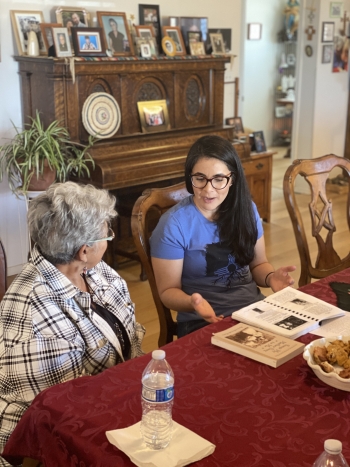
Angela Murphy (left) talks with ASU Associate Professor Vanessa Fonseca-Chávez in Murphy's home in Concho, Arizona. Photo courtesy of Mindy Jaffar
Download Full Image
“We would go into the mountains and go fishing. We’d get wood in the summertime, which we needed since we only had a wood-burning stove,” she said of the doublewide trailer she and her family lived in. “Often the pipes would freeze in the winter. But you bring in snow from outside, melt it on the stove, and now you have water to drink and bathe with.”
The 10-acre farm with ducks, pigs, chickens, a garden, cornfields and fruit trees that she grew up on seems very far away now. Fonseca-Chávez was recently promoted to tenure and is the associate professor of English and associate dean for diversity, equity and inclusion in the College of Integrative Sciences and Arts.
Also, in the span of a year, Fonseca-Chávez has published one book, edited another and been awarded a Whiting Public Engagement Seed Grant.
“Yeah, it’s been busy,” she said with a laugh..
It’s only going to get busier for her. The $10,000 seed grant will jump-start a community engagement project examining how Hispanic communities in northeastern Arizona understand their idea of place, or querencia. She will focus on three towns: Concho, St. Johns and Springerville.
"I am so pleased that Vanessa’s research has been recognized by the Whiting Public Engagement Seed Grant and by her recent publications,” said Joanna Grabski, dean of the College of Integrative Sciences and Arts. “Her scholarship and interdisciplinary approach have been crucial to advancing studies in ChicanxChicanx is a gender-neutral term for Chicano/a that is preferred by some groups and individuals. literature and culture. She is thoughtful, resourceful and brings so many insights to her role as an educator and colleague on our leadership team."
During the grant period, Fonseca-Chávez will work with community partners on a Concho Catholic Cemetery digitization project. This will include storytelling sessions for the fall and spring, with the goal of gathering at least 25 oral-history interviews and transcribing them by the end of the grant period. The Apache County Historical Society Museum and local libraries are part of this effort to archive family stories, documents and photos related to family members who are buried in the cemetery.
Both of her books published last year — the edited collection “Querencia: Reflections on the New Mexico Homeland,” with Levi Romero and Spencer R. Herrera, and “Colonial Legacies in Chicana/o Literature and Culture: Looking Through the Kaleidoscope” — feed directly into this storytelling project.
The concept of querencia is complex. Fonseca-Chávez described it this way: “At a base level, it’s about an attachment to a place. But it’s also about how you gain resilience. How do you thread ancestral knowledge of that place and conceive of that place in the future? What are your obligations to the place and community?”
As an example of querencia, she tells the story of a man from St. Johns who was interviewed for an ASU Public History Collaborative grant she worked on a few years ago.
ASU Associate Professor Vanessa Fonseca-Chávez
“Jake Romero told us how the schools were segregated in St. Johns. He said it made him want to fight all the time. But when he grew up, he didn’t want to fight anymore. Instead he ran for the city council,” recounted Fonseca-Chávez. “He said, ‘You can make decisions to be a part of the community, make decisions about the community and have a seat at the table.’”
In her book “Colonial Legacies in Chicana/o Literature and Culture: Looking Through the Kaleidoscope,” Fonseca-Chávez discusses the impact colonialism has had on Chicano/Hispanic literary culture and production — that impact has made it essential for community members in northeastern Arizona to share their stories, legacies and culture through their lens, rather than someone else telling their stories.
“They are a grounded community. Their families have been there since the 1880s. They have been colonizers and colonized. They have experienced powerlessness and power,” she explained. “It’s about not brushing them off, but making them feel they have a voice and that it matters."
Fonseca-Chávez said that while working on the ASU Public History Collaborative grant, 20 to 35 people gathered in Concho to discuss their family’s migrations from New Mexico to Arizona. She said they were invested in righting the origins of their towns, like Concho and St. Johns. Many families, including her own, were sheepherders and moved around looking for water sources, settling eventually in northeastern Arizona. While they recognize that their families came from New Mexico, they have established their own culture and distinctions about their communities, like Concho green chili and St. Johns-style tacos.
Fonseca-Chávez said it’s important to acknowledge the larger histories and identities of rural communities. Identities in these rural Arizona communities may be fluid and numerous, she also noted.
“Sometimes they identify as Hispanic, sometimes Chicano if part of the movement. They might see themselves as Mexican,” she said. “Matthew 'Matías' Montoya described the many times he was discriminated against in St. Johns, saying it was ‘because I’m Mexican.’ They are veterans, college educated and office holders. They have a lot to offer.”
Sometimes rural and urban communities can be at odds with one another, especially with rural communities feeling left out when it comes to policy that affects the whole state.
This press release was produced by Arizona State University. The views expressed here are the author’s own.