Schools
Arizona State University: Health Solutions Professor Earns Top Honor In The Speech, Language And Hearing Science Field
Shelley Gray, a professor of speech and hearing science at Arizona State University's College of Health Solutions, has been awarded the ...

2021-11-05
Shelley Gray, a professor of speech and hearing science at Arizona State University’s College of Health Solutions, has been awarded the Honors of the Association from the American Speech-Language-Hearing Association (ASHA), the nation’s premier professional organization for speech, language and hearing science.
Find out what's happening in Tempefor free with the latest updates from Patch.
Honors of the Association is ASHA’s most prestigious award and recognizes significant contributions to speech, language and hearing science throughout the recipient’s career.
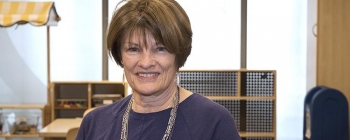
Shelley Gray, a professor in ASU's College of Health Solutions, has published more than 70 peer-reviewed papers, served on many ASHA boards and committees, mentored dozens of doctoral students and junior faculty and has earned 17 prior awards for her research, teaching and professional leadership.
Download Full Image
It is recognition Gray has rightly earned, said her colleague Julie Liss, an associate dean and professor of speech and hearing science at the College of Health Solutions.
Find out what's happening in Tempefor free with the latest updates from Patch.
“Shelley has been phenomenally successful in her research agenda, she’s been an outstanding mentor to her students — many of whom have gone on to do great things — and she’s a visionary who has represented the field well,” Liss said.
During her years as a college professor, Gray has published more than 70 peer-reviewed papers, served on many ASHA boards and committees, mentored dozens of doctoral students and junior faculty and has earned 17 prior awards for her research, teaching and professional leadership.
Currently, she heads the college’s Child Language and Literacy Lab (CHILLL), which conducts research on oral language, early literacy, reading and working memory development and disorders in children and adolescents. From this research, the lab develops assessments, curricula and professional development training that improve children’s learning and academic success. Among other accomplishments, Gray and her ASU colleague Jeanne Wilcox, the Nadine Mathis Basha professor in early childhood at the Mary Lou Fulton Teachers College, in conjunction with a large research team have developed and tested a curriculum called Teaching Early Literacy and Language (TELL) for teaching oral language and early literacy skills to preschool children with and without developmental speech and language impairment.
Although the TELL curriculum is still in its research edition, Gray said, “We’ve moved the field forward in demonstrating that a high-quality Tier 1 curriculum can improve the oral language and early literacy skills of young children.” Gray added that several published studies have followed cohorts of children enrolled in preschool from early childhood into adulthood.
“We have seen that children who attend high-quality preschool programs show improvements not only in academics, but also in their life satisfaction, their health and their employment after they leave school,” she said. “The positive impact is lifelong.”
The CHILLL lab has also conducted research into children’s working memory with an eye toward helping educators tailor instruction to a child’s working memory's strengths and weaknesses to improve learning. In addition, through the Child Language and Literacy Translational Team in the College of Health Solutions, she leads a community-based Project ECHO team that provides professional development training for early childhood educators and caretakers throughout Arizona.
Gray began her professional career as a school-based speech-language pathologist and has continued to contribute to the field in many ways, including through the editorial direction of Language, Speech, and Hearing Services in Schools, the top journal for school-based pathologists.
“This publication is widely read,” Liss said. “The articles Shelley solicited and published elevated that journal’s status and utility to clinicians working in the field.”
A highly competitive award, ASHA’s Honors of the Association requires nominees to be sponsored by three other association members who themselves have earned Honors of the Association. The application requires copious documentation on the nominee’s achievements. This documentation must demonstrate that the nominee’s contributions have enhanced the profession itself.
“I was very fortunate to choose speech-language pathology as a career,” Gray said. “It combines a love for science and for helping people.”
It’s also a field that has allowed her to work collaboratively with many fellow researchers and research teams to significantly improve health outcomes for children.
“By working on these interdisciplinary, collaborative research teams, we’ve been able to accomplish studies that have much greater impact than anything I could ever do by myself,” Gray said.
Regarding her thoughts on receiving this honor, Gray said, ““I’ve looked up to the people who’ve earned this award as pioneers and leaders in our field. To be considered among these leaders is a true honor.”
In March 2020, COVID-19 shut the doors to the ASU Speech and Hearing Clinic at the College of Health Solutions, but it didn’t end services to clients. A generous donation from the Phoenix Scottish Rite of Freemasonry Foundation allowed the clinic to pivot to telehealth services and keep providing therapy to those in need despite stay-at-home orders. The Masons also funded four scholarships to support graduate students training to be speech-language therapists.
“Around 20% of kids in America have challenges on some level with speech or reading,” said Mike Bernhardt, a member of the Scottish Rite Phoenix chapter and one of the board members for the chapter’s charitable foundation. “These are very capable kids, and we’re very proud to be serving them because there’s a connection between the ability to read, the ability to learn and the ability to be free-thinking.”

Alma Strasser, director of development for the College of Health Solutions, accepted several donations from the Phoenix Scottish Rite of Freemasonry Foundation earlier this year to support ASU Speech and Hearing Clinic programs and scholarships for speech-language pathology students. Pictured (from left): Phoenix Scottish Rite Foundation board members Mike Bernhardt, Curtis White and Tony Darin. Photo courtesy of Mike Bernhardt
Fellow Mason and board member Tony Darin works with Bernhardt in the Scottish Rite Foundation and notes Scottish Rite has been committed to children’s learning success for more than 100 years. In the 1950s, that commitment expanded to include supporting speech and language therapy for children. Today, Scottish Rite Masons fund nearly 180 RiteCare Centers, clinics that provide therapy for a range of childhood communication issues. Literacy is also a focus for the Masons.
That’s why Bernhardt and Darin’s chapter reached out to Kelly Ingram, clinical professor at the College of Health Solutions, four years ago and began supporting the Summer Program for Elementary Literacy and Language (SPELL). “
This program is for children who are falling behind the state’s standards for reading,” Ingram explained. “It’s essentially a therapy camp, and the Scottish Rite provided scholarship funds for families who cannot afford to send their children to the camp.”
SPELL camp provided daily, three-hour sessions at the clinic until 2020 forced remote learning.
“It’s hard to keep a second grader’s attention for three hours in an online format, so we had to shift what we were doing,” said Tracey Schnick, the clinic’s business manager. “We shortened some of our programs, which reduced the cost of them a bit.”
Then, to keep delivering services to clients who might be struggling financially due to pandemic job cuts, Ingram and Schnick asked the Scottish Rite team if they would provide a gift to cover a broad variety of clients in need.
“They said ‘yes,’ and that allowed us the freedom to provide a wide range of services that could not be covered any other way,” Ingram said.
Thanks to Scottish Rite’s support, 86 patients received free group and individual treatment for a total of 220 telehealth sessions throughout the summer in 2020.
“They were a huge part of our success, and we are so thankful that with their help we were able to provide services to those in need last summer,” Ingram said.
Shifting to online service delivery was essential not only for the clinic’s clients — telehealth services were also a lifeline for College of Health Solutions graduate students. As part of their training, speech-language pathology students work one-on-one with clients and the children who participate in SPELL camp.
“Support from the Scottish Rite literally saved last summer for our own students because they need a certain number of hours of clinical work,” Schnick said. “They can do some by simulation, but a lot of the hours have to be with actual clients. Without the telehealth services the Scottish Rite funded, we don’t think we would have been able to fill summer schedules, which could have delayed these students' graduations by a semester or more."
Along with keeping programs running, the local Masons also fund the Scottish Rite Graduate Fellowship, a gift that is helping four master’s degree students pay for their studies this year.
“Having a stipend like that means many graduate students can concentrate on their studies rather than having to work. This allows them to spend more hours at an internship site,” Ingram said.
None of the students selected for the fellowships this year had any personal ties to Freemasonry, but that doesn't matter to the Scottish Rite donors. As Darin pointed out, all the scholarship recipients were great students and highly professional.
“They’re philanthropic themselves,” Bernhardt added. “We look at that because it reflects our values.”
Talking to Bernhard and Darin, it’s easy to see how proud these men are of the good work Masons do.
“Masonry is the largest fraternity in the world,” Darin said, adding that Scottish Rite Masons support many philanthropic causes, including hospitals, recovery efforts for victims of catastrophes, and, of course, helping children with learning and language challenges so they can thrive in the classroom and reach their highest potential. In the U.S. some 550,000 men are Scottish Rite Masons, and this branch of Freemasonry has chapters worldwide.
Faculty and staff at the ASU Speech and Hearing Clinic are grateful for this dedicated group’s support, which has made a difference for so many clients as well as College of Health Solutions students.
“It’s been really great to partner with the Scottish Rite team,” Schnick said. “They’re passionate about helping kids with speech and language disorders. It’s so nice to have support from a group that truly shares our values and goals.”
This press release was produced by Arizona State University. The views expressed here are the author’s own.