Politics & Government
CA Rolling Blackouts Called Off As Energy Demand Sets Record
An Energy Emergency Alert 3 was in effect statewide Tuesday, and rolling blackouts started in parts of Northern California.


CALIFORNIA — Rolling blackouts began in California Tuesday evening as demand exceeded the capacity of California’s power grid in the face of record-setting heat. The state's power grid operator issued an Energy Emergency Alert 3 Tuesday afternoon, and major utilities such as Pacific Gas & Electricity warned hundreds of thousands of customers to prepare for rotating blackouts. Soon after, neighborhoods in Northern California went dark even as temperatures simmered well beyond sunset.
However, by 8 p.m., the California Independent System Operator downgraded the emergency alert and thanked Golden State residents for cutting back on electricity to avert widespread blackouts.
Customers in the Northern California communities of Alameda and Palo Alto were among the first to face power outages. According to KCRA3, PG&E notified about 525,277 customers to prepare for rolling blackouts and released a search map for customers to see if their homes will go dark. City officials in Alameda warned that rotating outages were beginning with the shutoff of two circuits for one hour, the Los Angeles Times reported. An hour later, the city called off its second hour of rolling blackouts
Find out what's happening in Across Californiafor free with the latest updates from Patch.
The outages were part of the state's highest-level energy emergency, and they came after days of warnings to conserve energy or expect blackouts.
Temperatures up and down the state soared past 110, setting records from the Bay Area to Southern California Tuesday afternoon. With the record heat, energy demands are also reached an all-time high. State energy officials said the electrical load Tuesday afternoon would top 51,000 megawatts, the highest demand the state has ever seen.
Find out what's happening in Across Californiafor free with the latest updates from Patch.
The Energy Emergency Alert 3 comes with a request for maximum conservation efforts.
The California Independent System Operator issued the alert shortly after 5 p.m, anticipating high loads and temperatures across the grid as the sun goes down and solar energy wanes.
"Outages are a significant inconvenience to those affected, but it's preferable to manage emergencies in a controlled manner rather than let it cause a wider spread, longer lasting disruption," according to the California Independent System Operator. "Power interruptions are kept as brief as possible and utilities rotate them through their customer base so that no one area has prolonged outages. Utilities make the determination of how best to spread and rotate the outages across their customer base, with the goal of limiting their duration as much as possible."
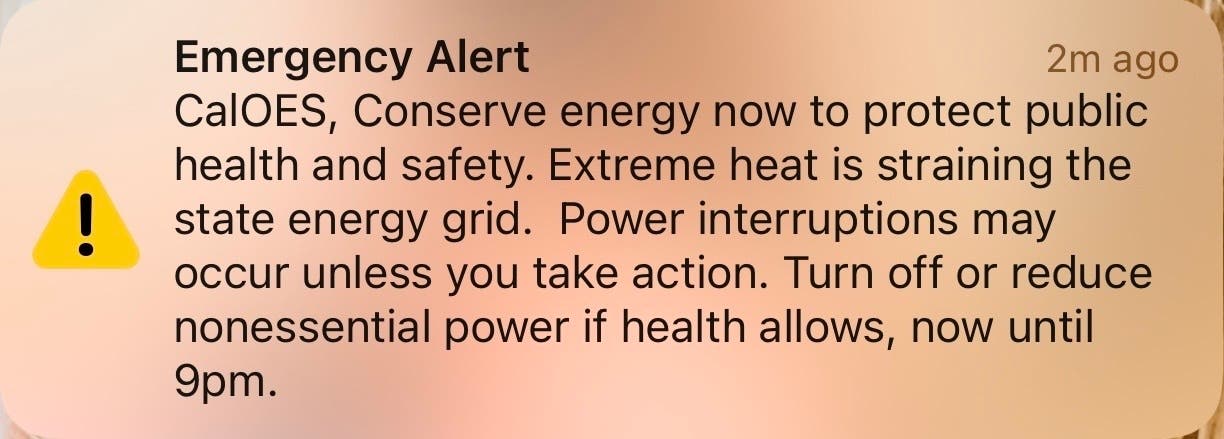
"CAISO is forecasting an energy deficiency with all available resources in use
for the specified time period," California Independent System Operator said in its alert. "Maximum conservation efforts are urged. During this time, participating customers will be directed by utilities to use generators approved for emergencies, or to reduce load following the protocols of each utility program."
As people crank up their air conditioners, the state forecasted record levels of energy use, said Elliot Mainzer, president of California Independent System Operators, which runs the state's electrical grid. The state has additional energy capacity at the moment “but blackouts, rolling, rotating outages are a possibility,” Mainzer warned Monday. He said additional conservation was “absolutely essential.”
California’s energy grid runs on a mix of mostly solar and natural gas during the day, along with some imports of power from other states. But solar power begins to fall off during the late afternoon and into the evening, which is the hottest time of day in some parts of the state. And some of the aging natural gas plants California relies on for backup power aren’t as reliable in hot weather.
At CAISO's request on Monday, four temporary emergency power generators deployed by the Department of Water Resources in Roseville and Yuba City were activated for the first time since they were installed last year, providing up to 120 megawatts, enough electricity for 120,000 homes.
In Los Angeles, the Los Angeles Department of Water and Power said customers are not expected to endure rolling blackouts as the state's largest city operates its own power grid.
Southern California residents may fair better than residents in the Northern part of the state, which has several more days of excessive heat in the forecast. While temperatures are expected to remain above normal for the rest of the week, Tuesday saw the heatwave peak in the southern part of the state, according to the National Weather Service.
The Northern part of the state saw temperature records shatter Tuesday. Four cities in the Bay Area including San Jose, Santa Rosa, Napa, King City experienced their hottest day ever Tuesday, and several cities such as Livermore and Redwood City tied all-time records, the Los Angeles Times reported. For the second day in a row, Livermore residents sizzled under 116-degree highs.
The Associated Press and City News Service contributed to this report.
Get more local news delivered straight to your inbox. Sign up for free Patch newsletters and alerts.