Crime & Safety
California Wildfires 2020: 5 Essential Things To Know
Everything you need to know about the fire season for 2020 and how to prepare for and prevent wildfires.


CALIFORNIA — As the ashes pepper the skies from more than 1 million acres of wildfire burning in California and dry lightning continues to wallop northern parts of the state, the 2020 fire season is shaping up to be a monster before it's even officially started. Compared to 2019, California has already significantly tipped the scales in total acres burned and number of wildfires this year.
A staggering 2,700 more wildfires have cropped up this year than last, with an additional 1.4 million acres burned from fires that ignited just in August, according to Cal Fire. California's fire season traditionally peaks in the fall after the summer heat cooked the landscape and the winds pick up. However, unusual summer thunderstorms over the last few weeks are the glaring catalyst in this year's fire season. Having sent more than 14,000 lightning strikes ricocheting across an uncharacteristically dry landscape for this time of year, the strikes have ignited more than 700 fires and burned a combined acreage bigger than some states in the U.S.
So far, 1.6 million acres have burned since the start of 2020. Last year, a mere 259,823 acres burned and saw the smallest amount of acres burned since 2011.
Find out what's happening in Across Californiafor free with the latest updates from Patch.
17 New Photos Show Impact Of California Wildfires
"These fires are historic because they are on pace and setting the pace of a historic fire season," Gov. Gavin Newsom said at a news conference Wednesday.
Find out what's happening in Across Californiafor free with the latest updates from Patch.
This month, state has seen some of the biggest fires in over a century, with the LNU and SCU Lightning Complex fires both growing to become the second and third largest wildfires in California history.
The largest California wildfire was the devastating Mendocino Complex in July 2018, burning 459,123 acres. For comparison, the SCU Lightning Complex Fire, currently the largest fire of the season, has scorched more than 365,772 acres.
And it's far from over. According to Cal Fire, this fire season could persist into October in Northern California. Other predictions point to a very dry winter conditions this fall, with offshore winds increasing fire danger in Southern California.
Officials are warning residents to be prepared for an extended fire season.
Here are the essential top five things you need to know about the 2020 wildfire season:
1) Did fire season arrive early?
Yes and no.
Fire season typically begins in May and ends in October and is a natural part of life in California with the state's rugged terrain and hot seasons. But a string of unusual summer thunderstorms in early August kicked the state into peak season a little early by igniting three of the largest complex fires the state has ever seen burning simultaneously within the last hundred years.
It's not unusual to see fires in August; However, fire season in California and across the West is beginning earlier and ending later each year, according to Cal Fire. The length of fire season has increased by about 75 days across the Sierras and seems to correspond with an increase in the extent of forest fires across the state, according to Cal Fire.
"It's not that we're seeing more fire, it's that the fires are able to burn at a bigger size with more destruction," said Daniel Berlant, a public information officer for Cal Fire in an informational video Tuesday.
Climate change is considered to be the key catalyst of these longer and more destructive fire trends.
"Warmer spring and summer temperatures, reduced snowpack, and earlier spring snowmelt create longer and more intense dry seasons that increase moisture stress on vegetation and make forests more susceptible to severe wildfire," Cal Fire said in a 2020 fire outlook.
Wildfires are predicted to get six times larger in the U.S. within the next 18 years, according to a study conducted by UC Merced's Sierra Nevada Research Institute in 2018.
California alone could see anywhere from a 10 to 150 percent increase in areas burned by 2039, according to Dave Shew in the 2018 report, staff chief with the state's Department of Forestry and Fire Protection.
“It’s gotten to the point now where we’re reluctant to use the term ‘fire season’ because we’re seeing fire impacts running year round now," he said in the report.
2) What is the 2020 fire season expected to look like in the coming months?
The 2020 fire season is expected to wind down in October, according to Cal Fire. August could be the peak of fire season for California, according to a wildfire outlook from the National Interagency Fire Center.
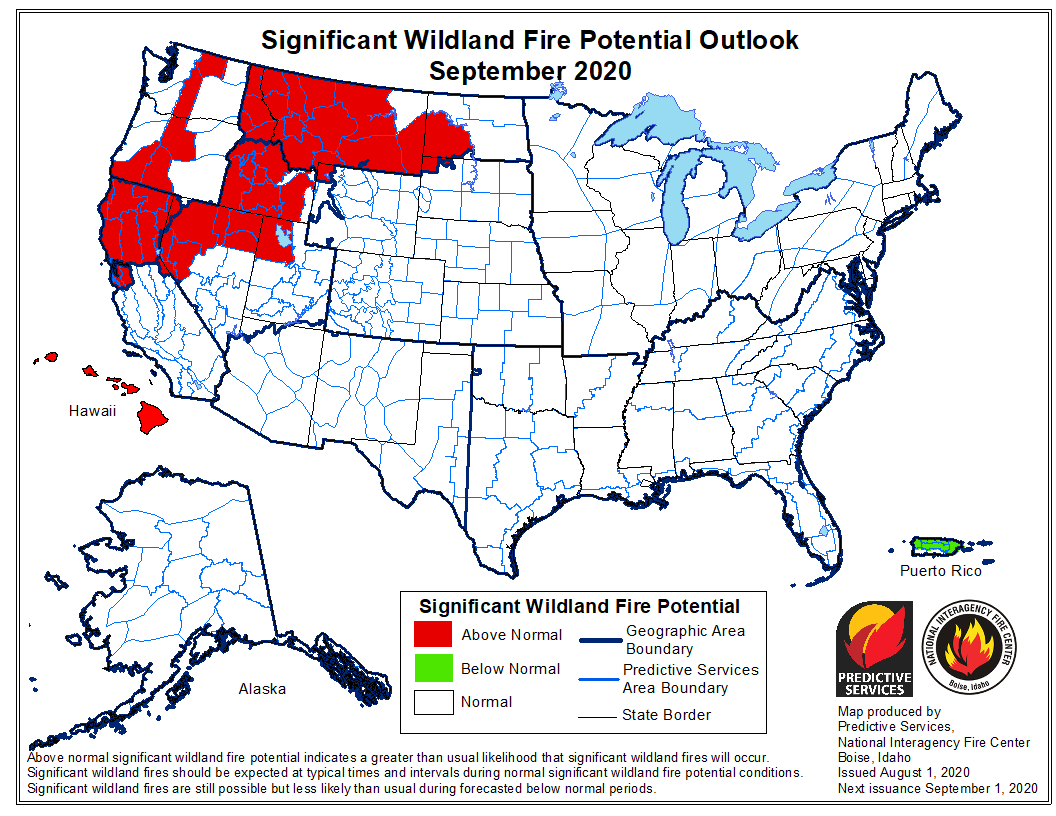
But as lighting continues to ravage drier than normal landscapes in the state, fire activity and large-scale fire potential has increased for September.
A significant increase of fire activity occurred in July as trees, brush and shrubbery continued to dry across much of California and lightning spread farther north and west into the Great Basin, northern California, Pacific Northwest, and northern Rockies.
The North American Monsoon is forecasted to remain intermittent, which will produce more dry lightning strikes, according to the Fire Center.
In the fall, precipitation and cooler temperatures are expected to arrive. But areas of concern will pivot to Southern California as offshore winds begin to start up. With a delayed rainy season, fuels could remain drier across most of the state.
The National Interagency Fire Center also predicts La Niña conditions this fall, which could deliver a very dry winter in California. Nonetheless, the fire season is projected to taper off in Southern California in November.
3) How can I prepare for wildfires?
There are a number of steps you can take to prepare for an extended wildfire season. The Ready for Wildfire site has detailed steps for what to do before, during and after a wildfire.
While there's a difference between an evacuation order and an evacuation warning, Ready for Wildfire says residents should leave as soon as an evacuation is recommended and should not wait to be ordered by authorities to leave.
"Evacuating the forest fire area early also helps firefighters keep roads clear of congestion, and lets them move more freely to do their job," the preparation website recommends. "In an intense wildfire, they will not have time to knock on every door."
Review the full list of resources from Ready for Wildfire to be sure that you're prepared.
4) What are the health effects of wildfires?
With the current COVID-19 pandemic in mind, it's more important than ever to maintain respiratory health, reduce exposure to smoke and poor air quality.
As fires rage across the state, it's not only important to wear a mask to prevent transmission of coronavirus, but to prevent the inhalation of wildfire smoke which contains particulate matter such as carbon monoxide, nitrogen oxides and other menacing compounds that can worsen air quality.
Exposure to smoke can increase respiratory and cardiovascular health risks and can even land you in the emergency room according to the Centers for Disease Control and Prevention. Smoke from wildfires can worsen chronic heart and lung diseases as well.
The CDC also adds that children are more likely to be affected by smoke as their airways are still developing. According to the agency, children breathe more air per pound of body weight than adults. People with heart and lung disease, along with older adults are also at greater risk. The CDC has a list of steps residents can take to minimize exposure to wildfire smoke.
5) Can I do anything to prevent wildfires?
About 95 percent of all wildfires are caused by humans, according to an analysis conducted by Jon Keeley, a research scientist with the U.S. Geological Survey's Western Ecological Research Center.
Last August, a blaze in the Eagle Rock neighborhood of Los Angeles was reportedly intentionally set by a pair at a homeless encampment. Before that, 2018's Ranch Fire was caused by a spark or metal fragment, which came from a hammer, Cal Fire determined.
The Ready for Wildfire website guides residents on how to be safe while using equipment, driving, burning debris and more.
Some fires are started by drivers dragging chains or low tire pressure, which can throw sparks that ignite dry brush. Other fires are started by campers who don't attend to the fire at all times or do not extinguish the fire properly.
A video from Cal Fire demonstrating best fire preventing practices can be found here.
Get more local news delivered straight to your inbox. Sign up for free Patch newsletters and alerts.